πŸ“š Agora node [[learning]] β˜†
Agora nodes contain community contributions with titles or topics that match your search. x
πŸ“œ File learning.md by @flancian β˜† πŸ“Ž οΈπŸ”— ✍️ β›Ά

LearningΒ§

  • Learning is virtuous because it is by learning about the world that we can seek to improve it.
    • We can improve it for ourselves, but also for [[others]].
    • We can improve the world by changing it.
    • [[Change the world]].
πŸ“œ File notes/pages/learning.md by @forshaper β˜† πŸ“Ž β›Ά
  • "No schoolhouse that required adherence to [[fixed]] ideas, reduced airplanes to numbers, or considered its instructors as [[priests]] could ever be [[Top Gun]] in our book."
πŸ“œ File study/learning.md by @karlicoss β˜† πŸ“Ž β›Ά

Table of ContentsΒ§

related [[spacedrep]]Β§

[2020-02-14] Ask HN: How do you learn complex, dense technical information? [[learning]]Β§

https://news.ycombinator.com/item?id=22325975

πŸ“œ File Learning.md by @protopian β˜† πŸ“Ž β›Ά

I have an insatiable [[Curiosity]] to learn

Currently learning: [[Mental Models]]

πŸ“œ File Learning.md by @agora@botsin.space β˜† πŸ“Ž β›Ά
πŸ“œ File learning.md by @agora@botsin.space β˜† πŸ“Ž β›Ά
πŸ“œ File learning.md by @antlerboy@mastodon.social β˜† πŸ“Ž β›Ά

Loading pushes...

✨ AI Synthesis Mistral Gemini ChatGPT Claude x

Expanding this section will automatically generate an AI synthesis of the contributions in this node.

🌌 Agora context for [[learning]]

Rendering context...

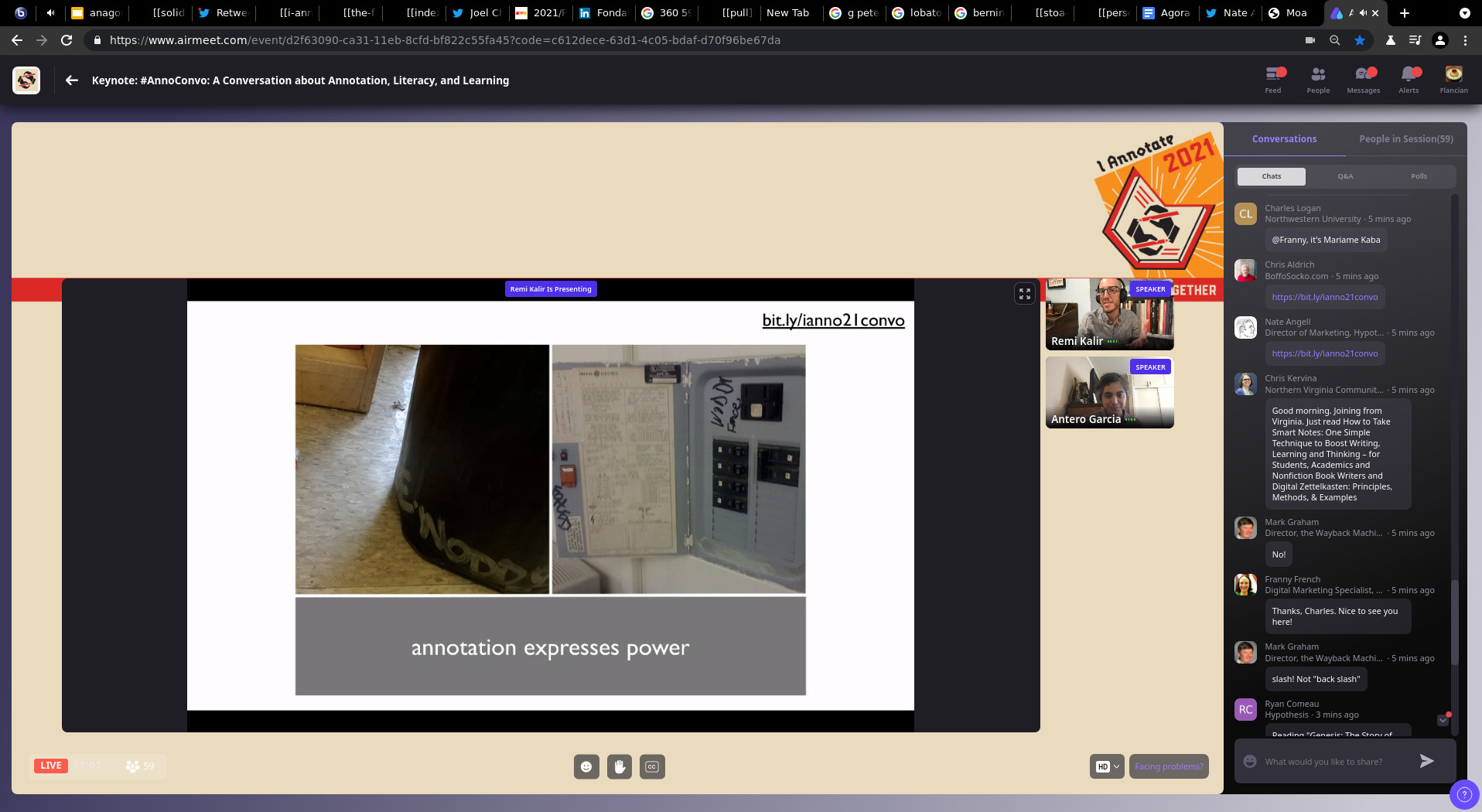
πŸ“š Agora node [[a conversation about annotation literacy and learning]] (pulled by the Agora)
πŸ“œ File a conversation about annotation, literacy and learning.md by @flancian β˜† πŸ“Ž οΈπŸ”— ✍️

β₯… [[Pasted image 20210624180959.png]]

β₯… [[Pasted image 20210624181009.png]]

β₯… [[Pasted image 20210624181210.png]]

β₯… [[Pasted image 20210624181355.png]]

β₯… [[Pasted image 20210624181627.png]]

β₯… [[Pasted image 20210624181841.png]]

β₯… [[Pasted image 20210624182124.png]]

β₯… [[Pasted image 20210624182655.png]]

β₯… [[Pasted image 20210624183529.png]]

β₯… [[Pasted image 20210624183806.png]]

my Q:

β₯… [[Pasted image 20210624185531.png]]

πŸ“š Agora node [[active learning]] (pulled by the Agora)
πŸ“œ File Artificial Intelligence/Introduction to AI/Week 3 - Introduction/Definitions/Active Learning.md by @KGBicheno β˜† πŸ“Ž

active learningΒ§

Go back to the [[AI Glossary]]

A training approach in which the algorithm chooses some of the data it learns from. Active learning is particularly valuable when labeled examples are scarce or expensive to obtain. Instead of blindly seeking a diverse range of labeled examples, an active learning algorithm selectively seeks the particular range of examples it needs for learning.

πŸ“š Agora node [[activelearning]] (pulled by the Agora)
πŸ“œ File ActiveLearning.md by @agora@botsin.space β˜† πŸ“Ž
πŸ“š Agora node [[adaptivelearning]] (pulled by the Agora)
πŸ“œ File AdaptiveLearning.md by @agora@botsin.space β˜† πŸ“Ž
πŸ“š Agora node [[applications for the three types of machine learning]] (pulled by the Agora)
πŸ“œ File Artificial Intelligence/Introduction to AI/Week 2 - Introduction/Applications for the three types of machine learning.md by @KGBicheno β˜† πŸ“Ž

Applications for the three types of machine learningΒ§

Go to [[Week 2 - Introduction]] or back to the [[Main AI Page]]

See the [[Machine Learning]] page.

A graphical representation of their applications

See:

#ToDo add Deep Learning from the Deep Dive

#AIBusinessCase

πŸ“š Agora node [[cap table learning]] (pulled by the Agora)
πŸ“œ File _notes/cap-table-learning.md by @bmann β˜† πŸ“Ž

This was a small group session for founders and potential founders to understand cap tables, outside investment, and funding.

I have since given very similar material to many other groups.

January 2015Β§

I first gave this presentation while I was at [[Full Stack]] in January 2015.

On Speakerdeck:

July 2020Β§

Run through [[Venture Scouts]] and posted to events there. Includes a whole back section of founder questions that we walked through:

On Notist:

View Cap Table & Term Sheets Learning Session on Notist.

<script async src=”https://on.notist.cloud/embed/002.js”>

On YouTube:

πŸ“š Agora node [[center for collective learning]] (pulled by the Agora)
πŸ“œ File center for collective learning.md by @flancian β˜† πŸ“Ž οΈπŸ”— ✍️
πŸ“œ File center for collective learning.md by @agora@botsin.space β˜† πŸ“Ž
πŸ“œ File center for collective learning.md by @an_agora@twitter.com β˜† πŸ“Ž
πŸ“š Agora node [[classification supervised learning]] (pulled by the Agora)
πŸ“œ File Artificial Intelligence/Introduction to AI/Week 2 - Introduction/Classification - supervised learning.md by @KGBicheno β˜† πŸ“Ž

Classification - supervised learningΒ§

Go to [[Week 2 - Introduction]] or back to the [[Main AI Page]]

Classification in supervised learning uses the model to output which of many classifications the input falls into based on the inputs. Each column of the data set is a feature and each row is a data point. The ‘classifier’ as our algorithm is known, uses some set of the learning data to determine the discrete ‘class’ to which the input belongs.

πŸ“š Agora node [[cross disciplinary learning]] (pulled by the Agora)
πŸ“œ File cross-disciplinary-learning.md by @neil β˜† πŸ“Ž οΈπŸ”— ✍️

cross-disciplinary learningΒ§

good for [[tangential thinking]]

πŸ“š Agora node [[deep learning]] (pulled by the Agora)
πŸ“œ File Artificial Intelligence/Introduction to AI/Week 2 - Introduction/Deep Learning.md by @KGBicheno β˜† πŸ“Ž

Deep LearningΒ§

Go to [[Week 2 - Introduction]] or back to the [[Main AI Page]]

The point: Even with limited examples, neural networks can generalize and successfully deal with unseen examples.

Deep Learning layers algorithms to create a Neural Network, an artificial replication of the structure and functionality of the brain, enabling AI systems to continuously learn on the job and improve the quality and accuracy of results.

Deep learning neural nets have many "hidden layers" of [[Perceptrons]] through which the inputs are passed, with each layer being tuneable by engineers to find the patterns the model is supposed to find.

The basic flowchart of a deep learning model

A more accurate view of a neural net.

Some nets can be smaller, some can be much larger

Neural networks are based on their [[Biological comparisons]], the neurons in our brain.

Artificial neural networks pass numbers as signals through a weight to each neuron, which itself modifies that signal with its own bias (the same for all input signals). The weighted and biased inputs are then passed through an activation function (such as a sigmoid function) to become that neuron’s output. << This process taken in isolation is a perceptron, as described in [[Perceptrons]].

A graphical representation of a sigmoid perceptron

πŸ“š Agora node [[deeplearning]] (pulled by the Agora)
πŸ“œ File Deeplearning.md by @agora@botsin.space β˜† πŸ“Ž
πŸ“š Agora node [[double loop learning]] (pulled by the Agora)
πŸ“œ File double-loop-learning.md by @neil β˜† πŸ“Ž οΈπŸ”— ✍️

double-loop learningΒ§

For Argyris and SchΓΆn (1978: 2) learning involves the detection and correction of error. Where something goes wrong, it is suggested, an initial port of call for many people is to look for another strategy that will address and work within the governing variables. In other words, given or chosen goals, values, plans and rules are operationalized rather than questioned. According to Argyris and SchΓΆn (1974), this is single-loop learning. An alternative response is to question to governing variables themselves, to subject them to critical scrutiny. This they describe as double-loop learning. Such learning may then lead to an alteration in the governing variables and, thus, a shift in the way in which strategies and consequences are framed.

– Chris Argyris: theories of action, double-loop learning and organizational le…

πŸ“š Agora node [[e textbook design for learning]] (pulled by the Agora)
πŸ“œ File content/E--Textbook-design-for-learning.md by @houshuang β˜† πŸ“Ž
  • #public
  • Thinking about textbooks,
    • the blog post about why textbooks are good for learning
    • and all the lists of really good textbooks
      • The Best Textbook on Every Subject
  • Imagine taking a transcript of [[Awakening From the Meaning Crisis]].
    • How long would it be, how long would the entire series be if it was published as a book?
    • How much editing would you need to turn it into readable prose?
    • What would it look like to turn it into, not a nonfiction book, but a textbook?
    • Where is the best research on effective textbooks for learning for efficient adult learners?
      • There are often many graphical elements and pedagogical elements
        • definitions of terms.
        • Pull outs with anecdotes, or more details.
          • And I guess this can be seen in one way, as kind of a zoomable interface where you can go more or less in depth in one way.
          • And you can also skip explanations if you already know the concept.
        • There can be
          • visualizations,
          • graphs,
          • knowledge graphs,
          • pre-reading questions
          • post reading questions,
          • learning objectives
          • comprehension questions.
        • Is there a good course, whether as a textbook or interactive on how to write a textbook?
        • Are there good examples of interactive textbooks?
          • They don’t have to be intelligent, but just web native with very responsive layouts
        • Are there good frameworks, or tools to author very nice looking web textbooks with all these design elements?
        • There are probably LaTeX templates or DocBook or whatever, for programming books, but the end result is a PDF.
          • That is very difficult to read on a small screen.
          • Is there a good HTML template.
            • Something like Tufte style with margin annotations. Table of Contents.
  • It would be a really interesting candidate for experimenting with Andy Matuschak integrated spaced repetition.
  • It could also grow wiki like with
    • annotations and
    • links to interesting discussions,
      • from reading groups or blog posts, etc.
    • I wonder what kind of visuals, or explanations or even interactive elements, could be useful.
      • And to what extent they would be actually useful for the understanding or disruptive.
    • I often felt that textbooks from schools in Norway today are far too busy with elements graphical elements and pictures and so on.
      • But perhaps it is working well.
    • How do you test the effectiveness of a textbook?
      • What do you measure, at the end, retention?
    • It’s interesting how we have never ever looked at textbooks during my PhD studies.
      • Yet it is such a fundamental aspect of learning.
    • Open Learning Initiative at CMU might be an interesting source.
    • OpenStax are still just very traditional textbooks, written in a different way.
    • Wikibooks/Wikiversity.
    • Brett Victor’s stuff.
    • I started thinking of this because I was thinking about the ebooks about running a company in Norway, that I just purchased and worked through.
      • They are helpful because they are extremely well structured,
        • which probably also makes them easy to update every year.
      • Of course there are no pedagogical features there.
      • But I am so much happier with these textbooks than with a series of short videos,
        • like all of these Teachable courses and so on. Or a MOOC, or a webinar.
        • But why do so many people prefer videos?
          • Even for something as visual as drawing or painting. I think I would prefer an interactive textbook, which has many of the ideas or theories, written out.
          • And then, shorter or longer video clips illustrating specific visual aspects.
            • Is there any platform that works like that, or that even helps you build it yourself.
            • It would be interesting to talk to the LearnAwesome people who have been building these skills trees.
  • I wonder if John Vervaeke could be convinced to release his material under a Creative Commons license to enable this kind of remixing.
    • What would it look like to make a skills tree of [[Awakening From the Meaning Crisis]]
      • chopping the videos into small pieces, and interlinking them.
        • That’s an interesting corollary to Roam, to have deep video integration with transcripts,
          • that you can then block indent, and you get automatically block-style back references,
            • so that you could quickly see all of the segments from many videos talking about for example Shamans,
              • just like the tools that let you edit video or audio just by editing the transcript
  • What would it look like to add more textbook-like features to podcasts, even though you would be listening to the actual podcast.
    • Think of the podcast as a class,
      • you would do pre work.
        • Maybe some short readings, maybe, reflecting on certain questions,
    • then you would engage with the actual podcast.
    • And then you will have some follow up questions, and maybe some Spaced Repetition questions that keep coming back to you.
      • Over the next few weeks or months.
    • Are there ways in which we can enable people to create massive amounts of high quality textbook material from the raw material that we already have.
      • And would it make big differences in people’s ability to learn and retain.
  • What would popular nonfiction books look like if they were rewritten as textbooks?
    • Could you have a textbook overlay?
      • I guess in a way you have that for with reading guides for popular/non-popular fiction, for example.
        • Of course there are probably superficial surface features of textbooks and much more profound details about how content is organized
        • Are there competing pedagogical theories about textbook construction?
        • Behaviourist, mastery learning, others? multimedia learning theory and cognitive load theories?
  • Is Distill a kind of academic journal that has had textbook functionality applied to it?
    • I just saw a tweet saying they wanted the podcast where someone is live-sketching ideas, but I’ve never really been so impressed by sketch notes and live sketching
      • was pretty amazing the first time I saw it
        • but afterwards it seems to focus far too much attention on things that are not relevant to the argument.
      • However, having something like a Compendium facilitator.
        • Live mapping out an argument while a discussion or a debate or a complex argument is being presented could be really interesting
        • building out a concept map as you’re talking or going back and doing it over the recording.
          • Why don’t we have good videos of this, I should talk to Jack Park about it.
πŸ“š Agora node [[federated learning]] (pulled by the Agora)
πŸ“œ File Artificial Intelligence/Introduction to AI/Week 3 - Introduction/Definitions/Federated_Learning.md by @KGBicheno β˜† πŸ“Ž

federated learningΒ§

Go back to the [[AI Glossary]]

A distributed machine learning approach that trains machine learning models using decentralized examples residing on devices such as smartphones. In federated learning, a subset of devices downloads the current model from a central coordinating server. The devices use the examples stored on the devices to make improvements to the model. The devices then upload the model improvements (but not the training examples) to the coordinating server, where they are aggregated with other updates to yield an improved global model. After the aggregation, the model updates computed by devices are no longer needed, and can be discarded.

Since the training examples are never uploaded, federated learning follows the privacy principles of focused data collection and data minimization.

For more information about federated learning, see this tutorial.

πŸ“š Agora node [[few shot learning]] (pulled by the Agora)
πŸ“œ File Artificial Intelligence/Introduction to AI/Week 3 - Introduction/Definitions/Few-Shot_Learning.md by @KGBicheno β˜† πŸ“Ž

few-shot learningΒ§

Go back to the [[AI Glossary]]

A machine learning approach, often used for object classification, designed to learn effective classifiers from only a small number of training examples.

See also one-shot learning.

πŸ“š Agora node [[machine learning]] (pulled by the Agora)
πŸ“œ File posts/machine-learning.md by @flancia.org β˜† πŸ“Ž ✍️ πŸ€—

So, I’ve been trying to learn Machine Learning. It’s been an open subject for me for years; I remember going to university to learn computer science (which took me a long time to begin with — a story for another day perhaps) already with the fuzzy idea of going into Machine Learning.

Prior to that I had studied Literature/Linguistics, and already I had the fuzzy idea there of specializing in Neurolinguistics. In the end I only did some introductory subjects on the matter before dropping out. Dropping out is sort of what I do, by the way. I’m trying to change this aspect of my personality, and actually starting this blog has to do with that.

Anyway, I’ve always been interested in ML, but for several years now I’ve been content with reading Wikipedia on it from time to time. And to sit back and sort of spectate about how the field has been advancing. Only a month ago I decided to get into it more seriously, and I’ve been doing the well-rated (and by now sort of classic) Coursera course on the matter (Andrew Ng’s). It’s been great fun, and I intend to do it to completion (not to drop out this time). What comes after that, I’m not completely sure right now, but that’s sort of exciting on its own right.

πŸ“œ File machine learning.md by @flancian β˜† πŸ“Ž οΈπŸ”— ✍️

machine learningΒ§

πŸ“œ File pages/machine-learning.org by @jakeisnt β˜† πŸ“Ž

Tools for learning machine learning. Obviously, this will expand into many files once I've developed more knowledge.

Papers

https://github.com/NathanUA/U-2-Net salient object detection https://github.com/pliang279/awesome-multimodal-ml reading about multimodal ml

Tutorials

https://github.com/fzenke/spytorch gradient learning for spiking neural networks

Utilities

https://github.com/joseph-zhong/LipReading yes https://github.com/RasaHQ/rasa ml framework for automating text conversations

ETC

The case for sparsity in neural networks, Part 1: Pruning tiny scalar-valued autograd engine and a neural net library on top of it with PyTorch-like API https://stites.io/ — great writing on neural networks Darknet: Open Source Neural Networks in C A Recipe for Training Neural Networks Towards understanding glasses with graph neural networks | DeepMind Neural networks and deep learning https://machinelearningmastery.com/learn-add-numbers-seq2seq-recurrent-neural-networks/ https://www.reddit.com/r/MachineLearning/comments/6l2esd/d_why_cant_you_guys_comment_your_fucking_code/ Meet The Stanford AI Lab Alums That Raised $15 Million To Optimize Machine Learning [P] I trained a GAN to generate photorealistic fake penises - MachineLearni h2oai/h2o-3: Open Source Fast Scalable Machine Learning Platform For Smarte https://www.forbes.com/sites/igorbosilkovski/2020/07/14/meet-the-stanford-ai-lab-alums-that-raised-15-million-to-optimize-machine-learning/amp/?__twitter_impression=true book by rahul khanna gpt 3 https://www.reddit.com/r/MachineLearning/comments/i1aafb/p_i_trained_a_gan_to_generate_photorealistic_fake/ fun with generating gans http://blog.ezyang.com/2013/01/nlp-the-missing-framework/ https://minimaxir.com/2019/09/howto-gpt2/ — fun gpt 2 training time https://ezyang.github.io/convolution-visualizer/index.html https://www.reddit.com/r/MachineLearning/comments/gc834u/d_programming_language_choices_in_ai_nlp_and https://www.reddit.com/r/compsci/comments/g1eivp/from_cvpr_2020_turn_any_picture_to_a_3d_photo/ https://github.com/tokee/juxta https://www.reddit.com/r/compsci/comments/g8circ/a_repository_of_graph_classification_research/ https://arxiv.org/abs/2004.14545 https://arxiv.org/abs/2004.10934/

intels introductory ml course simple ml mindsweeper stream accel framework https://en.wikipedia.org/wiki/Discrete_cosine_transform signal processing: the discrete cosine transformation https://en.wikipedia.org/wiki/Discrete_cosine_transform data compression with fourier methods https://julialang.org/blog/2017/12/ml-pl/# https://www.youtube.com/watch?v=hx7kvTZLHYI https://www.youtube.com/watch?v=HgDdaMy8KNE whaaaat https://minimaxir.com/2019/09/howto-gpt2/ — make text with gpt2! ml with cool functional languages https://www.youtube.com/watch?v=Jr9sptoLvJU&app=desktop

natural language processing

https://www.reddit.com/r/compsci/comments/g1y5af/cmu_deepmind_googles_xtreme_benchmarks/ http://brainstormingbox.org/what-do-you-think-about-natural-language-processing/

https://blog.benwiener.com/programming/2019/04/29/reinventing-the-wheel.html discovering optimal rolling shape in pytorch! https://minimaxir.com/2020/01/twitter-gpt2-bot/ https://github.com/alimir1/ml/blob/master/index.md framework for learning machine learning and self studying

GPT

A robust Python tool for text-based AI training and generation using GPT-2. Sharif Shameem on Twitter: &quot;This is mind blowing. With GPT-3, I built a lay GPT-3 Creative Fiction Β· Gwern.net Giving GPT-3 a Turing Test A browser extension that displays the GPT-2 Log Probability of selected text Sharif Shameem on Twitter: &amp;quot;This is mind blowing. With GPT-3, I built a lay

AI

Reddit - AIDungeon - Using the Dragon Module, I just generated what is hand AI Dungeon: Dragon Model Upgrade. You can now play AI Dungeon with one of…

GAN

Making Anime Faces With StyleGAN Β· Gwern.net "TensorFlow Distributed Image Serving - A lightweight, RESTful remote inference library for decoupling deep learning development and deployment. Example usage cases with CycleGAN and Faster R-CNN. Includes tutorial ipynbs."

https://reddit.com/r/MachineLearning/comments/huyp4d/n_the_lisbon_ml_school_starts_tomorrow_talks_will https://www.reddit.com/r/learnmachinelearning/comments/hxxtik/ai_application_python_implementation_of_proximal/ https://www.reddit.com/r/magicTCG/comments/ht0o1f/oc_lands_painted_by_an_artificial_intelligence/ https://github.com/evhub/minecraft-deep-learning https://github.com/jasonmayes/Real-Time-Person-Removal https://github.com/facebookresearch/Hanabi_SPARTA https://github.com/OpenMined/PySyft https://github.com/koursaros-ai/nboost an automatic paper generator

https://github.com/evvo-labs/evvo distributed evolutionary algorithms nlp transformer model https://github.com/una-dinosauria/human-motion-prediction human motion prediction https://github.com/KartikChugh/Otto

End-to-End Object Detection with Transformers https://github.com/HumanCompatibleAI/evaluating-rewards https://github.com/paruby/snake-face Web Design semi-supervised learning architecture https://github.com/facebookresearch/dlrm deep learning recommendation model https://github.com/chiphuyen/machine-learning-systems-design machine learning systems design Neural Style Transfer for Fluids

discovering optimal rolling shape in pytorch!

openai langauge model used for code generation https://github.com/semi-technologies/weaviate vector search engine for scaling ml models

discriminator style transfer face averaging

eeg experiments in python and jupyter notebooks role2vec OpenAI Gym 'Lego style' pytorch deep learning model for CNNs latent adversarial generation of high resolution images gpt-3 open source driver assistance system, openpilot muzero paper gan work h2oai/h2o-3 Understanding LSTM Networks Artificial Intellgence Engines CS 330 Deep Multi-Task and Meta Learning mdroste/stata-pylearn: Supervised learning algorithms in Stata

Full Stack Deep Learning - Full Stack Deep Learning

Understanding LSTM Networks — colah&#039;s blog jantic/DeOldify: A Deep Learning based project for colorizing and restoring https://openai.com/blog/image-gpt/ https://raw.githubusercontent.com/jethrokuan/braindump/master/org/actor_critic.org [actor-critic methods]]

EPR: The Strange Paradox of Distance and Observation | qnkxsovc Blog Explanation: Convolutions on Feature Maps With Multiple Channels | qnkxsovc Word2Vec Part 2: Color Vectors | qnkxsovc Blog Word Vectors, From the Ground Up | qnkxsovc Blog

Following learnopengl.com but my triangles being culled weirdly. Code in comments https://blogs.nvidia.com/blog/2020/05/22/gamegan-research-pacman-anniversary/ https://people.cs.umass.edu/~arjun/main/home/ https://jelv.is/

https://www.aquicarattino.com/blog/how-write-programming-book/

Full Stack Deep Learning boltzmann machine: recurrent neural networking neural networ chess engine https://github.com/alec-tschantz/predcoding predictive coding Programming Languages improving connectonomics https://news.ycombinator.com/item?id=23032243 openai jukebox: generative music styles<a href="/raw/garden/jakeisnt/file:music.org][Music"><img class="image-embed" src="/raw/garden/jakeisnt/file:music.org][Music"></img><p class="obsidian-embed"></a>β₯… Musiclt;/p> autoaugment: learning augmentation policices from data statistical distances and gan training

PyTorch Implementation of Differentiable SDE Solvers Experimenting with Remembrance Agents Emacs

Amortized Population Gibbs Samplers with Neural Sufficient Statistics https://www.reddit.com/r/artificial/comments/gxrnhq/d_paper_explained_synthetic_petri_dish_a_novel/ https://towardsdatascience.com/the-unreasonable-ineffectiveness-of-deep-learning-on-tabular-data-fd784ea29c33 https://www.indexventures.com/perspectives/rebirth-robotics-how-covariant-unlocks-power-deep-learning-robots/ https://codeplay.com/ https://remis.io/ https://keras.io/examples/audio/speaker_recognition_using_cnn/ https://twitter.com/fchollet/status/1280733141980680193 <button class="pull-tweet" value=https://twitter.com/fchollet/status/1280733141980680193>pull</button> theriley106/isMask.py: Realtime Face Mask Detection in ~10 lines of Python Code

https://tech.slashuot.org/story/20/06/21/1858251/facebook-research-releases-tech-to-create-3d-models-of-people-from-photographs

https://github.com/worldmodels/worldmodels.github.io models of the world?

self taught machine learning study group and cirriculum

https://www.nature.com/articles/nature14539 deep learning retro paper https://jkjung-avt.github.io/tensorrt-yolov4/ https://openai.com/blog/image-gpt/

https://oops.cs.columbia.edu/ predicting unintentional action in video

https://yunzhuli.github.io/V-CDN/ causal discovery in systems from videos https://www.apaperaday.com/ a deep learning paper eery day https://news.ycombinator.com/item?id=24096154

https://news.ycombinator.com/item?id=24042150 idk what this is but it s https://github.com/vt-vl-lab/3d-photo-inpainting

dick rnn

πŸ“œ File Artificial Intelligence/Introduction to AI/Week 2 - Introduction/Machine Learning.md by @KGBicheno β˜† πŸ“Ž

Machine LearningΒ§

Go to [[Week 2 - Introduction]] or back to the [[Main AI Page]]

Machine Learning Venn Diagram

**Machine Learning, a subset of AI, uses computer algorithms to analyze data and make intelligent decisions based on what it has learned. **

Uses models not rules.

A solid reference I’ve used heavily is Models for machine learning from the IBM developer blog.

Statistical AlgorithmsΒ§

Traditional programming flowchart

Machine Learning ModelsΒ§

Machine learning flowchart

The three types of machine learningΒ§

Supervised, Unsupervised, and Reinforcement learning

[[Applications for the three types of machine learning]]

πŸ“œ File Artificial Intelligence/Introduction to AI/Week 3 - Introduction/Definitions/Machine_Learning.md by @KGBicheno β˜† πŸ“Ž

machine learningΒ§

Go back to the [[AI Glossary]]

A program or system that builds (trains) a predictive model from input data. The system uses the learned model to make useful predictions from new (never-before-seen) data drawn from the same distribution as the one used to train the model. Machine learning also refers to the field of study concerned with these programs or systems.

πŸ“œ File machine-learning.md by @neil β˜† πŸ“Ž οΈπŸ”— ✍️

machine learningΒ§

πŸ“œ File machine learning.md by @an_agora@twitter.com β˜† πŸ“Ž
πŸ“š Agora node [[machinelearning]] (pulled by the Agora)
πŸ“œ File MachineLearning.md by @agora@botsin.space β˜† πŸ“Ž
πŸ“š Agora node [[network of learning]] (pulled by the Agora)
πŸ“œ File images/network-of-learning.png by @patterning β˜† πŸ“Ž


πŸ“š Agora node [[networked learning]] (pulled by the Agora)
πŸ“œ File networked-learning.md by @neil β˜† πŸ“Ž οΈπŸ”— ✍️

Networked learningΒ§

πŸ“š Agora node [[one shot learning]] (pulled by the Agora)
πŸ“œ File Artificial Intelligence/Introduction to AI/Week 3 - Introduction/Definitions/One-Shot_Learning.md by @KGBicheno β˜† πŸ“Ž

one-shot learningΒ§

Go back to the [[AI Glossary]]

A machine learning approach, often used for object classification, designed to learn effective classifiers from a single training example.

See also few-shot learning.

πŸ“š Agora node [[onlinelearning]] (pulled by the Agora)
πŸ“œ File OnlineLearning.md by @agora@botsin.space β˜† πŸ“Ž
πŸ“š Agora node [[pace layering how complex systems learn and keep learning]] (pulled by the Agora)
πŸ“œ File Readwise/Articles/Pace Layering How Complex Systems Learn and Keep Learning.md by @protopian β˜† πŸ“Ž

Pace Layering: How Complex Systems Learn and Keep LearningΒ§

rw-book-cover

MetadataΒ§

HighlightsΒ§

  • From the fastest layers to the slowest layers in the system, the relationship can be described as follows: Fast learns, slow remembers. Fast proposes, slow disposes. Fast is discontinuous, slow is continuous. Fast and small instructs slow and big by accrued innovation and by occasional revolution. Slow and big controls small and fast by constraint and constancy. Fast gets all our attention, slow has all the power.

Pace Layering: How Complex Systems Learn and Keep LearningΒ§

rw-book-cover

MetadataΒ§

HighlightsΒ§

  • In recent years a few scientists (such as R. V. O’Neill and C. S. Holling) have been probing the same issue in ecological systems: how do they manage change, how do they absorb and incorporate shocks? The answer appears to lie in the relationship between components in a system that have different change-rates and different scales of size. Instead of breaking under stress like something brittle, these systems yield as if they were soft. Some parts respond quickly to the shock, allowing slower parts to ignore the shock and maintain their steady duties of system continuity.
  • But the unit of survival is different at each of the six time scales. On a time scale of years, the unit is the individual. On a time scale of decades, the unit is the family. On a time scale of centuries, the unit is the tribe or nation. On a time scale of millennia, the unit is the culture. On a time scale of tens of millennia, the unit is the species. On a time scale of eons, the unit is the whole web of life on our planet.
  • I propose six significant levels of pace and size in the working structure of a robust and adaptable civilization. From fast to slow the levels are: * Fashion/art * Commerce * Infrastructure * Governance * Culture * Nature
  • We can examine the array layer by layer, working down from the fast and attention-getting to the slow and powerful. Note that as people get older, their interests tend to migrate to the slower parts of the continuum. Culture is invisible to adolescents but a matter of great concern to elders. Adolescents are obsessed with fashion while elders are bored by it.
    • Note: culture war. also art/fashion as drivers of generational identity?
πŸ“š Agora node [[passive learning]] (pulled by the Agora)
πŸ“œ File passive learning.md by @vera β˜† πŸ“Ž

A term I was thinking about today that essentially means that you learn things by clicking [[wikilink]] e.g. [[agora]] and [[wikipedia]]

πŸ“š Agora node [[perceptron learning]] (pulled by the Agora)
πŸ“œ File Artificial Intelligence/Introduction to AI/Week 2 - Introduction/Perceptron Learning.md by @KGBicheno β˜† πŸ“Ž

Perceptron LearningΒ§

Go to [[Week 2 - Introduction]] or back to the [[Main AI Page]] An extension of the page on [[Neural Networks]]

πŸ“š Agora node [[pythonlearning]] (pulled by the Agora)
πŸ“œ File pythonlearning.md by @an_agora@twitter.com β˜† πŸ“Ž
πŸ“š Agora node [[q learning]] (pulled by the Agora)
πŸ“œ File Artificial Intelligence/Introduction to AI/Week 2 - Introduction/Q-learning.md by @KGBicheno β˜† πŸ“Ž

Q-LearningΒ§

Go to [[Week 2 - Introduction]] or back to the [[Main AI Page]]

Part of the [[Reinforcement - supervised learning]] page.

Q-learning is an iterative approach to reinforcement learning where the current state of the environment and future states are taken into account. The algorithm will take into account the idea that new information might be worth less than old, or that doing nothing might be better than acting. It takes long-term probabilistic rewards into account when considering immediate rewards.

Q values are updated for each state–action pair as an action is selected for a given state. The Q value for the state–action pair is updated with some reward provided by the move (may be nothing) along with the maximum Q value available for the new state reached by applying the action to the current state (discounted by a discount factor). This is further discounted by a learning rate that determines how valuable new information is over old. The discount factor indicates how important future rewards are over short-term rewards. Note that the environment may be filled with negative and positive rewards, or only the goal state may indicate a reward.

The algorithm for Q-Learning, stare at it because it makes sense

I get the feeling this would be used in a computer game character’s AI. That kind of thing.

πŸ“œ File Artificial Intelligence/Introduction to AI/Week 3 - Introduction/Definitions/Q-Learning.md by @KGBicheno β˜† πŸ“Ž

Q-learningΒ§

Go back to the [[AI Glossary]]

#rl

In reinforcement learning, an algorithm that allows an agent to learn the optimal Q-function of a Markov decision process by applying the Bellman equation. The Markov decision process models an environment.

πŸ“š Agora node [[reading and learning]] (pulled by the Agora)
πŸ“œ File Reading and Learning.md by @binnyva β˜† πŸ“Ž

Reading and LearningΒ§

Don’t just read - make notes. Don’t just learn - share what you learn(blog posts, videos, talks).


TagsΒ§

#read #learning #book

πŸ“š Agora node [[regression supervised learning]] (pulled by the Agora)
πŸ“œ File Artificial Intelligence/Introduction to AI/Week 2 - Introduction/Regression - supervised learning.md by @KGBicheno β˜† πŸ“Ž

Regression - supervised learningΒ§

Go to [[Week 2 - Introduction]] or back to the [[Main AI Page]]

Regression models are built by looking at the relationships between features x and the result y where y is a continuous variable. Essentially, Regression estimates continuous values.

#ToDo Make sure I follow up on regression in AI, this definition is unsatisfactory.

See also [[Regresion Analysis In Economics]]

πŸ“š Agora node [[reinforcement learning]] (pulled by the Agora)
πŸ“œ File Reinforcement Learning.md by @agora@botsin.space β˜† πŸ“Ž
πŸ“œ File Reinforcement Learning.md by @flancian@social.coop β˜† πŸ“Ž
πŸ“š Agora node [[reinforcement supervised learning]] (pulled by the Agora)
πŸ“œ File Artificial Intelligence/Introduction to AI/Week 2 - Introduction/Reinforcement - supervised learning.md by @KGBicheno β˜† πŸ“Ž

Reinforcement LearningΒ§

Go to [[Week 2 - Introduction]] or back to the [[Main AI Page]]

This is where you give an algorithm or model a goal, and a set of constraints, then tell it to achieve that goal within those constraints. You give it positive feedback for achieving the the goal, and negative for not. You then tune the constraints for increased efficiency in achieving the goal.

An example of this would be playing chess or navigating an obstacle course.

Reinforcement learning algorithms don’t just work out how to map a series of inputs to a series of outputs, but they work out the way to map them as well by working out the algorithm on the fly based on a goal outcome and a critic’s feedback on/reward for its own trial-and-error.

There are many specialised forms of reinforcement learning, including [[Artificial Intelligence/Introduction to AI/Week 2 - Introduction/Q-learning]]ntelligence/Introduction to AI/Week 2/Q-learning]], such as State-action-reward-state-action, all ideal for uncertain environments and further research.

A graphic representation of a reinforcement learning model

Reinforcement learning exists in the context of states in an environment and the actions possible at a given state. During the learning process, the algorithm randomly explores the state–action pairs within some environment (to build a state–action pair table), then in practice of the learned information exploits the state–action pair rewards to choose the best action for a given state that lead to some goal state.

State-Action Pair: For any given state, an action that is possible at that state. Think of a list of vectors, start with state a, then actions 1 through however many possible actions there are [a, 1], [a, 2], [b, 1] … [b, 4006], etc


Learn more with Train a software agent to behave rationally with reinforcement learning.

#ToDo Oh dear god, one day, psuedo-code time. I’d say start with blackjack then an overlay-layer on top of a supervised NLP model for one of the bots.

πŸ“š Agora node [[semi supervised learning]] (pulled by the Agora)
πŸ“œ File Artificial Intelligence/Introduction to AI/Week 3 - Introduction/Definitions/Semi-Supervised_Learning.md by @KGBicheno β˜† πŸ“Ž

semi-supervised learningΒ§

Go back to the [[AI Glossary]]

Training a model on data where some of the training examples have labels but others don’t. One technique for semi-supervised learning is to infer labels for the unlabeled examples, and then to train on the inferred labels to create a new model. Semi-supervised learning can be useful if labels are expensive to obtain but unlabeled examples are plentiful.

πŸ“š Agora node [[situatedlearning]] (pulled by the Agora)
πŸ“œ File SituatedLearning.md by @agora@botsin.space β˜† πŸ“Ž
πŸ“š Agora node [[supervised learning]] (pulled by the Agora)
πŸ“œ File Artificial Intelligence/Introduction to AI/Week 2 - Introduction/Supervised Learning.md by @KGBicheno β˜† πŸ“Ž

Supervised LearningΒ§

Go to [[Week 2 - Introduction]] or back to the [[Main AI Page]]

This is where you have pre-labelled or pre-meta-data-affixed data and train the model with it so that it learns on a training set, then when fed future examples, it can lable those examples with a certain level of confidence.

Image recognition and NLP are good examples of this.

Supervised learning requires [[Training your model]]

πŸ“š Agora node [[tabular q learning]] (pulled by the Agora)
πŸ“œ File Artificial Intelligence/Introduction to AI/Week 3 - Introduction/Definitions/Tabular_Q-Learning.md by @KGBicheno β˜† πŸ“Ž

tabular Q-learningΒ§

Go back to the [[AI Glossary]]

#rl

In reinforcement learning, implementing Q-learning by using a table to store the Q-functions for every combination of state and action.

πŸ“š Agora node [[transfer learning]] (pulled by the Agora)
πŸ“œ File Artificial Intelligence/Introduction to AI/Week 3 - Introduction/Definitions/Transfer_Learning.md by @KGBicheno β˜† πŸ“Ž

transfer learningΒ§

Go back to the [[AI Glossary]]

Transferring information from one machine learning task to another. For example, in multi-task learning, a single model solves multiple tasks, such as a deep model that has different output nodes for different tasks. Transfer learning might involve transferring knowledge from the solution of a simpler task to a more complex one, or involve transferring knowledge from a task where there is more data to one where there is less data.

Most machine learning systems solve a single task. Transfer learning is a baby step towards artificial intelligence in which a single program can solve multiple tasks.

πŸ“š Agora node [[unsupervised learning]] (pulled by the Agora)
πŸ“œ File Artificial Intelligence/Introduction to AI/Week 2 - Introduction/Unsupervised Learning.md by @KGBicheno β˜† πŸ“Ž

Unsupervised LearningΒ§

Go to [[Week 2 - Introduction]] or back to the [[Main AI Page]]

This is where you allow the algorithm to parse unlabled data and it will find patterns and clusters in the data, labelling it based on similarities, closeness, etc. Data science techniques can then be applied to make meaning of these results.

An example of this would be to find baseline and malicious traffic in network traffic.

Notes on lack of a criticΒ§

While the definition and many use-cases lack a critic, and therefore no way to measure performance, it is more likely that the results will be interrogated (usefulness of clustering, efficacy of the recommendation engine) and the model tweaked from there.

A basic graphical representation of unsupervised learning

You can implement unsupervised learning by using a variety of algorithms, such as

#ToDo you probably have enough information to code these. You’ll need to research them more, but even just the psuedo-code in the k-means clustering could be updated to better match a neuron approach, maybe. At the very least you’ve got enough to code it properly.

πŸ“š Agora node [[unsupervised machine learning]] (pulled by the Agora)
πŸ“œ File Artificial Intelligence/Introduction to AI/Week 3 - Introduction/Definitions/Unsupervised_Machine_Learning.md by @KGBicheno β˜† πŸ“Ž

unsupervised machine learningΒ§

Go back to the [[AI Glossary]]

#clustering

Training a model to find patterns in a dataset, typically an unlabeled dataset.

The most common use of unsupervised machine learning is to cluster data into groups of similar examples. For example, an unsupervised machine learning algorithm can cluster songs together based on various properties of the music. The resulting clusters can become an input to other machine learning algorithms (for example, to a music recommendation service). Clustering can be helpful in domains where true labels are hard to obtain. For example, in domains such as anti-abuse and fraud, clusters can help humans better understand the data.

Another example of unsupervised machine learning is principal component analysis (PCA). For example, applying PCA on a dataset containing the contents of millions of shopping carts might reveal that shopping carts containing lemons frequently also contain antacids.

Compare with supervised machine learning.

πŸ“š Agora node [[watson machine learning]] (pulled by the Agora)
πŸ“œ File Artificial Intelligence/Watson AI Overview/Module 3 - Advanced Watson AI Services/Watson Machine Learning.md by @KGBicheno β˜† πŸ“Ž

Watson Machine LearningΒ§

Go to [[Module 3 - Advanced Watson Services]] or the [[Main AI Page]]

Watson Machine Learning

The Watson Machine Learning Service is a set of REST APIs that you can call from any programming language to develop applications that make smarter decisions, solve tough problems, and improve user outcomes.

Benefits