Cooperation Jackson webinar
- webinars with different grassroots organisations
- aim: internationalise and share experience from people in different contexts
- of networks organising using solidarity economy, building from the grassroots
- organising for a better life and the freedom of their society
- SEA: small coop based in the UK
⥅ [[cooperation-jackson.png]]
Speaker
: [[Kali Akuno]] of [[Cooperation Jackson]]
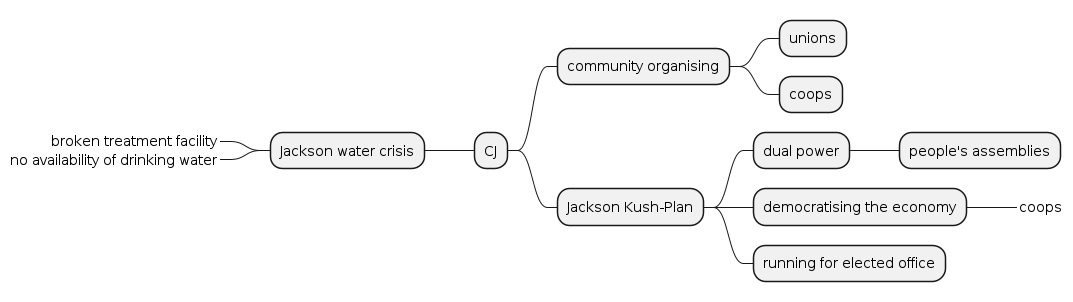
currently a water crisis in Jackson
currently in the middle of distribution event
types of community organising
- organising by trades (union style)
- cooperatives
- originally coops serviced social and reproductive needs
- child care coops, etc
- after: a compromise during 1930s compromise
- capital struck a deal with some labour leaders
- national labour board etc
- set it up so that labour could only work for wages, hours, and healthcare
- but removed ability for political strikes and political action
- one union can not work in concert with other set of workers
- same as UK
- social security and social welfare as well
- removed the need for social organising in a sense - divorced the coops from the trade unions
- limiting what both could do in terms of power and struggle, became special interest groups within bourgeious order
- coop jackson are intentional in trying to break that
- history exists in a context of colonization, white power and patriarchy
- black workers did not work in industries that were allowed to be unionzed
- e.g. farming or maids
- because of race
- black workers were excluded from trade unions
- lost the ability to own the means of production
- CJ developing model that gets out of these relations of production
- Jackson, rouhgly 220,000 in Jackson
- it has shrunk to about 160-180 thousand in recent years
- 80% of city is black
- brain drain: black doctors from Mississipi move elsewhere in the US
- 85% population is potential leverage of political power
- black political power
- Jackson-Kush Plan
- automous independent power, dual power
- self-governance through people’s assemblies
- democratising the economy
- CJ was explicitly for this part of it
- political power without economic power is symbol without substance
- additionally running for elected office
- two mayors have been elected
- a young project with a lot of experimentation
- mistake have been made, CJ aim to learn from them
- CJ about 8 years old
- accomplishments:
- [[community land trust]]
- 44 properties
- collectively-owned
- saved up money to own outright
- (CJ don’t trust banks, racist institutions)
- network of federated [[cooperatives]]
- Green Team (landscaping cooperative)
- Freedom Farms (hit hard by water crisis)
- [[Community Production Coop]] - manufacturing coop
- digital fabrication coop, 3d printing, electrical design and craft, print shop
- in the pipeline
- Zero Waste Jackson (recycling and composting coop)
- People’s Groceries
- Cannabis coop - medicinal cannabis coop
- hemp and bamboo as sustainable materials for the CPC
- withstand pressures of capitalist market
- largest employer in Mississipi is Wal-Mart
- a vicious corporation - they want no form of competition
- some coops have failed, but there’s space to do that
- owning gives this time and space for learning
- one coop failed (previous recycling and composting coop)
- too tightly coupled to city system
- city shut everything down, then the coop failed
- walmart investor in recreational cannabis in mississipi
to democratise economy
- create supply and value chains
most coops in US
- constructed on friends and favours orientation
- 10 people who like the same thing, turn it in to an income
- in CJ, given poverty etc
- what will given the most independence from market structure and political leverage?
e.g. food was weaponised during hurricane katrina, so ownership of food supply is strategic
a lot of trial and error in CJ
- that’s something to get used to in solidarity economy
outline
- link between coops and unions
- limits to power for both of these
how are the people’s assemblies organised and used?
questions
what does the solidarity economy mean to CJ?
-
what are CJ striving against?
- entrepreneuriship has been promoted in black community as answer to all problems
-
i.e. individual ownership
- but this is a continuation of unequal relationships
- prefer individuality over individualism
-
solidarity is the antidote to individualism
- being in alignment and in practice with people who are not your blood or kin or clan, but your community
- productive relationships where we consciously and deliberately depend upon each other
how to get started in Solidarity economy
- start with what you have
- avoid thinking in terms of deficits
- e.g. if you don’t have a job, maybe you have a lot of time
- who can I work with and how can I work with them
water crisis in Jackson
- there’s no affordable drinking water currently in Jackson
-
water pressure has been restored (since about a week ago)
- sanitary system was not functioning
-
need to avoid airborne diseases
- it’s a hot and humid region
- malaria and denge fever and sleeping sickness are coming back
-
to get bottled water you would have had to go 20 miles out of the city (last week)
- now if you get to a grocery store early in the morning you can buy water
- most people don’t have enough money to go and buy water
- CJ doing water distribution
-
all the faith and community organisations are doing water distribution
- but still not enough people are getting water
- if you don’t have a car, you can’t get enough water
- CJ going to members in the community and doing water drop offs
-
working age people are off working elsewhere sending money back
- reverse bell curve for the population (lots of young and elderly)
- no indication as to when the water will be restored
-
problems
- pipes are old, antiquated and lead, they break a lot
-
treatment facility is broken - it’s not cleaning the water
-
billions of dollars to build a new treatment facility
- state government is refusing to give money for this
-
racial component to how it is playing out
- state government redirecting money from federal government to white neighbourhoods outside of jackson
how did jackson get going?
- it was a long time in gestation
- going back generations
-
then in 2001…
- group decided to get together and pool resources
- $50 a month in to collective pool
- to buy land in mississipi
- a lot of patience, a lot of discipline
- first purchase in 2011
-
additionally some athletes and entertainers from the area
-
property values are low in mississipi and in jackson
- might not have been able to do the same thing in atlanta for example
how to avoid cooptation?
- foundations come and offer grants with a lot of conditions
- have to be patient and disciplined and don’t be tempted by these
- a long-term intergenerational vision and being able to stick to it
accountability processes?
- open communication and transparent communication
threats to CJ from the state etc
-
the most concerning of late
- mississipi has a supermajority that controls state legislature now
- passing preventative laws
-
e.g. climate justice
- after helping with committment to reducing emissions by about 10% in a couple of years…
-
state legislature
- said mississipi must not adhere to any EU standards around climate
- so CJ have had to censor themselves to some degree
-
FBI sniffing around, trying to intimidate
- they’ve been infiltrated, disruption
how to get those on low income involved?
-
don’t just assume that people can participate
- that is classist and gendered
- low dues
- but if can’t afford it, then give us some time
-
building up systems that allow people to participate
- e.g. single mothers - provide childcare