📚 Agora location [[how to take smart notes]] ☆
👩🌾 Contribution how-to-take-smart-notes.md by @neil ☆ raw ️🔗 ✍️
How To Take Smart Notes
- source: How To Take Smart Notes: 10 Principles to Revolutionize Your Note-Taking and …
- tags: [[note taking]]
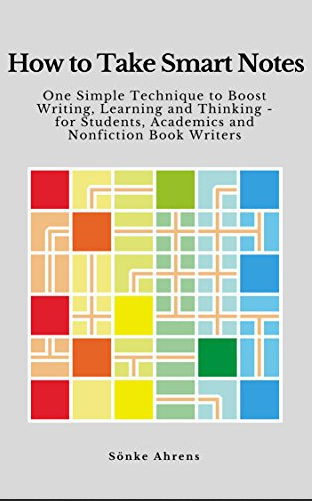
A book on note-taking from [[Sönke Ahrens]].

Mainly about breaking down ideas into smaller reusable chunks. Let them have free form structure. Have a good way to pull them back together again when you need them.
The gist of the system is:
- While reading, make notes using your own words. Only when we’ve actually understood the material can we express it in our own words
- Link these notes with other notes that could be related — this helps uncover patterns. Forming these connections also helps our memory, and recall becomes easier in the correct context
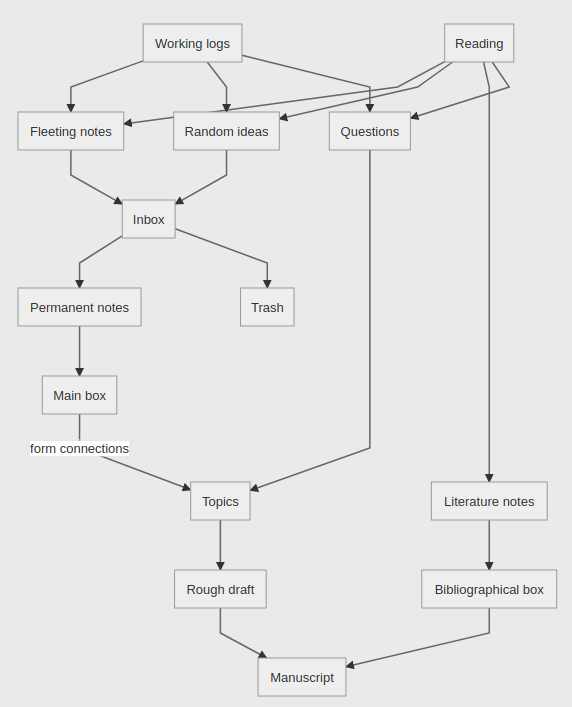

we will be able to “efficiently turn our thoughts and discoveries into convincing written pieces and build up a treasure of smart and interconnected notes along the way.”
sounds good.
He wrote only on one side of each card to eliminate the need to flip them over, and he limited himself to one idea per card so they could be referenced individually.
– How To Take Smart Notes: 10 Principles to Revolutionize Your Note-Taking and …
- Principle #1: Writing is not the outcome of thinking; it is the medium in which thinking takes place
- Principle #2: Do your work as if writing is the only thing that matters (I like the focus on writing)
- Principle #3: Nobody ever starts from scratch
- Principle #4: Our tools and techniques are only as valuable as the workflow
- Principle #5: Standardization enables creativity. "Notes are like shipping containers for ideas" I like that.
- Principle #6: Our work only gets better when exposed to high-quality feedback
- Principle #7: Work on multiple, simultaneous projects
- Principle #8: Organize your notes by context, not by topic
- Principle #9: Always follow the most interesting path
- Principle #10: Save contradictory ideas
"By standardizing and streamlining both the format of our notes and the steps by which we process them, the real work can come to the forefront: thinking, reflecting, writing, discussing, testing, and sharing. This is the work that adds value, and now we have the time to do it more effectively."
true
"Writers don’t think about a single, “correct” location for a piece of information. They deal in “scraps” which can often be repurposed and reused elsewhere. The discarded byproducts from one piece of writing may become the essential pillars of the next one. The slip-box is a thinking tool, not an encyclopedia, so completeness is not important."
👩🌾 Contribution book notes/How to Take Smart Notes.md by @bbchase ☆ raw
Sönke Ahrens Copyright © 2017
Quotes:
“Notes on paper, or on a computer screen […] do not make contemporary physics or other kinds of intellectual endeavor easier, they make it possible … no matter how internal processes are implemented […you..] need to understand the extent to which the mind is reliant upon external scaffolding.” (Levy 2011, 270)
“One cannot think without writing.” (Luhmann 1992, 53)
👩🌾 Contribution How to Take Smart Notes.md by @binnyva ☆ raw
How to Take Smart Notes
Context: This is notes made from the book ‘How to Take Smart Notes’ by S Ahrens - Website of the Book
Of all the writing, most people focus only on the writing the lengthy pieces, a book or article. The process of writing starts early - the actual writing of the paper is only a small part of the entire process.
Its easy to make bad notes - there is no immediate negative consequence to it.
Dunning-Krueger Effect: People who don’t know much think of themselves as experts Impostor Syndrome: People who are experts think they don’t know much.
Step by Step Process
- Make Fleeting notes: Just a easy way to capture every idea that pops into your head. This can be discarded when permanent notes are made.
- Make Literature Notes: Every time you consume content, make notes on it. Whatever you want to remember or use later. Keep it short, very selective and use your own words.
-
Make Permanent Notes: Does the new information contradict, correct, support or add to your existing content? Can you combine it with existing content to create something new? What questions are triggered?
- Write one idea per note.
- Write as if you are writing for someone else - use full sentences, show sources.
- Be precise, clear and brief
- Should be understood even if you don’t know the context it was taken from.
Zettelkasten is an external scaffold for thinking.
If you can rephrase something in your own words, you have understood it.
Many times, its the simplicity of an idea that makes it powerful.
Zettelkasten can lose its value when notes are added indiscriminately - each note should be worthy of publishing.
Project Notes: Project specific notes that can be deleted/archived at end of project. Includes…
- Comments in the manuscript
- Collection of project related literature
- Outlines
- Drafts, Snippets
- Reminders
- Todo lists
Fixed Mindset: Fear and avoid feedback - at it might damage their positive self image. Growth Mindset: Actively seek and welcome feedback(positive and negative). Exposes yourself to new challenges and possible learnings from failures.
6 Steps to Successful Writing
- Give each task your undivided attention. Our attention span has come down - because of many sources of distraction.
- Multitasking is not a good idea.
- Give each task the right kind of attention
Focused Attention: Focus on one thing only - sustained only for a very small time(few seconds) Sustained Attention: Stay focused on one task for a longer period - necessary to learn, understand or get things done.
"On one hand, those with wandering defocused, childlike minds seem to be the most creative;on the other, it seems to be analysis and application that’s important. … creative people need both - the key to creativity is being able to switch between a wide-open, playful mind and a narrow analytical frame"
- Become an expert instead of a planner. Without the rigid structure of a plan, you have to draw from decisions on what to do from experience - getting better over time. Mere-exposure Effect: Doing something many times makes us believe that we are good at it - independent of our actual skill.
- Get Closure. Get things out of your mind by writing it down. [[Zeigarnik Effect]]: Open tasks tend to occupy our short-term memory - until they are done. We get distracted by unfinished tasks. But if we write them down, brain considers it done.
- Reduce the number of decisions.
"Ego Depletion: Temporary reduction in the capacity or willingness to engage in volitional action(controlling the environment, controlling self, making choices, initiating action) caused by prior exercise of volition"
Reliable and standardized working environment is less taxing on our attention, concentration and willpower.
Breaks are crucial for learning - it allows the brain to process information and move it to long term memory
Read for Understanding
- Read with pen in hand/Have note taking capability
- Keep an Open mind When going thru content, we should look for dis-confirming arguments an facts that challenge our way of thinking. But we are naturally drawn to everything that confirms what we already believe. When we decide on a hypothesis, our brains automatically look for supporting data. [[Confirmation Bias]]
Zettelkasten solves this by changing the initiative from finding confirming facts to an indiscriminate gathering of any relevant information regardless of the argument it will support.
-
Get the Gist The practice of extracting notes and permanent notes makes us better in reading and understanding text. This gives you the ability to spot patterns, see the frames used - and lets you think critically and look at the assertions made by the text. To put this knowledge to use, you must be able to reframe questions, assertions and information.
-
Learn to Read You have understood something only if you can explain it to someone else. Permanent notes are a micro version of this ‘explaining’. This will reveal the gaps in our understanding. Re-reading the text will not do this - it will give you a fake "I already know that" feeling due to [[Mere-Exposure Effect]]
-
Learn By Reading
Take Smart Notes
A good metric for productivity would be: number of permanent notes / day. Aim for 3.
Think outside the brain: When we think, the brain will overlook the issues in the thought - it will auto fill the gaps in our understanding. But when we write it down, these issues becomes very apparent.
We rewrite our memory every time we try to retrieve it. Brain always try to find meanings, patterns and connections between things - even if there is none.
Two measurements for memory…
- Storage Strength
- Retrieval Strength
Elaboration: Connecting information to other information in a meaningful way. This is a very successful learning method.
Useful learning connects a piece of information to as many meaningful contexts as possible - so any of those contexts can be used to retrieve the information.
Develop Ideas
Tags should be created and assigned based on what you are interested in or working on - not just based on the content of the note.
When working with the Slip-box, we retrieve old ideas and connect them with new ideas - this is the recommended way to learn.
We learn things when…
- connecting new things to prior knowledge
- understanding broader implications(elaboration)
- Retrieve it at different times(spacing)
- use in different contexts(variation)
- retrieval with help of chance(contextual interference)
- Retrieval with deliberate effort
Tags
#book #notes #literature-notes #zettelkasten
Loading pushes...
✨ AI Synthesis Mistral Gemini ChatGPT Claude
Expanding this section will automatically generate an AI synthesis of the contributions in this node.