πŸ“š Agora node [[podcast]] β˜†
Agora nodes contain community contributions with titles or topics that match your search. x
πŸ“œ File podcast.md by @flancian β˜† πŸ“Ž οΈπŸ”— ✍️ β›Ά
πŸ“œ File podcast.md by @neil β˜† πŸ“Ž οΈπŸ”— ✍️ β›Ά

podcastΒ§

πŸ“œ File podcast.md by @agora@botsin.space β˜† πŸ“Ž β›Ά
πŸ“œ File Podcast.md by @agora@botsin.space β˜† πŸ“Ž β›Ά
πŸ“œ File podcast.md by @an_agora@twitter.com β˜† πŸ“Ž β›Ά

Loading pushes...

✨ AI Synthesis Mistral Gemini ChatGPT Claude x

Expanding this section will automatically generate an AI synthesis of the contributions in this node.

🌌 Agora context for [[podcast]]

Rendering context...

πŸ“š Agora node [[podcasts]] (pulled by user) x
πŸ“š Agora node [[20200707090530 we_never_learned_anything_about_lacan_regrettable_century_podcast]] (pulled by the Agora)
πŸ“œ File literature/20200707090530-we_never_learned_anything_about_lacan_regrettable_century_podcast.org by @ryan β˜† πŸ“Ž
  • tags :: psychoanalysisJacques Lacan

  • source

  • Unlike the analysts who came after Sigmund Freud Lacan felt that the process of becoming an analyst was one that could be done without the need of an institution

  • Neil says that in his experience leftists tend to get a sense of purpose out of feeling marginalized, that being in power would be something they wouldn't want or wouldn't know what to do with, as being marginalized gives them a sense of purpose

  • Freud's work Beyond the Pleasure Principle talks about how people want more than just hedonistic pleasure in their lives

  • Leftists are meant to be long-suffering, like religious people

  • Leftists tend to hate their ostensible allies more than their enemies

    • Leftists can hate the right because the right is very upfront with them. On the left, there's things like gatekeeping and processes of exclusion that are more subtle

  • use of the term jouissance

  • Lacan gets grouped in with a lot of political stuff

  • Psychoanalysis was subsumed into the medical industry, whereas in Latin America its tied up in politics

  • Lacan was more interested in letting people do what they want to do (unleash and understand their own desire as opposed to being beholden to their own drive)

πŸ“š Agora node [[criminalpodcast]] (pulled by the Agora)
πŸ“œ File CriminalPodcast.md by @agora@botsin.space β˜† πŸ“Ž
πŸ“š Agora node [[d c ’s rising libertarian star with her β€˜healthy skepticism of state power ’ secures an influential podcast]] (pulled by the Agora)
πŸ“œ File Readwise/Articles/D.C.’s rising libertarian star, with her β€˜healthy skepticism of state power,’ secures an influential podcast.md by @protopian β˜† πŸ“Ž

D.C.’s rising libertarian star, with her β€˜healthy skepticism of state power,’ secures an influential podcastΒ§

rw-book-cover

MetadataΒ§

HighlightsΒ§

  • She says there’s too much bad-faith performative posturing in arguments about politics today. Americans often get a distorted view of politics they don’t share, which she likens to the misleading shadows cast by the burning fire in Plato’s allegory of the cave.
πŸ“š Agora node [[do you listen to the desert oracle radio podcast]] (pulled by the Agora)
πŸ“œ File Do-you-listen-to-the-Desert-Oracle-Radio-podcast.md by @enki β˜† πŸ“Ž

Do you listen to the Desert Oracle Radio podcast?Β§


Do you listen to the Desert Oracle Radio podcast? I find it quite compelling, and I’ve never even been on that half of the continent.

By John Ohno on April 13, 2018.

[Canonical link](https://medium.com/@enkiv2/do-you-listen-to-the-desert- oracle-radio-podcast-664aa3d5b15b)

Exported from Medium on September 18, 2020.

πŸ“š Agora node [[flavor world the kids table the flavor friday podcast]] (pulled by the Agora)
πŸ“œ File flavor-world-the-kids-table-the-flavor-friday-podcast.md by @yiction β˜† πŸ“Ž

Flavor World & The Kids’ Table & The Flavor Friday PodcastΒ§

I met Drew Kinkade in Chicago. We both showed up to my friend Chase’s apartment in the heat of summer for one hazy weekend of meeting, greeting, and idea sharing. Chase hosted a party the night I met Drew, and a bunch of people neither of us knew came. Drew was showing me his mung beans (the main staple of his diet) and spilled a bunch of them across the floor. I’d like to think we became friends as I helped him pick up his beans around all the cool kids.

Drew founded Flavor World a few years ago. It started as a simple clothing brand. He would print a design he liked on a t-shirt and then sell it to his friends. Through many conversations with him, I’ve learned about the true artistic intent behind his brand, and the deeper I get into his mind, the more I become invested in it.

Flavor World is much more than a brand to sell shirts through. It’s an artistic movement devoted to reinvigorating the childlike creative energy that once resided in all of us. No creativity is off limits. Through content creation and community building, Drew hopes to use Flavor World to make our world into a more creative (and therefore happy) place.

I became "involved" with Flavor World during the transition between 2019 and 2020. I was staying at my sister’s place in Santa Barbara, California, and had an hour-long FaceTime with Drew where we compared life philosophies and talked about whatever came up. It was one of the most natural FaceTimes I’ve ever had, and we both agreed that we needed to stay in closer contact throughout the coming year.

In early 2020, Drew started the Flavor Friday Newsletter, an email newsletter that shipped every Friday (a popular idea in 2020, yes). But this newsletter is different. It’s not some boring wall of text, or five "curated" links to someone else’s content. It’s just a way for Drew to connect with the Flavor World audience and share what’s going on in his head. Very entertaining read.

In the end of May, 2020, Drew wanted to shake up the newsletter a bit. Coincidentally, I was also getting into newsletter editing and copywriting. The product fit the price, and the Kids’ Table was born. Each week, I write a friendly column about what we liked as kids. The first week, I wrote about rocks.
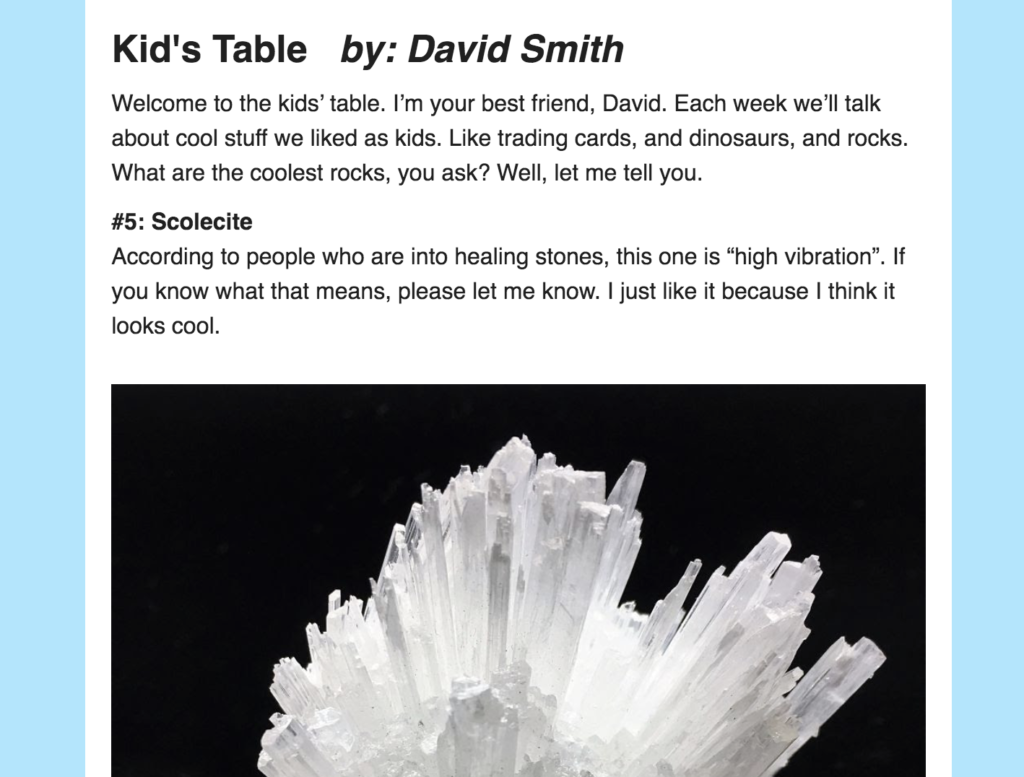
![](https://yiction.com/wp-content/uploads/2020/09/Screen- Shot-2020-09-21-at-10.28.49-AM-1024x777.png)

I keep the content engaging by inserting videos and other content types at random. An example of this is this nine-second video I made about Azurite.

I’ve covered a diverse array of topics throughout my weeks running the kids’ table, such as dinosaurs, video games, lizards, school lunch, sweepstakes, bouncy houses, juice boxes, grandparents, all-nighters, childhood pets, sugar, and much more.

To diversify our content even more, we started the Flavor Friday podcast in August 2020. This podcast has a loose, relaxed feel. In it, Drew and I record a FaceTime call during which we discuss that week’s newsletter. It’s unlike any podcast you’ve heard, I can guarantee that. Check it out here.

My collaborations with Drew have only just begun (as of the writing of this in September 2020). I’m excited to see where they go.

πŸ“š Agora node [[mindscapepodcast]] (pulled by the Agora)
πŸ“œ File MindscapePodcast.md by @agora@botsin.space β˜† πŸ“Ž
πŸ“š Agora node [[red enlightenment podcast]] (pulled by the Agora)
πŸ“œ File red-enlightenment-podcast.md by @neil β˜† πŸ“Ž οΈπŸ”— ✍️

Red Enlightenment (podcast)Β§

Found at : https://repeater-radio.com/shows/red-enlightenment/

Featuring : [[Graham Jones]]

Red Enlightenment is an 8-part exploration of [[socialism]], [[science]], and [[spirituality]].

In the first episode, he talks about the [[Enlightenment]] a bit, and gives it a good critique.

πŸ“š Agora node [[rethinking the tools for thinking podcast]] (pulled by the Agora)
πŸ“œ File Rethinking the Tools for Thinking Podcast.md by @rel8 β˜† πŸ“Ž οΈπŸ”— ✍️

Rethinking the Tools for Thinking PodcastΒ§

To build and nurture a community of practice around tools for thinking, as well as make good thinking more available in the world.

We’re wrapping Season One of the [[Tools for Thinking Podcast]]. This page is to design [[T4T Season Two]].

Season One got some enthusiastic responses from individuals, but we didn’t light the sector on fire, nor did we build a very big audience (which may not be a thing we’re aiming for).

We have an opportunity to make it better. Here are some thoughts.

Build a Hive Mind (vs a single podcast)Β§

Have Multiple Podcasts and HostsΒ§

We have one existing podcast, [[Tools for Thinking]], which we can continue producing. That podcast could have multiple hosts, instead of just one.

We also have ideas for other podcasts with different focal areas. For example, a HyperTalk podcast could focus on the history of computing.

The idea is to be flexible and creative hosting a community of podcasts with multiple hosts pursuing multiple quests, intersecting and sharing resources a lot.

Use the ToolsΒ§

Tools for Thinking ought to use Tools for Thinking! A lot! So let’s.

In fact, let’s leave behind layer after layer of useful materials, building atop the visionary documents that described the potential that computers offered us.

Simplify the FormatΒ§

Let’s take the production value down a notch (from Riverside recording back to Zoom, with less editing) and not worry about audience size, but instead about utility and accessibility.

Podcast Design QuestionsΒ§

  • What tools do we want to use to record, edit and distribute the podcast? To post about it? Other resources?
  • How should we coordinate?
    • Scheduling on Airtable? Notion? Other?
    • Conversations on Discord? Other?
  • What roles can people adopt in this community? ([[Ways You Can Participate]])
  • Who is interested in participating?
    • Jess Martin?
    • Maggie Appleton?
    • John Underkoffler?
  • What organizations might be interested?
  • Where is the common virtual ground? [[The Big Fungus]]? [[The Betterverse]]?
  • Build diversity in from the start
  • Instead of producing a podcast for people to get literate, how about involving them directly?
  • What templates/structures do we need so the podcast episodes build well?
  • Keep "Tools for Thinking"? Rename it HyperTalk? Something else? (here’s a [[T4T Venn Diagram]]?)
  • Where does the main entity live? Who hosts it?

Potential Podcast Episode Topics (for Notion)Β§

  • What parts of the early visions have been fulfilled? Which have not materialized?
  • How can the early visions improve what we’re building now?
  • Why is computer history so white male? Where is the diversity?
  • How best to connect computer history to computer literacy?
  • How can computer history be made most available?
  • What is the curriculum for computer history? In what sequence should people tackle it?
  • How do we build a thriving ecosystem here, mixing businesses and the Commons?
  • What happens when startups fail?
    • Analyze HyperCard

Potential Podcast Guests (for Notion)Β§

  • Dan’l Lewin, director of the Computer History Museum
  • Eric Rangell, who has been experimenting with Ted Nelson’s ZigZag
  • Eric Eugene Kim, who worked with Engelbart for years
  • Adele Goldberg, creator of Smalltalk
  • Tech-historian bloggers and podcasters
  • Chris Aldrich, who knows this history well
  • David Vargas, SamePage
  • Sam Arbesman
πŸ“š Agora node [[revolutions podcast]] (pulled by the Agora)
πŸ“œ File revolutions podcast.md by @flancian β˜† πŸ“Ž οΈπŸ”— ✍️
πŸ“š Agora node [[the what am i doing here podcast]] (pulled by the Agora)
πŸ“œ File the-what-am-i-doing-here-podcast.md by @yiction β˜† πŸ“Ž

The What Am I Doing Here? PodcastΒ§

I was hanging out with my friends Lukas and Chase after our second failed "let’s start a podcast" attempt. We had a problem: none of us knew what we wanted to do with our lives. We weren’t sure how to define purpose, success, and happiness in this stage of the 21st century. The future is uncertain, and we have legitimate feelings of ambiguity and anxiety about how it might turn out. We loved talking about these ideas with each other; it feels productive to talk rather than bottle them up inside.

Then, the lightbulbs went off in our heads: we could ask our professors (some of the most inspirational and learned people that we know) about the paths they took, the decisions they made, and how they define purpose, success, and happiness through the scope of their lives. We could ask them the questions that you wouldn’t ask them in class. Then, our peers could be inspired to think about these questions as well. In that moment, the What Am I Doing Here? Podcast was born. We would interview a professor, prominent community member, or anyone else who inspired us every week to figure out what they valued and why they did what they did. The results were fantastic. You can check out our episodes here.

What I Did

AUDIO EDITING: I use Logic Pro X to edit the raw audio of the podcast. This experience has taught me how horrible it is to listen to a recording of yourself. You don’t notice every "um" and "like" that you say in conversation. Having the chance to analyze my speech, as well as the speech of the intelligent guests that we have on the podcast, has vastly improved my everyday use of language.

GUEST OUTREACH: Cold emailing professors is intimidating. I learned how to craft emails that elicit a (positive) response. A well-written email sparks curiosity and inspires the will to act on the values of the podcast. I’ve also learned that there’s only so much you can do with an email. The most effective way to convince someone to come on the podcast was by speaking to them in person. Who knew.

What I Learned

PROFESSIONAL COMMUNICATION: When reaching out to a potential guest, it’s vitally important to use professional language. I have experience writing professional emails through my internship with ARMR and as the Chancellor of DSP, so I translated these skills to guest outreach. However, communication goes further than email. During the podcast recordings, I learned the importance of concision. Taking the thoughts in your head and translating them into a succinct question is difficult; it requires as much practice as possible.

LINKEDIN MARKETING: Lukas, Chase, and I each chose a different social network to represent the podcast on. I picked LinkedIn. I use different content types, such as video, audio, and photo, to engage with my followers. You can check out the LinkedIn page here.

πŸ“š Agora node [[tools for thinking podcast]] (pulled by the Agora)
πŸ“œ File Tools for Thinking Podcast.md by @rel8 β˜† πŸ“Ž οΈπŸ”— ✍️

Tools for Thinking PodcastΒ§

We’ve kicked off our quest to level up the [[Tools for Thinking]] space with a "Render" session on August 16 2022 at betaworks in NYC (see [[the notes]] we took during the event).

Our mid-term goal is to attract startups in this space to participate in an accelerator program called Think Camp.

As a bridge, and also as a fun way to explore the space, we’re starting a Tools for Thinking Podcast where we’ll interview the people writing code, using the tools and framing the space.

We’ll drop an episode a week, weaving what we learn and who we meet into this wiki. We’ll publish a video version on YouTube, and an audio-only version through Anchor to several podcast broadcasters.

EpisodesΒ§

[[Rethinking the Tools for Thinking Podcast]]

πŸ“œ File Tools for Thinking Podcast.md by @agora@botsin.space β˜† πŸ“Ž
πŸ“œ File Tools for Thinking Podcast.md by @flancian@social.coop β˜† πŸ“Ž
πŸ“š Agora node [[zebras unite podcast]] (pulled by the Agora)
πŸ“œ File pages/zebras unite podcast.md by @vera β˜† πŸ“Ž