📜 Contributions by @ at [[socialism]]
Agora nodes contain community contributions with titles or topics that match your search.

Loading pushes...
Loading pushes...
There are those (such as syndicalists who believe that trade unions are at the forefront of revolutionary activity, and that because unions are closest to the labor process, unions are the ones who can bring about not just improvement for working conditions but revolutionary change as well.
Arguably, the sovietswere one such example: organizations that worked with unions and persisted after the revolution, albeit neutered.
Likewise, there are those who say that unions will only exist in capitalism, and that at best all unions can do is improve working conditions. There may be some truth to this, but I believe that it's too dismissive of the role of unions.
Not a very succinct title.
In the history of capitalist development, there is an observed problem that the working classes abandon socialism or are otherwise divided. For them class struggle isn't the most important thing. This is thought to be at least partially caused by labor aristocracyand subsequently imperialism
Some have put forward the idea that a blockchaincould be used for socialist purposes. There are a few possible suggested applications, though maybe the only worthwhile application would be to facilitate labor-time accounting
Otherwise, the logic of cryptocurrency is inherently capitalist
In the final synthesis of the sixth assessment report from the Intergovernmental Panel on Climate Change (IPCC), the world’s scientists have given humanity a stark final warning: we are destroying the planet, and we need ‘deep, rapid, and sustained’ reduction in emissions in order to avoid irreversible loss and damage to nature and people. Along with the report, UN Secretary-General António Guterres stated the need for climate action ‘by every country and every sector and on every timeframe’. For those of us that work in the ever-growing sector of information and communication technology (ICT) we face the question: what action should we take?
The media has made much of one recent example: a startup company heating public swimming pools with the excess heat from small, local data centres that process machine learning and artificial intelligence. At face value, the story of the ‘digital boiler’ is fun, innovative and feels like positive action. But in the face of catastrophic climate change, driven by capitalism and aided and abetted by the Big Five tech companies (Alphabet, Apple, Amazon, Meta, Microsoft), is this kind of activity enough? Commenting on the inadequacy of dislocated, parochial attempts to challenge capitalism, Jodi Dean famously remarked: "Goldman Sachs doesn’t care if you raise chickens". Relocating this sentiment to the capital-driven digitalization of the world, we can ask: "Does Amazon care how you heat swimming pools?"

The IPCC is unequivocal as to the cause of the crises of our times: human activity. We are altering the planet to such a degree that the change has been proposed as its own geological epoch: the Anthropocene. Others hone this further, asserting that it is not the presence of humans per se that is the cause, but the very particular configuration of our recent history: capitalism and growth. We are in the Capitalocene, and only an alternative to capitalism will get us out of it.
In all of this, one of the sectors with a major role to play is ICT. Computing and communication devices are now integral to our society - from our phones to our computers to the servers and the global infrastructure that networks them together. ICT has a significant environmental impact of its own through the lifecycle of its physical devices, but also an enabling and structural effect on the impact of other sectors and society in general. ICT plays a huge role in how the world operates.
Unfortunately, much of ICT has been captured for capitalist ends. Big Tech corporations are some of the largest in the world. They represent the majority of companies to have ever attained over $1 trillion in market capitalization, and they have resulted in "an intensification of labour and environmental exploitation on a planetary scale". The paradigm of digital capitalism needs to be challenged and reversed if we are to stand a chance of combatting climate change. What can challenge its dominance?
Sustainable development and the sustainable development goals are well-known organising principles that aim to put people and planet first. The field of ICT for sustainability (ICT4S) explores the principles of sustainable development as applied to ICT. Yet, as with sustainable development as a whole, there are various approaches to ICT4S, and the majority either sustain the status quo or offer only mild reforms - such as repurposing excess computational heat rather than questioning its presence in the first place. Much more transformative strategies are needed to make the changes that we need in the timeframe that we have.
On the radical end of the spectrum of sustainable development lies ecosocialism. It melds socialist and environmental politics, with a strong anti-colonial and anti-capitalist sentiment that moves beyond private profit to socially useful and ecocentric production. Digital ecosocialism is the extension of ecosocialist ideals into the digital realm. It is ICT that embeds the values of planetary stability, social equity and agency throughout the sector. Many of the building blocks are here already: for example libre software and creative commons licenses. Digital ecosocialism combines resistance and regulation with the building of alternatives. Examples of digital ecosocialism in action include the cultivation of platform cooperatives; the socialisation of physical infrastructure; federated and democratically governed social media platforms; the building of data commons; the right to repair; tech worker unions; and activism against the excesses of Big Tech.
Perhaps one day in a post-capitalist future community-run digital boilers will power municipal infrastructure, but right now Amazon does not care how we heat swimming pools. Big Tech will care about strike action and worker empowerment; campaigns against exploitative practices; the deconstruction of intellectual property laws; regulation against monopolistic practices and early obsolescence; technology appropriation for the common good, and digital degrowth. As concerned ICT workers we need to urgently agitate, organise and educate to foster digital ecosocialism.
Iterative Enquiry for [[digital ecosocialism]].
Very much an experiment and a work in progress. I am working through [[Design Journeys through Complex Systems]] and trying to explore some of the methods and diagrams as I go.
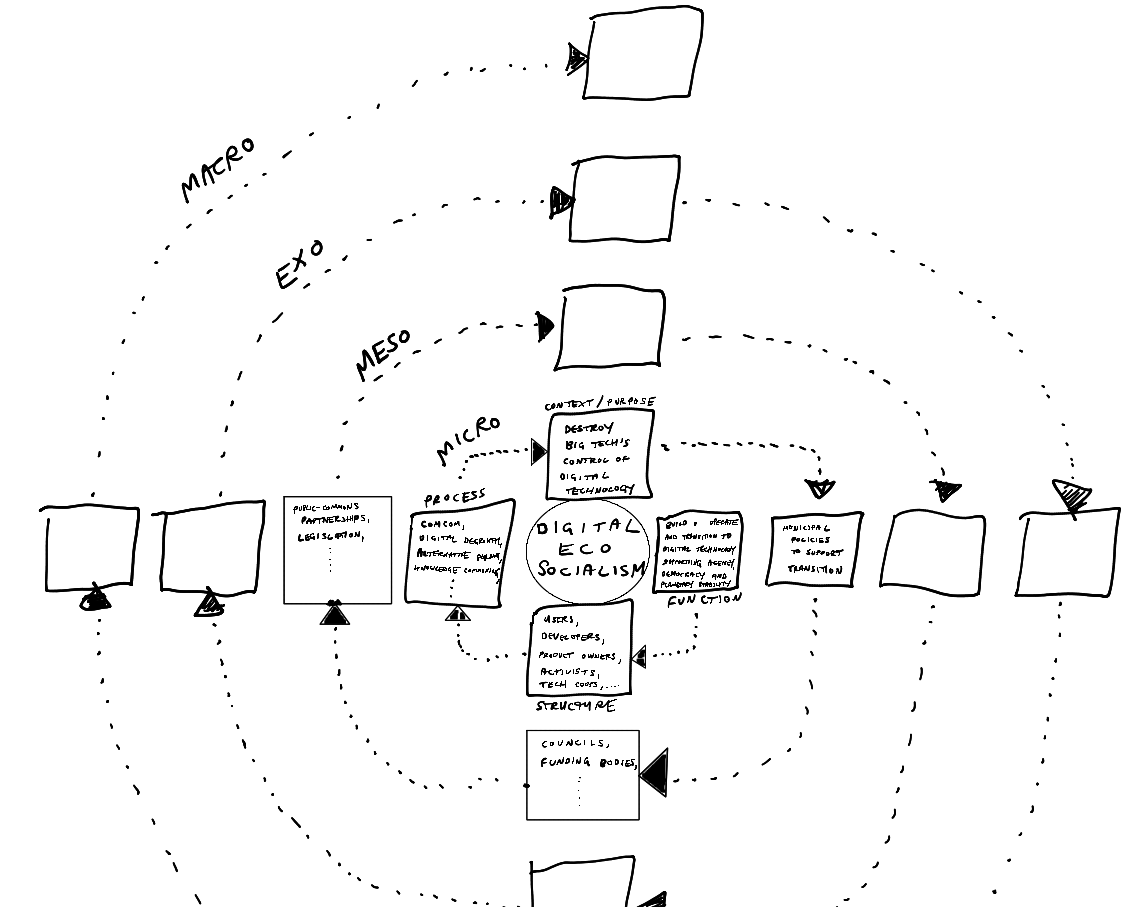
Finding that the ideas I’ve been exploring in [[Reclaim the stacks]] are mapping pretty well on to this notion of function, structure, process and context/purpose at the various levels (micro, meso, exo and macro).
[[Iterative Inquiry]] for [[digital ecosocialism]].
Very much an experiment and a work in progress. I am working through [[Design Journeys through Complex Systems]] and trying to explore some of the methods and diagrams as I go.
Finding that the ideas I’ve been exploring in [[Reclaim the stacks]] are mapping pretty well on to this notion of function, structure, process and context/purpose at the various levels (micro, meso, exo and macro).
I heard of it first from [[Aaron Benanav on Associational Socialism and Democratic Planning]].
There he says it has similarities to [[Guild socialism]] and [[council communism]]. So, I think, something of an avoidance of centralised party control, with power more in the hands of ‘associations’. Which might be guilds or councils, but might be other types of associations.
[[Buddhist socialism]]: https://en.wikipedia.org/wiki/Buddhist_socialism
Author : [[Christian Fuchs]]
URL : https://www.triple-c.at/index.php/tripleC/article/view/1144
Page 7 : 3.2. Production and Labour
Page 7 : Toil is for Marx and Engels incompatible with a socialist society. They see the reduction of necessary labour and the abolition of hard labour as an important aspect of
Page 8 : In a high-tech socialist society, where the division of labour is abolished, humans are enabled to freely choose their work activities and to be active as well-rounded individuals who engage in many different activities. This means that humans can freely use their capabilities. Labour turns into free activity without a struggle for survival and coercion by the market.
Page 8 : In a socialist society, production takes place based on the principle of human need and not based on the principle of profit (the need of capital). This requires some form of planning of production:
Page 8 : Part of the reason state communism failed was that the central planning of human needs and the economy failed. Economies are complex and have unpredictable features.
Page 8 : Economic planning needs to be decentralised, which in a networked and computerised society can take on the form of a decentralised collection of the goods that individuals and households require. This information can then be sent to production units that thereby know how many goods are required during a certain period of time. Networking of production within industrial sectors enables the comparison of the available production capacities and productivity levels, which enables the production of the right amount of goods. ● not quite so simple…
Page 8 : For Marx and Engels, socialism includes a democratic economy, in which the workers own the means of production in common.
Page 9 : 348). 3.3.
Page 9 : Marx and Engels distinguish between two phases of a socialist society: crude communism as the first stage and fully developed communism as the second stage.
Page 9 : In the first stage, there is the elimination of capital, profit and the private property of the means of production, but not necessarily the abolition of wage-labour, money, exchange, and commodities. The means of production are collectively owned, but the productive forces are not yet developed to the stage that allows the abolishment of necessary labour.
Page 9 : In the higher, fully developed form of communism, the means of production are highly developed so that necessary labour and exchange are abolished:
Page 10 : From each according to their abilities, to each according to their needs” is a central communist principle. In a fully developed communist society, there is no wage-labour and no compulsion to work.
Page 10 :
Page 10 : Freedom is an important principle of democratic societies. For Marx, socialism means the abolition of alienation and the realisation of true freedom that allows humans to fully develop their potentials. A socialist society is a democracy and a humanism, in which the freedom of all interacts with individual freedom.
Page 11 : Progressive politics that socialists support include, for example, a “heavy progressive or graduated income tax”, the “[e]xtension of factories and instruments of production owned by the State”, the “[c]ombination of agriculture with manufacturing industries; the “gradual abolition of all the distinction between town and country by a more equable distribution of the populace over the country”, or the “[f]ree education for all children in public schools”
Page 11 : of the populace over the country”, or the “[f]ree education for all children in public schools” (Marx and Engels 1848, 505). 5. Socialist Culture
Page 11 : 5.1. Togetherness
Page 11 : Whereas capitalist culture through the logic of commodity consumption advances a culture of isolation and individualisation focused on the individual consumption of commodities and the competition for reputation, socialist culture means the development of a common culture, where humans associate and produce and consume culture together:
Page 11 : 5.2. The Family
Page 11 : Socialist society also changes personal relations and the family. It reduces the dependence and power relations within the family and thereby advances equality:
Page 11 : 5.3. Internationalism
Page 11 : and nationalism in a socialist society.
Page 12 :
Page 12 : For Marx (1844, 296), communism as revolutionary socialism is the “reintegration or return of man to himself, the transcendence of human self-estrangement”, “the real appropriation of the human essence”, “fully developed humanism”
Page 13 : There are three dimensions of a socialist society: the socialist economy, socialist politics, and socialist culture.
Page 14 : Discussions about socialism in the 21st century have foregrounded the commons. The basic argument is that neoliberal capitalism has resulted in the commodification and privatisation of common goods that are either produced by all humans or that all humans need in order to exist.1
Page 14 : Michael Hardt and Antonio Negri (2017, 166) argue that there are two major forms of the commons: the social and the natural commons. These forms are divided into five subtypes: the earth and its ecosystems; the “immaterial” common of ideas, codes, images and cultural products; physical goods produced by co-operative work; metropolitan and rural spaces that are realms of communication, cultural interaction and cooperation; and social institutions and services that organise housing, welfare, health, and education (2017, 166).
Page 15 :
Page 15 : 7.1. Socialism and Technology
Page 15 : 7.1.1. The Antagonism of Productive Forces and Relations of Production
Page 16 : In the 21st century, information technology and the Internet are founded on an antagonism of class relations and the now networked productive forces. A good example is that the Internet allows the free sharing of information via peer-to-peer platforms and other technologies, which on the one hand questions the capitalist character of culture and so makes the music and film industry nervous, but on the other hand within capitalism can also constitute problems for artists who depend on deriving income from cultural commodities.
Page 16 : Networks are a material condition of a free association, but the cooperative networking of the relations of production is not an automatic result of networked productive forces.
Page 16 : 7.1.2. The Antagonism Between Productive Forces and Relations of Production in the Grundrisse’s “Fragment on Machines”
Page 16 : necessary labour time – the annual labour-time a society needs in order to
Page 16 : The capitalist antagonism between productive forces and relations of production is an antagonism between necessary labour (that technology ever more reduces) and surplus labour (that capital tries to ever more increase):
Page 17 : 7.1.3. Technology and Time in Capitalism and Socialist Society
Page 17 : But its tendency always, on the one side, to create disposable time, on the other, to convert it into surplus labour.
Page 18 : 7.1.4. Fully Automated Luxury Communism?
Page 18 : Bastani rightly reiterates Marx’s insight that communism requires material and technological foundations and can therefore only be a high-tech communism. ● debateable
Page 18 : A communist society requires prospective, critical technology assessment and communist tech ethics and tech policies that regulate new technologies. Technology is not just an economic issue, but also has political and cultural dimensions that are based on but not reducible to the economy.
Page 19 : requires technological foundations, but high tech alone is not enough. Communism’s guiding principle is neither technology nor love of technology, but love.
Page 19 : Bookchin reminds us that not all technologies are liberating. Technologies need to be combined with and shaped by environmentalism and communalism. Bookchin argues for an “ecological approach to technology that takes the form of ensembles of productive units, energized by solar and windpower units” (46).
Page 20 : (convivial technologies), André Gorz (post-industrial socialism), Ernst Bloch (alliance technology), etc.
Page 19 : The list of theorists of socialist technology could be continued with names such as Herbert Marcuse (post-technology), Erich Fromm (humanised technology), Ivan Illich
Page 20 : Fully Automated Luxury Communism is, despite its tendencies of idealist utopianism and historical blindness, good food for thought about the foundations of communism.
Page 20 : 7.2. Socialism and Communication
Page 20 : and Communication 7.2.1.
Page 20 : Alienated and socialist forms of knowledge and communication 7.2.2. Public Service Media and Community Media
Page 21 : The political economist of communication Graham Murdock (2011, 18) argues that the three political-economic possibilities in the media and cultural sector are ownership by capital (the commodity form of communications), by the state (the public service form of communications) and by civil society (communications as gifts/commons). ● podcasts as gift economy / commons
Page 22 : Community media are, in capitalism, often based on voluntary, self-exploitative, unpaid or lowpaid labour. The history of alternative and community media is a history of self-determined but precarious labour and resource precarity.
Page 22 : In the 20th century, many states held monopolies over telecommunications, broadcasting networks, railways, and the postal service. These are large infrastructures of communication. Organising them as public services enables fair, universal, affordable access. Today, there is a need for public service Internet platforms, such as a public service YouTube run by a network of public service companies, in order to challenge
Page 22 : Alternatives to communication services that store and process lots of personal data, such as Facebook, should be organised as self-managed community platforms because too much involvement by the state poses a certain danger of state surveillance potentials directed towards citizens.
Page 22 : 7.2.3. Rosa Luxemburg: The Freedom of the Press in Socialist Society
Page 22 : Rosa Luxemburg on the one hand supported the need to replace the Czarist regime by a socialist society and on the other hand stresses the need for the democratic character of such a society.
Page 23 : Luxemburg criticised the curtailment of the freedom of expression in Russia under Lenin.
Page 23 : service media organisations and self-managed media organisations. 7.2.4. Democratic Communications
Page 23 : In his book Communications, Raymond Williams (1976, 130-137) distinguishes between authoritarian, paternal, commercial and democratic communication systems (communications). The first three communication systems are political,
Page 24 : 7.2.5. Socialist Journalism
Page 24 : Fogarasi implicitly applies Georg Lukács’ (1971) critique of reified consciousness to the capitalist press. In the capitalist press, the focus is often not on the dialectic of totality, particularity and individuality, but merely on individual, isolated pieces of news. According to Fogarasi, strategies of the capitalist press include reporting a multitude of isolated facts that quench the readers’ thirst for knowledge; de-politicisation and sensationalism that work “systematically in the service of such diversion” (1921/1983, 150); and pseudo-objectivity. In contrast, the socialist press tries to advance the consciousness of society as totality and of the relation of single events with each other and broader contexts, the unmasking of the capitalist press, and the participation of readers as producers of reports ● stream vs gsrden
Page 24 : 7.2.6. Digital Commons
Page 24 : Given that computing has become a central resource in modern society, the use of computers for organising cognition, communication and cooperation has become a human need.
Page 25 : being loved and recognised), communicative needs (such as friendships and community) and co-operative needs (such as working together with others in order to achieve common goals) in all types of society. In a digital and information society, computers are a vital means for realising such needs. But given that computers are always used in societal contexts, computer use as such does not necessarily foster the good life, but can also contribute to damaging human lives.
Page 26 :
Page 26 : both public services and civil society as the realms from where alternatives emerge. There are ten principles of communicative/digital socialist politics: 1. Techno-dialectics:
Page 26 : How can technology and society be shaped in manners that benefit all humans, workers and citizens and develop the positive potentials of society and humanity?
Page 26 : Instead, it asks: How can technology and society be shaped in manners that benefit all humans, workers and citizens and develop the positive potentials of society and humanity? 2. Radical
Page 26 : workers: Communication corporations exploit different kinds of workers. Alternatives to communicative
Page 27 : Collective control of the means of communication as means of production: ● governable stacks
Page 27 :
Page 27 : privacy: Public and commons-based communications should respect users’ privacy and minimise their economic and political surveillance as well as other forms of surveillance. Personal
Page 27 :
Page 28 :
Page 28 : Alternatives decelerate information flows (slow media), foster informed political debate and learning through collective creation, and participation in spaces of public communication that are ad-free, non-commercial, and not-for-profit.
Page 28 : classist, fascist, racist, xenophobic and sexist discourse. 9. Political and protest communication: Communication technologies are not the cause of protests, rebellions and revolutions, but they are an important part of
Page 28 : Socialist communication politics seeks to use communication technologies for spreading socialist politics to a broad public.
Page 28 : Self-managed, democratic governance:
The connection between socialism, anarchism and communism is confusing.
I take socialism to be the broader term, and communism and anarchism to be examples of revolutionary socialism.
But sometimes you hear socialism as being the precursor stage to communism. I think this is from Marxism-Leninism.
free markets & socialism…
So long as we translate the terminology carefully, we can synthesize marxist economics with non-marxist economics & gain useful insight…
Cowen, like most defenders of capitalism, seems to confuse capitalism with free markets & socialism with planned economy. (Non-economists who aren’t writing books can be forgiven for being confused in this way, since the most visible and vocal socialist project, the USSR, had a planned economy.) This means that their criticisms often fail to land, because they’re not criticizing what actual marxists mean: it’s possible to have a completely communist system that has free markets, for instance, and our current capitalist system is dominated by large vertically-integrated planned economies (albeit ones that don’t correspond to states very well).
So long as we translate the terminology carefully, we can synthesize marxist economics with non-marxist economics & gain useful insight: the primary problem with non-marxist economics being that, pragmatically, they systematically underestimate how insulated decision-makers are from market forces & systematically overestimate how much freedom-of-informed-choice (and thus, control) customers have. (On this point, Thiel is right: the goal of any capitalist is to insulate themselves from the need to add value and become a rent-seeker, whether by monopoly or by financialization. Thiel thinks this is a good thing, and it’s a good thing for people like Thiel who can play that game, but it’s a bad thing for everybody else.)
It is in this way that the left writ large should learn from capitalism (and this is in line with history: Marx’s greatest achievement was not inventing communism but inventing capitalism by writing the first systematic analysis of it; meanwhile, communism he left quite vague).
By John Ohno on August 1, 2019.
[Canonical link](https://medium.com/@enkiv2/cowen-like-most-defenders-of- capitalism-seems-to-confuse-capitalism-with-free-markets- socialism-747a0bef045)
Exported from Medium on September 18, 2020.
A : [[claim]]
[[data commons]] are examples of [[digital ecosocialism]].
Persons of a reflective bent all too often underestimate the enormous strength that truly abysmal [[ignorance]] can bring. [[Knowledge is power]], of course, but—measured by a purely Darwinian calculus—too much knowledge can be a dangerous weakness. At the level of the social phenotype (so to speak), the qualities often most conducive to survival are [[prejudice]], simplemindedness, blind [[loyalty]], and a militant want of curiosity. These are the virtues that fortify us against [[doubt]] or fatal hesitation in moments of crisis. [[Subtlety]] and [[imagination]], by contrast, often enfeeble the will; [[ambiguities]] dull the [[instincts]]. So while it is true that [[American]] political thought in the main encompasses a ludicrously minuscule range of live options and consists principally in [[slogans]] rather than ideas, this is not necessarily a defect. In a nation’s struggle to endure and thrive, unthinking obduracy can be a precious advantage.
Even so, I think we occasionally take it all a little too far.
Not long ago, in an op-ed colum…
What an opening salvo! I shouldn’t trust someone more for writing like this, but it is honed to hit my weak spots.
Many other good quotes:
Any day now in [[Sweden]], it seems, free dentistry will mutate into a secret state-police apparatus and a sprawling archipelago of reeducation camps.
Just as we Americans have succeeded in turning “[[Christianity]]” into another name for a system of values almost totally antithetical to those of the Gospel, I have every confidence that we will find a way to turn “[[socialism]]” into just another name for late-modern [[liberal]] [[individualism]].
Contrary to conventional wisdom, Christianity has never really taken deep root in America or had any success in forming American consciousness; in its place, we have invented a kind of Orphic mystery religion of personal liberation, fecundated and sustained by a cult of Mammon.
What remains of that tradition now I cannot say with any certainty. To some extent, it was always a dream of an impossible future sustained by fantasies of a nonexistent past. And some of its aspects, however well-intended—those overly rosy views of class distinction, for instance, or that gauzily gleaming pre-Raphaelite medievalism—are not worth preserving or reviving, except perhaps in radically qualified form.
See [[Ecosocialism and degrowth]].
A : [[claim]]
[[Degrowth and ecosocialism]].
First read it explicitly stated by any prominent degrowth advocate in [[The Double Objective of Democratic Ecosocialism]] (Jason Hickel).
My [[hub note]] of entry points into trains of thought on digital ecosocialism. I intend to make some structure notes on the topic soon.
[[Digital ecosocialism is the application of digital technologies for ecosocialist ends]].
[[Digital ecosocialism is the counter to digital capitalism]].
They embody the general principles of open knowledge; cooperativism; commoning; degrowth ; socially useful / ecologically safe production; adversarial interoperability; municipal support; innovation from below; and socialisation / deprivatisation (of physical and digital ICT infrastructure).
They should be transformative - i.e. actively enabling a transition to ecosocialism. They should not be simply maintaining the status quo or making mild reforms.
Examples of digital ecosocialist technologies and initiatives are: [[libre software]]; [[data commons]]; [[open hardware]] and the [[right to repair]]; [[platform cooperatives]].
A system of [[digital socialism]] would phase out intellectual property, socialize the means of computation, democratize data and digital intelligence and place the development and maintenance of the digital ecosystem into the hands of communities in the public domain.
Many of the building blocks for a socialist digital economy already exist. Free and Open Source Software ([[FOSS]]) and [[Creative Commons]] licenses, for example, provide the software and licensing for a socialist mode of production.
As James Muldoon notes in [[Platform Socialism]], city projects like [[DECODE]](DEcentralised Citizen-owned Data Ecosystems) provide open source public interest tools for community activities where citizens can access and contribute data, from air pollution levels to online petitions and neighborhood social networks, while retaining control over data shared.
[[Platform coops]], such as the Wings food delivery platform in London, provide a prominent workplace model whereby workers organize their labor through open source platforms collectively owned and controlled by the workers themselves.
There is also a socialist social media alternative in the [[Fediverse]], a set of social networks that interoperate using shared protocols, that facilitate a decentralization of online social communications.
But these building blocks would need policy change to thrive.
Projects like the Fediverse, for example, are not able to integrate with closed systems or compete with the massive concentrated resources of the likes of Facebook. A set of radical policy changes would therefore be needed to force big social media networks to interoperate, decentralize internally, open up their intellectual property (e.g. proprietary software), end forced advertising (advertising people are subjected to in exchange for “free” services), subsidize data hosting so that individuals and communities — not the state or private companies — can own and control the networks and perform content moderation. This would effectively strangle tech giants out of existence.
The socialization of infrastructure would also need to be balanced with robust privacy controls, restrictions on state surveillance and the roll-back of the carceral security state.
[[Governable stacks]].
Another good interview with the [[Half-Earth Socialism]] authors.
This one has a strong focus on the planning aspects of it.
~00:02:18 Nice summary definition of Half-Earth Socialism.
~00:03:50 Critiques of [[BECCS]], [[nuclear power]], and [[Half-Earth]].
~00:30:09 Some good overview here on how the planning might actually work.
An alternative spelling of [[ecosocialism]].
[[I am an ecosocialist]].
A combo of [[socialism]] with [[green politics]], [[ecology]] and [[alter-globalisation]]. A baseline of fulfillment of human needs while staying within [[planetary boundaries]]. Ecosocialism sees [[social and environmental issues as interconnected and inseparable]]. Ecosocialism is [[anti-capitalist]], seeing capitalism as the root cause of both social inequity and the overshoot of planetary boundaries.
Loosely defined, ecosocialism describes a classless socioeconomic system in which humans live in balance with nature.
– [[Jackson Rising Redux]]
an ideology merging aspects of socialism with that of green politics, ecology and alter-globalization or anti-globalization.
market-based solutions to ecological crises (ecological economics, environmental economics, green economy) are rejected as technical tweaks that do not confront capitalism’s structural failures.
What is its [[political economy]] then?
Eco-socialists advocate dismantling capitalism, focusing on common ownership of the means of production by [[freely associated producers]], and [[restoring the commons]].
[[Commons]].
What’s the specifically eco bit?
Exchange value would be subordinated to use value by organiszing production primarily to meet social needs and the requirements of enviornmental protection and ecological regeneration.
– [[Jackson Rising Redux]]
To build an ecologically rational society along these lines requires the collective ownership of the means of production, democratic planning to enable society to define the goals of production and invemestment, and a new technological production structure that meshes with society’s plans and stays within the Earth’s ecological carrying capacity.
– [[Jackson Rising Redux]]
There are various [[types of ecosocialism]].
The discursive terrain of ecosocialist thinking is vast, and there is no single way to define ecosocialism. However, we can identify three broad principles that would likely be shared across these varieties: 1) the priority of use-value over exchange-value; 2) collective ownership and planning to shape and constrain markets; and 3) “contraction and convergence” in consumption levels between the global north and south
– [[Ecosocialism for Realists: Transitions, Trade-Offs, and Authoritarian Dangers]]
But at core these movements share a commitment to struggling for a socioecological transition beyond capitalism by democratizing the means of production, subjecting markets to more ecologically rational planning, and subordinating private profit to social use-value and ecocentric production.
– [[Ecosocialism for Realists: Transitions, Trade-Offs, and Authoritarian Dangers]]
One might argue that the climate situation is so serious, we should prioritise it over everything; if we don’t get this right there’s no room for any human society, equitable or otherwise. But then, I would say, the changeover to sustainability is an enormous undertaking, requiring the energies of society as a whole: hence we must therefore address the disempowerment of the vast majority. This is why I proceed from a ‘red-green’ perspective, which is socially radical as well as environmentally conscious.
[[William Morris]], the English novelist, poet and designer, is largely credited with developing key principles of what was later called eco-socialism
The "pre-revolutionary environmental movement", encouraged by the revolutionary scientist Aleksandr Bogdanov and the Proletkul’t organisation, made efforts to "integrate production with natural laws and limits" in the first decade of Soviet rule, before Joseph Stalin attacked ecologists and the science of ecology and the Soviet Union fell into the pseudo-science of the state biologist Trofim Lysenko, who "set about to rearrange the Russian map" in ignorance of environmental limits
The eco-socialist future is female
[[G. D. H. Cole]].
We find in Cole’s writings an intriguing theory of [[democratic associationalism]], in which cooperation rather than force is seen as the mechanism that enables people to build organisations and work towards shared goals.
– [[Platform socialism]]
The driving force of Cole’s guild socialism was the desire to institute what he called a ‘functional democracy’ in different domains of social life. This was an idea of democracy understood not simply as a set of abstract rights but in terms of real participation and involvement in the most important associations that governed individuals’ everyday lives.
– [[Platform socialism]]
He called for a participatory democracy in which multiple and overlapping producer, consumer and municipal associations coordinated social life. In Cole’s sketch in Guild Socialism Restated, he envisioned cultural councils organising art galleries, museums and libraries; education guilds organising schools, universities and other tertiary institutions; health guilds; collective utilities councils; industrial councils; civil service councils; consumer councils; and co-operative councils.
– [[Platform socialism]]
This vision of a radical democratic future entailed a greater emphasis on distributed forms of governance, a participatory political culture and citizens exercising meaningful democratic control over their lives.
– [[Platform socialism]]
Cole’s theory required a decentralisation of power throughout society. He argued that the power and authority of the state should be drastically reduced to a coordinating agency – one small element in a larger social system of internally democratic associations led by active citizens.
– [[Platform socialism]]
Cole represented what Mark Bevir has called a ‘distinctive socialist tradition of pluralism’ within early twentieth-century British politics which challenged the state’s centralisation of power and the tendency of socialists to think of socialisation exclusively in state terms.8 The pluralist agenda of this associationalism posed a radical alternative to Fabianism and the various forms of state socialism of the era.
– [[Platform socialism]]
For Cole, the central concept was ‘community control’ – how interconnected individuals working towards a common cause could regain collective self-determination over their economic and political institutions.
– [[Platform socialism]]
A : [[book]]
URL : https://www.versobooks.com/books/3818-half-earth-socialism
An excellent book with a bold programme for [[eco-socialism]]. Very readable.
Touches on [[socialist calculation debate]], [[Markets vs planning]], [[climate science]], [[climate breakdown]], [[eco-socialism]], [[Project Cybersyn]], [[Viable system model]], etc etc.
I like that it has some [[speculative fiction]] and homage to things like [[News from Nowhere]].
The accompanying game that you can play at https://play.half.earth is brilliant.
The main thing that it is lacking is a plan for [[revolutionary transition]]. But they’re quite open about that, to be fair, happy to be a work of [[utopian socialism]]. The appropriation of the loaded term "Half-Earth" is questionable, but probably deliberately provocative.
Main nub of it:
A kind of socialism based on the recognition of ecological limits and the limits of our understanding of the natural world. Envronmental crisis can only be overcome by socialism, because only socialism allows humans to decide to manage economic growth (impossible under capitalism). Socialists have to be environmentalists because they have to realise that total control over nature is impossible, the more we intervene in nature the more risks we take, such as pandemics and climate change. Also arguging for Neurathian conscious control of the economy. We propose rewilding half of the planet, having energy quotas, and veganism, to reduce our impact on nature, while also ensuring a good life for all.
– paraphrasing from [[Drew Pendergrass and Troy Vettese on Half Earth Socialism]]
In [[Climate Leviathan]] terms, I would suggest that their proposals fit as a mixture of [[Climate Mao]] and [[Climate X]] - i.e. staunchly socialist and non-capitalist, with a mixture of central authority and democratic decentralisation.
Think then of Half-Earth Socialism as a cookbook divided into four courses: the philosophical, the material, the technical, and the imaginative

Our framework draws on [[ecology]], [[energy studies]], [[epidemiology]], [[cybernetics]], [[history]], [[mathematics]], [[climate modelling]], [[utopian socialism]], and, yes, [[neoliberalism]]
We invite everyone from all liberatory traditions to join us in the revolutionary kitchen to think up many new recipes and work together to realize them
The environmental crisis forces us to decide between controlling the market and controlling nature
We follow his example of digging deep into the epistemic layers of our beliefs, but whereas Hayek covered the market with the veil of ignorance, we drape that veil over nature
Don’t plan nature, plan the market.
The environmental crisis, however, strains the neoliberals’ foundational postulates because they have to decide what is more complex and unknowable – the market or nature
Rather than the conscious control of nature, the neoliberals seek one unconscious realm (nature) to be subdued by another (capital
In response, we try to out-Hayek Hayek by arguing that nature is more unknowable than the market, and therefore far more deserving of our awe as an unconscious, decentralized, and unimaginably complex system
Each of these thinkers is a primogenitor of one of the three great lineages in environmental thought: Hegel’s [[Prometheanism]], [[Malthusianism]], and [[Jennerite ecological scepticism]]
One can go beyond Boulding by giving his framework a Jennerite twist: Earth is a natural machine, both ancient and alien, whose operating systems we will never fathom, and therefore it is wisest to let the ghost in the shell control the circuitry even if we do not always understand it ourselves
The process of nature’s humanization stops not when it is realized, but when our species comes to recognize that this process undermines the basis of human freedom. Climate change, emerging zoonotic diseases, and other environmental crises make a mockery of this pretence of control. To bring the humanization of nature to an end, the collective consciousness (Geist) must become aware of its own limits
The task of unbuilding makes clear that environmentalism isn’t so much the idealization of ‘pristine’ nature (though it is vital to protect intact ecosystems) but the recognition that it is still possible to repair our broken world
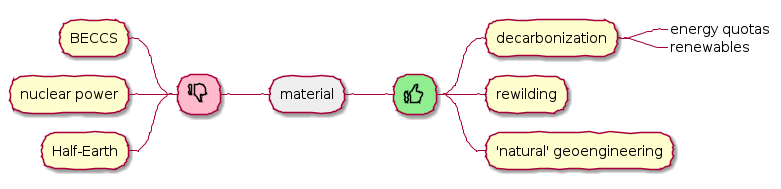
The goals of Half-Earth socialism are simple enough: prevent the [[Sixth Extinction]], practise ‘natural geoengineering’ to draw down carbon through rewilded ecosystems rather than SRM, and create a fully [[renewable energy]] system
way to save land would be to produce less energy, which is why Half-Earth socialism embraces quotas. The exact number can be debated, but we admire the target of the [[2,000-Watt Society]]
An economic system resembling Half-Earth socialism can actually be found in recent history: Cuba’s [[Período Especial]]
[[Socialist planning]].
the third chapter that tackles the difficult problem of organizing production and distribution without the market.
If it is necessary to prevent the market commodifying and controlling all of nature, and we also have a sense of what material goals we want to achieve, how then is it possible to organize production and consumption without a market? We draw on a range of influences, including [[Soviet cybernetics]] and mathematics, Chile’s ‘[[Cybersyn]]’ programme, [[meteorology]], and cutting-edge [[integrated assessment models]] (IAMs) used by climate scientists today.
Half-Earth socialist planning is inspired by a slew of traditions, including Neurath’s [[in natura calculation]], Kantorovich’s [[linear programming]], Beer’s Cybersyn, and the climate-economy models of Austria’s IIASA
necessary to marry Kantorovich’s technical vision to Neurath’s [[democratic socialism]], in which planners lay out their goals and constraints in natural units and then devise different plans that could be chosen by an informed public
similar to [[P2P Accounting for Planetary Survival]]?
In this chapter, we will detail how to organize a democratically planned economy in an age of ecological crisis
Even a wisely managed eco-socialist utopia would still be plagued by some inefficiencies and shortages, as we will discuss later in the chapter. However, we believe that it is worth paying to gain other advantages, such as a [[stable climate]], wondrous [[biodiversity]], and a respite from pandemics. Half-Earth socialism also promises the prospect of a unified humanity, peace, and equality, with an economy
Half-Earth socialism requires a similar balancing act, supplying everyone with the material foundations for a good life – sustenance, shelter, education, art, health – while protecting the biosphere from destabilization
[[Doughnut Economics]]-y.
While the static, one-off calculations made using linear programming are a valuable tool in managing any complicated project – the method is ubiquitous in contemporary applied mathematics, including in planning renewable energy systems – we will need other tools to allow local administrators to meet the needs of the people they serve, while simultaneously achieving global goals such as rewilding or long-distance trade.
There were two main currents that shaped planning debates in the Soviet Union over the following decade: the theory of mathematical optimization (e.g., linear programming) and the cybernetic theory of control, built around differential equations
Thirdly, and perhaps more importantly, these loosely connected models create space for democracy, diversity, and political initiative, all unified in pursuit of national or even global goals
Although Chile in the early 1970s might seem far removed from the global crises in the 2020s, Cybersyn is perhaps the closest historical analogue to Half-Earth socialism
In our effort to understand how Half-Earth socialism could work in practice, we have undertaken a tour of socialist planning theory that has travelled from Leningrad to Vienna to Novosibirsk and finally to Santiago. At this point, we return to Siberia some two decades after Kantorovich’s work at CEMI began.
[[Olga Burmatova]]
As Kantorovich noted in his vision of multilevel linear programming, a planned society needs a way to balance an overarching national or global vision with sensitivity to local conditions
[[climate science]]. [[Downscaling]]. [[Data assimilation]].
All this data does not mean that we fully know nature, only that Half-Earth socialist planners would have access to the vital signs of the planet so they could modify humanity’s interchange with nature when necessary
[[János Kornai]], [[shortage economy]]
British socialist utopians in this period were a tightly knit group. [[Oswald]] might have been an acquaintance of [[William Godwin]], whose utopian writings provoked Malthus to write his Essay on Population. Godwin, who dabbled in vegetarianism, knew herbivorous radicals [[Robert Owen]] and [[Percy Shelley]]
We hope that Orwell spins in his grave when Half-Earth socialism becomes a movement, radiant in its queer, feminist, vegetarian glory
The other inheritor of the unorthodox Left was the [[Frankfurt School]], whose theorists criticized the destruction wrought by the mindless conquest of nature. Adorno, Horkheimer, and Benjamin, as well as Alfred Schmidt and Herbert Marcuse, all contributed to the foundations of eco-socialism
The point, however, is not simply to substitute socialist utopianism for Promethean Marxism, but rather to strive for a synthesis of the two to create a new, epistemically humble socialism.
humanity faces a choice: to futilely try to further the humanization of nature through mad schemes like geoengineering, or to plan an economy within planetary boundaries.
By contrast, the authors’ vision is almost as austere as Pol Pot’s
– [[Mish-Mash Ecologism]]
And their plan to rewild half the Earth’s habitable surface would require perhaps the most preposterous proposal of all: the imposition of universal mandatory veganism (otherwise the numbers would never add up).
– [[Mish-Mash Ecologism]]
Doesn’t seem that preposterous to me.
Weak on the question of [[revolutionary transition]], but to be fair they clear from the outset that this text is on programme.
Vettese and Pendergrass invite us to imagine that ‘the Half-Earth socialist revolution happens tomorrow’, but they do not explain how this might occur. Though they gesture towards a pro-Half Earth political coalition, its members are vaguely delineated: ‘there should be animal-rights activists and organic farmers there, as well as socialists, feminists and scientists’ – constituencies that make up miniscule fractions of the eight billion-strong population they hope to corral. As for broader layers such as social classes, Half Earth Socialism is largely silent. Like The Future is Degrowth and much of the left for the last half-century, the authors assume that a ‘movements of movements’ – uniting various disparate and subaltern groups – will eventually gain enough power to confront capital.
– [[Mish-Mash Ecologism]]
In some countries it might follow a path similar to the rise of Nelson Mandela and the African National Congress in South Africa: a mixture of strikes, divestment, sabotage, elections, boycotts, and violence. In other countries a purely electoral strategy might work, but such a victory would only mark a new phase of struggle.
[[Markets for goods and services are compatible with socialism]].
A : [[claim]]
The first sort [[[markets for goods and services]]] was compatible with [[feudalism]], and it can be compatible with [[socialism]]: with solid regulation, price discovery through market clearance is a useful tool in signaling demand and avoiding the shortages in goods and services that may result from clumsy, or capricious, [[central planning]].
Type : [[claim]]
Agreement level : [[Ask again later]]
The article seems good. I don’t know enough about markets to make this claim solidly though.
Things like:
to improve local economies and communities and the lives of residents.
[[The Preston Model]] being an example, I think.
But also wider society as a whole?:
the spending of local authority money in order to benefit the public as a whole.
– Municipal socialism - Why the Liberals introduced social welfare reforms - Hi…
Not a new thing:
In the UK, interest in the economic and political possibilities of municipal socialism came and went with the rising and ebbing of the tides of economic reform and mass politics.
– The ‘Preston Model’ and the modern politics of municipal socialism - New thin…
In tension with top-down governance:
Tensions soon arose, however, between local and national aspirations. With the rise of Labour as an electorally successful national party committed to a top-down reorganisation of the British economy, municipal socialism began to wither.
– The ‘Preston Model’ and the modern politics of municipal socialism - New thin…
Only with the sunset of the top-down Keynesian economic management of the postwar Golden Age did municipal socialism begin to re-emerge as a political force. In the dark days of Thatcherism, radical local experiments re-appeared in the shape of the Greater London Council (GLC) and other metropolitan councils
– The ‘Preston Model’ and the modern politics of municipal socialism - New thin…
Though cooperatives may offer an additional line of defence they don’t prevent the systematic problems these regions face due to their location within the national economy. These models may help retain money spent in the economy but compared to national investment strategies they will do little to economic realities such as the fact almost half of new jobs in the UK are in the South East and London.
– [[Can municipal socialism be Labour’s defence against ongoing austerity?]]
Supportive municipal policies for provision or support for physical infrastructures for DisCOs, including hackerspaces, hackerlabs, maker and co-working spaces. Unused municipal facilities could serve as short- or long-term incubators for knowledge work, skill sharing and technology transfer, as well as for the development of new, federated DisCOs
– [[The DisCO Elements]]
I’m reading the book about platform socialism at the moment after listening to the podcast [[Platform Socialism and Web3]].
Seems pretty good - focused on the community ownership and governance of the tech platforms we use.
the organisation of the [[digital economy]] through the social ownership of digital assets
democratic control over the infrastructure and systems that govern our digital lives.
Social ownership of digital platforms should also be combined with new structures of democratic governance.
Multi-stakeholder governance would therefore be suitable in many cases, which could include consumers/users and other groups affected by the actions of the firm.
Drawing on Cole’s idea of a participatory society of active citizens, we could imagine a thriving platform ecosystem of different-sized associations that are socially owned, are democratically managed and provide benefits for their members and the public.
A : [[book]]
Author : [[James Muldoon]]
To bring about a change to big tech, says we need to be resisting, regulating and recoding.
Resisting is things like unionisation and strikes. Regulation is support from state legislation. Recoding is creating alternative platforms.
A deep sense of [[technological determinism]] pervades our present era
Reclaiming our sense of [[collective self-determination]] requires a new kind of [[platform economy]]. How do we imagine an alternative that is neither private oligarchy nor unaccountable state bureaucracy – an alternative outside of rule by [[Big Tech]] or [[Big State]]? The answer lies in new forms of [[participatory governance]] and [[decentralised governance]] which place human freedom over profits and ensure the benefits of technology are equally distributed. It involves citizens’ active participation in the design and control of socio-technical systems rather than their after-the-fact regulation by a technocratic elite. I call this idea platform socialism – the organisation of the digital economy through the social ownership of digital assets and democratic control over the infrastructure and systems that govern our digital lives.
Rather than just trying to fix Facebook, we should start to imagine what better alternatives could take its place
This movement is not a quest for an ideal or harmonious society but is driven by antagonistic practices and a resistance to commodification and exploitation. It gestures beyond piecemeal reforms and the bland crisis management and troubleshooting that characterises much of our present response to Big Tech
It is strategically unsound to always be on the defensive, waiting to protest the latest round of capitalist tech innovation
The approach advocated here is a threefold strategy of resisting, regulating and recoding existing digital platforms
Platform socialism starts at the local level with services delivered by organisations that promote inclusion, social ownership and community control.
We should foster the development of broad-based ownership structures, including workers’ co-operatives, community and municipal ownership and small and medium-sized private enterprises.
Socialising capital funds.
The socialisation of these large pools of capital could open up new avenues for these funds to be used to finance ambitious infrastructure projects, provide grants for local businesses and promote just and sustainable investment in socially useful projects.
In fact, when we look at the options for democratic ownership and control more closely, there are two equally problematic alternatives to be avoided: exclusive workers’ control and top-down nationalisation
The concern is that workers left to control individual firms could potentially ignore the interests of others and engage in price gouging or monopoly/rent-seeking behaviour.
Even the Swedish Meidner Plan – which would have transferred ownership of large corporations to employees – was planned to be controlled by big unions rather than the workers themselves.
With an absence of grassroots participation, nationalisation simply replaces private oligarchs with distant bureaucrats
We should strive for a pluralist approach to democratic platform governance in which the ownership and management of platforms are undertaken at a variety of levels: local, regional, national and international.
Democratic platforms should be governed by a principle of [[subsidiarity]] – services should be delivered by the most local and proximate level that would be able to undertake the task efficiently, sustainably and in a manner that would maximise its benefit for users.
Things like unionisation and strikes.
Muncipalism is probably not enough.
Local and municipal institutions may serve as ideal locations for new participatory structures of certain forms of platform governance, but concerted effort is needed at the level of the state to adequately regulate current multinational companies.
Regulations are needed to supplement. Regulations are a "necessary but not sufficient condition for the transformation of the platform economy".
Dozens of mini-Facebooks still operating on a similar model will not fundamentally transform the underlying problems of the digital economy.
But the liberal agenda of strengthening markets and enhancing competition runs counter to our ultimate goal of creating and sustaining non-market forms of coordinating economic activities.
We need new legislation that makes it clear that companies cannot find loopholes to exploit vulnerable classes of workers and erode the existing protections available to full-time employees.
Autonomous craftsmen in late nineteenth-century America safeguarded their collective control over the labour process by refusing to work when their bosses were watching.
Despite the limitations of the antitrust cases identified in previous chapters, the US federal government should pursue the unwinding of tech empires such as the mergers between Facebook, WhatsApp and Instagram as a first step towards reducing their monopoly power
Predatory and unfair business practices by large tech companies should also be investigated.
As a step towards democratic ownership and control, companies that provide a service to the public should be designated as public utilities and regulated as such.
Another important regulation would be for platform companies to be compelled to share their data with public authorities.
This means that regulation will always have to be pursued through harnessing the power of a bottom-up people’s movement to put pressure on regulators to make decisions in the best interests of the public.
Throughout this book we have stressed the importance of constructing institutional designs that would empower voluntary associations in civil society to exercise effective control over digital platforms.
In order to recode Big Tech, we can’t be satisfied with just fixing the platforms we have. We need to imagine how we can build and support alternatives that will be able to grow and sustain themselves in the long term as centres of social power.
Drawing on the framework of sociologist Eric Olin Wright, this strategy could be characterised as one of interstitial transformation: building radical democratic institutions within the ‘cracks’ of the capitalist system with a view to eroding the dominance of capitalist institutions.
Wright’s reflections on theories of transformation are particularly pertinent to platform socialism because many of the examples of emerging ‘real utopias’ he championed were taken from internet-based forms of organisation. He characterises Wikipedia as an example of a non-capitalist form of knowledge production that exists alongside other forms on the internet. He also drew inspiration from online strategies to subvert capitalist intellectual property rights such as music sharing sites and free and open-source software.
The primary contradiction of this strategy of interstitial transformation is that the growth of alternatives would be strongly opposed by elites whose interests were threatened by transformation. Small-scale alternatives would be tolerated and even encouraged as convenient pressure release valves for the system. But as soon as alternatives began to threaten real change, elites would exercise their power to block and subvert them.
First chapter was a good intro, the next two are pretty heavy, focusing on the problems with Facebook and Airbnb. I get that it’s necessary for a thesis, if you’re going to propose something new then you need to examine what’s currently wrong. That’s fine but no longer new to me, and sometimes a bit draining just hearing about the problems. But the author stated early on that they will go on to discuss their proposals for how to change things. I’m eager to get to these parts.
Liking the chaper on guild socialism and democratic planning, heavily featuring Cole and Neurath. And the chapter on platform cooperativism and new municipalism.
Finished it. It was good. Lots of good food for thought. Resist, regulate and recode is a good framework to have in mind. I can try and see how that might be applied to digital ecosocialism.
Lots of highlights to incorporate elsewhere in the garden.
URL : https://theecologist.org/2022/dec/05/problems-ecosocialism
Gives some critiques of [[ecosocialism]]. I don’t necessarily agree, but worth a read and a think about.
Criticisms are roughly:
Also available as: [[pdf]] and [[odt]].
This research investigates the role that information and communication technology workers can play in a transition to an environmentally stable and socially equitable society. Against a context of ICT’s role in society, and the dominance of the capitalist mode of production in ICT, I explore alternative approaches in ICT and how they can contribute to an ecosocialist political programme. I provide evaluative criteria for how ICT workers can engage in and support initiatives to help transition to these alternatives.
In the final synthesis of the sixth assessment report from the Intergovernmental Panel on Climate Change, the world’s scientists presented a stark final warning to humanity: we are destroying the planet, and we need ‘deep, rapid, and sustained’ reduction in emissions in order to avoid irreversible loss and damage to nature and people ({IPCC}, 2023). Along with the report, UN Secretary-General António Guterres stated the need for climate action ‘by every country and every sector and on every timeframe’({UN Press}, 2023). For those of us that work in the ever-growing sector of information and communication technology (ICT) we face the question: what action should we take?
The IPCC is unequivocal as to the cause of the crises of our times: human activity ({IPCC}, 2023 p. 4). We are altering the planet to such a degree that the change has been proposed as its own geological epoch: the Anthropocene (Syvitski, Jaia and Waters, Colin N. and Day, John and Milliman, John D. and Summerhayes, Colin and Steffen, Will and Zalasiewicz, Jan and Cearreta, Alejandro and Ga{\l}uszka, Agnieszka and Hajdas, Irka and Head, Martin J. and Leinfelder, Reinhold and McNeill, J. R. and Poirier, Cl{'e}ment and Rose, Neil L. and Shotyk, William and Wagreich, Michael and Williams, Mark, 2020). Others hone this further, asserting that it is not the presence of humans per se that is the cause, but the very particular configuration of our recent social history: capitalism and growth (Hickel, Jason, 2020). We are in the Capitalocene, and only an alternative to capitalism will get us out of it (Moore, Jason W., 2017).
In all of this, one of the sectors with a major role to play is ICT. Computing and communication devices are integral to our society - from our phones to our computers to the servers and global infrastructure that networks them together. ICT has a significant environmental impact of its own through the lifecycle of its physical devices (Freitag, Charlotte and {Berners-Lee}, Mike and Widdicks, Kelly and Knowles, Bran and Blair, Gordon S. and Friday, Adrian, 2021), but also an enabling and structural effect on the impact of other sectors and society in general (Hilty, Lorenz M. and Aebischer, Bernard, 2015).
With such impact, ICT has the potential to be a liberatory technology at scale. Yet, much of ICT has been captured for capitalist ends. The `Big Tech’ corporations are some of the largest capitalist structures in the world. They represent the majority of companies to have ever attained over $1 trillion in market capitalization (Monica, Paul R. La, 2021). The result is "an intensification of labour and environmental exploitation on a planetary scale" (Likav{\v c}an, Luk{'a}{\v s} and {Scholz-W{\"a}ckerle}, Manuel, 2022)[^fn:1]. The paradigm of digital capitalism needs to be undone if we are to stand a chance of combatting climate change. What can challenge its dominance?
This research investigates what an ecosocialist programme for ICT could look like, and how ICT workers can contribute to this programme.
Sustainable development and the sustainable development goals are well-known organising principles that aim to put people and planet first ({United Nations}, 2015). Sustainable development is an approach to economic activity that explicitly recognises the interdependence of environmental and socio-economic issues, and the need to move beyond an economy that grows without considering the limits of the planet.
Hopwood, Bill and Mellor, Mary and O’Brien, Geoff (2005) acknowledge the positive direction of sustainable development’s core messages, but criticise the lack of programmatic definition of how to achieve its goals. They map out various existing approaches to organising society and the economy, assessing their strength on the dual axes of environmental concerns and socio-economic equity. Depending on the strength for each of these concerns, the approaches are grouped into three areas of sustainable development - Status Quo, Reform and Transformation. Figure fig:sdmap shows this mapping.
<a href="/raw/garden/neil/Ecosocialism_and_ICT/2023-05-08_20-32-56_screenshot.png "Mapping of sustainable development approaches (from Hopwood, Bill and Mellor, Mary and O’Brien, Geoff, 2005).""><img class="image-embed" src="/raw/garden/neil/Ecosocialism_and_ICT/2023-05-08_20-32-56_screenshot.png "Mapping of sustainable development approaches (from Hopwood, Bill and Mellor, Mary and O’Brien, Geoff, 2005)."">
Status Quo approaches ignore the urgency of the crises, asserting that a strategy of `business as usual’ is sufficient, and that a continued pursuit of economic growth and technological development through markets will eventually resolve them. Reform approaches believe that change is needed, but that such change can happen slowly over time, through gentle reforms to markets and government policies. Transformation approaches are more radical, asserting that the solution lies only within deep societal transformation away from growth and capitalism.
Hopwood, Bill and Mellor, Mary and O’Brien, Geoff (2005) argue that status quo approaches have caused the current crises, and that reform alone will not be effective in the short window of time that we have. They argue that approaches based on transformation are essential, backed by pragmatic short-term reforms to facilitate transition.[^fn:2] There is a substantial body of work making the detailed case for transformation (e.g. Klein, Naomi, 2014, Hickel, Jason, 2020), with the global consensus of the IPCC being the latest, most mainstream addition to this.
What transformative approaches to sustainable development do we have? Hopwood, Bill and Mellor, Mary and O’Brien, Geoff (2005) situate a number of approaches within the transformation group: anti-capitalist and environmental justice movements; social ecology; ecofeminism; ecosocialism; and indigenous movements (top right of figure fig:sdmap). All contain important elements of transformative practice, and between them “there is a constant interchange of ideas and cross-fertilization” (Hopwood, Bill and Mellor, Mary and O’Brien, Geoff, 2005 p. 10). Albert, Michael J. (2022) describes ecosocialism as the foremost present post-capitalist alternative, situating ideas such as degrowth and ecofeminism within it. As such, in this research I will focus on ecosocialism, while recognising that similar transformative tendencies exist in and around it.
Ecosocialism is a political programme that melds socialist and environmental politics, with a strong anti-colonial and anti-capitalist sentiment. Its tenets move beyond private profit to build forces and relations of production that are both ecologically-minded and socially-useful (Brownhill, Leigh, 2022).
ICTs throughout history have had a significant impact on society, affecting politics, economy, labour, production, consumption and resource use (Creutzig, Felix and Acemoglu, Daron and Bai, Xuemei and Edwards, Paul N. and Hintz, Marie Josefine and Kaack, Lynn H. and Kilkis, Siir and Kunkel, Stefanie and Luers, Amy and {Milojevic-Dupont}, Nikola and Rejeski, Dave and Renn, J{\"u}rgen and Rolnick, David and Rosol, Christoph and Russ, Daniela and Turnbull, Thomas and Verdolini, Elena and Wagner, Felix and Wilson, Charlie and Zekar, Aicha and Zumwald, Marius, 2022). This impact continues to this day, with the present incarnation of digital ICT ("digitalization") having a huge impact on the world ({The World in 2050}, 2019).
ICT is an industry that spans many layers of society. In a traditional, technical sense, it is a combination of software, hardware and communications infrastructure stacked upon one another. Broader definitions of ICT range philosophically further, viewing it as an ecology of design, materials, humans, nonhumans, values, politics, and more (e.g. Bratton, Benjamin H. (2015)). ICT facilitates the activities of much of modern society, even when viewed in a purely technical sense. Viewed in the wider sense, ICT and digitalization is all-encompassing of everyday life.
Like any technology, embedded in society as they are, the structures of ICT can never be value-neutral (Hare, Stephanie, 2022). They are imbued with a particular political economy by a particular social context.
Over the years, digital ICT has moved from a starting position of public good to one of private ownership (Tarnoff, Ben, 2022). This enclosure has continued to such an extent that the consolidation of the ICT stack by Big Tech corporations represents the current apex of capitalism (Likav{\v c}an, Luk{'a}{\v s} and {Scholz-W{\"a}ckerle}, Manuel, 2022, Wark, McKenzie, 2019). ICT companies represent the majority of companies to have ever attained over $1 trillion in market capitalization (Monica, Paul R. La, 2021). Google, Amazon, Facebook, Apple and Microsoft control vast tracts of society through software, hardware, networks, supply chains and manufacturing. They "span much of the terrain of ordinary experience" (Greenfield, Adam, 2017 p. 275), "mediate and monetize everyday life to the maximum possible extent" (Greenfield, Adam, 2017 p. 238). They have resulted in “an intensification of labour and environmental exploitation on a planetary scale” (Likav{\v c}an, Luk{'a}{\v s} and {Scholz-W{\"a}ckerle}, Manuel, 2022 p. 12). Capitalistic forms of ICT currently dominate the world.
If we accept that the stacks of Big Tech dominate capitalism, and that capitalism is negatively impacting nature and society, then as concerned ICT workers we should try to reclaim the stacks - engaging with and promoting alternatives to capitalist ICT that respect society and the environment.
The field of ICT for sustainability (ICT4S) explores the principles of sustainable development as applied to ICT (Hilty, Lorenz M. and Aebischer, Bernard, 2015). Yet, as with sustainable development as a whole, there are various approaches to ICT4S, and the majority either sustain the status quo or offer only mild reforms (Santarius, Tilman and Wagner, Josephin, 2023). They tend to focus on a notion of digital ‘efficiency’ (focusing on the operating efficiency of ICT, while still allowing its growth overall to continue) and ignore the concept of digital ‘sufficiency’ (the reduction of demand), and to ignore higher-level questions of structural transformation (Santarius, Tilman and Wagner, Josephin, 2023 p. 2). Much more transformative strategies are needed to make the changes that we need in the timeframe that we have (Hopwood, Bill and Mellor, Mary and O’Brien, Geoff, 2005). What could an ecosocialist ICT look like?
A number of contemporary works have presented programmes for an ecological or socialist ICT (Lovink, Geert, 2020, Schneider, Nathan, 2022, Creutzig, Felix and Acemoglu, Daron and Bai, Xuemei and Edwards, Paul N. and Hintz, Marie Josefine and Kaack, Lynn H. and Kilkis, Siir and Kunkel, Stefanie and Luers, Amy and {Milojevic-Dupont}, Nikola and Rejeski, Dave and Renn, J{\"u}rgen and Rolnick, David and Rosol, Christoph and Russ, Daniela and Turnbull, Thomas and Verdolini, Elena and Wagner, Felix and Wilson, Charlie and Zekar, Aicha and Zumwald, Marius, 2022, Muldoon, James, 2022, Tarnoff, Ben, 2022, Kwet, Michael, 2022, Medina, Eden, 2014, Smith, Hannah, 2022, Likav{\v c}an, Luk{'a}{\v s} and {Scholz-W{\"a}ckerle}, Manuel, 2018, Kleiner, Dmytri, 2010)). In this section I review these through the lens of ecosocialism, looking for common principles, example initiatives and evaluative criteria that are contained within them.
An initiative is an existing, real-word example of an ecosocialist ICT that an ICT worker could support today. By outlining example initiatives, and identifying different criteria with which they can be evaluated, as ICT workers we can identify initiatives which are the most opportune for us to contribute to.
We can evaluate initiatives for an ecosocialist ICT against a number of different criteria. Knowing: the broad domain of ecosocialism; the layer of the stack; the type of action; and the level of radicalism involved; can help identify which initiatives fit best with a particular ICT worker’s skillsets and capacity.
Creutzig, Felix and Acemoglu, Daron and Bai, Xuemei and Edwards, Paul N. and Hintz, Marie Josefine and Kaack, Lynn H. and Kilkis, Siir and Kunkel, Stefanie and Luers, Amy and {Milojevic-Dupont}, Nikola and Rejeski, Dave and Renn, J{\"u}rgen and Rolnick, David and Rosol, Christoph and Russ, Daniela and Turnbull, Thomas and Verdolini, Elena and Wagner, Felix and Wilson, Charlie and Zekar, Aicha and Zumwald, Marius (2022) outline three domains: planetary stability; social equity; and agency. Planetary stability refers to issues such as energy, emissions, material use, land demand, and in general, the recognition of planetary boundaries and the need to stay within them. Social equity refers to the fair distribution of benefits (and disbenefits) associated with digital technologies. Similarly, Smith, Hannah (2022) references the concepts of social foundations and planetary boundaries in an ICT-focused interpretation of the well-known framework of Doughnut Economics (Raworth, Kate, 2017). Agency refers to ownership and control and the ability to participate. The stewards of a technology should be the people who use and are affected by the technology. Schneider, Nathan (2022) identifies sovereignty and democracy as key aspects of agency.
Difference initiatives relate to different layers of the technological stack. For example, ‘down the stack’, at the layer of the network, Tarnoff, Ben (2022) advocates for publicly and cooperatively owned networks such as community broadband and community mesh networks. ‘Up the stack’, at the layer of software and platforms, Tarnoff advocates for the protocolization of social media, highlighting alternative social media initiatives such as the Fediverse[^fn:3] and for platform cooperativism - the worker control and ownership of platforms. Creutzig, Felix and Acemoglu, Daron and Bai, Xuemei and Edwards, Paul N. and Hintz, Marie Josefine and Kaack, Lynn H. and Kilkis, Siir and Kunkel, Stefanie and Luers, Amy and {Milojevic-Dupont}, Nikola and Rejeski, Dave and Renn, J{\"u}rgen and Rolnick, David and Rosol, Christoph and Russ, Daniela and Turnbull, Thomas and Verdolini, Elena and Wagner, Felix and Wilson, Charlie and Zekar, Aicha and Zumwald, Marius (2022) discuss initiatives at the hardware layer, such as legislation against planned obsolescence.
Initiatives fall into different types of action and the leverage points that they work with. Muldoon, James (2022) outlines the notions of resist, regulate and recode. Resistance is acts that directly confront the status quo, such as unionisation, strikes, protest and direct action. Regulation is the advocacy for laws introduced by a state actor. Recoding is the active building of alternatives, referencing the notion of Erik Olin Wright’s concept of ‘real utopias’ (Wright, Erik Olin, 2010). Similarly, Kwet, Michael (2022) discusses a mixture of alternative-building, use of regulation, and direct action. Creutzig, Felix and Acemoglu, Daron and Bai, Xuemei and Edwards, Paul N. and Hintz, Marie Josefine and Kaack, Lynn H. and Kilkis, Siir and Kunkel, Stefanie and Luers, Amy and {Milojevic-Dupont}, Nikola and Rejeski, Dave and Renn, J{\"u}rgen and Rolnick, David and Rosol, Christoph and Russ, Daniela and Turnbull, Thomas and Verdolini, Elena and Wagner, Felix and Wilson, Charlie and Zekar, Aicha and Zumwald, Marius (2022) observe that digitalisation can be well applied to the key leverage points in a system (rules and feedback, structures, goal setting and mindset shifts) as outlined by Meadows, Donella H. and Wright, Diana (2008).
The various programmes discuss initiatives with differing degrees of radicalism (the desire to break with the continuity of existing institutions). Some ICT workers may be more comfortable participating in initiatives that promote (non-reformist) reforms to existing structures, whereas others may be willing/able to participate in more radical action.
As seen, Hopwood, Bill and Mellor, Mary and O’Brien, Geoff (2005) give us a spectrum of status quo, reform and transformation. Schneider, Nathan (2022) describes a criteria for governable stacks of "insurgency" - a direct defiance against attempts at rule. Kwet, Michael (2022) promotes an explicitly anti-colonialist digital ecosocialism, and calls for direct actions such as boycott, divestment and sanctions. Likav{\v c}an, Luk{'a}{\v s} and {Scholz-W{\"a}ckerle}, Manuel (2018) call for technology appropriation.
Across the programmes, there are a number of general principles repeated. These are open knowledge (such as libre software and creative commons); cooperativism (such as platform coops and tech coops); commoning (such as data commons and knowledge commons); degrowth (such as concepts of digital sufficiency); socially useful / ecologically safe production; adversarial interoperability; municipal support (such as community wealth building and public-commons partnerships); innovation from below (such as design justice); and socialisation / deprivatisation (of physical and digital ICT infrastructure). These general principles can be used to identify an ICT initiative as ecosocialist.
As outlined by Albert, Michael J. (2022), ecosocialists must go beyond simply defining a wish list of things that we want to achieve, and must critically discuss how we might go about achieving them. In our domain, it is important to focus on steps of transition from digital capitalism to digital ecosocialism.
For the ICT worker, one approach to this is participating in praxis that supports initiatives of ecosocialist ICT. Based on the criteria above, an ICT worker can find initiatives that lie close to intersection of their expertise and interests. The classic socialist slogan is to "educate, agitate and organise." For any given initiative, an ICT worker can support it by learning about it; sharing it and teaching it to others; and directly contributing skills or financial support to the initiative.
For example, an ICT worker might identify the problem of early obsolescence and short upgrade cycles as a problem they wish to challenge, where devices such as laptops, tablets and smartphones are consumed at an unsustainable rate, due to aggressive policies of manufacturers in pursuit of growth, leading to e-waste, carbon emissions and labour exploitation.
This problem falls into the domain of Planetary stability, at the Hardware layer. Various initiatives might contribute to an ecosocialist response to this problem. Campaigning for right to repair policy[^fn:4] aims for non-reformist Reform through acts of Regulation. Initiatives such as Fairphone[^fn:5] or Framework[^fn:6] are attempts to Recode the way in which devices are produced, with fairer supply chains and repairable designs. The reverse engineering and distribution of schematics of devices to enable repair would be a more Transformative act of Resistance.
Another ICT worker might be concerned at the practices of social media platforms, driving addiction through the attention economy in the pursuit of advertising revenue. Alternative social media initiatives such as the Fediverse aim to Recode social media giving users more agency. Initiatives such as Nitter[^fn:7] Resist the hegemony of the big tech social media platforms through adversarial interoperability. Campaigns to enforce network interoperability are a radical form of Regulation, whereas anti-trust regulation is reformist (Kwet, Michael, 2022).
Dependent on their skillsets, the ICT workers can choose to support these initiatives as best fits them.
In order to prevent social and environmental disaster, all sectors of society need to engage in a rapid change towards sustainability. ICT, with both a direct and indirect effect on emissions and societal activity, is integral in this. Ecosocialist ICT is an alternative to capitalist ICT, and as concerned ICT workers we can contribute to the necessary transition by supporting ecosocialist ICT initiatives.
A programme of ecosocialist ICT combines resistance and regulation with the building of alternatives. Many building blocks and blueprints are here already: initiatives such as libre software and creative commons; platform coops and tech coops; federated and democratically governed social media platforms; data commons and data trusts; strike actions, worker empowerment and campaigns against exploitative practices; the deconstruction of intellectual property laws; regulation against monopolistic practices and early obsolescence; and many more.
We as ICT workers can contribute to a transition by building and supporting these initiatives. In this research I have reviewed existing programmes and presented a set of criteria for ICT workers to pick out initiatives that they can best support. Big Tech will not be challenged by maintaining the status quo; as concerned ICT workers we need to urgently agitate, organise and educate to foster transformative initiatives for an ecosocialist ICT.
This research has looked at initiatives in relative isolation from one another. It is important to also recognise the interconnectedness of these initiatives and to investigate how they interact in a broader strategy. Future work could engage with systems thinking to do this.
A struggle for ecosocialist ICT is only one facet of an ecosocialist strategy. Future work should investigate the connection points of ecosocialist ICT to the wider strategy of ecosocialist transition - for example, how it could support and be part of an ecosocialist Green New Deal.
Albert, Michael J. (2022). Ecosocialism for {{Realists}}: {{Transitions}}, {{Trade-Offs}}, and {{Authoritarian Dangers}}, Capitalism Nature Socialism.
Bratton, Benjamin H. (2015). The Stack: On Software and Sovereignty, {MIT Press}.
Creutzig, Felix and Acemoglu, Daron and Bai, Xuemei and Edwards, Paul N. and Hintz, Marie Josefine and Kaack, Lynn H. and Kilkis, Siir and Kunkel, Stefanie and Luers, Amy and {Milojevic-Dupont}, Nikola and Rejeski, Dave and Renn, J{\"u}rgen and Rolnick, David and Rosol, Christoph and Russ, Daniela and Turnbull, Thomas and Verdolini, Elena and Wagner, Felix and Wilson, Charlie and Zekar, Aicha and Zumwald, Marius (2022). Digitalization and the {{Anthropocene}}, Annual Review of Environment and Resources.
Engler, Mark and Engler, Paul (2021). Andr'e {{Gorz}}’s {{Non-Reformist Reforms Show How We Can Transform}} the {{World Today}}.
Freitag, Charlotte and {Berners-Lee}, Mike and Widdicks, Kelly and Knowles, Bran and Blair, Gordon S. and Friday, Adrian (2021). The Real Climate and Transformative Impact of {{ICT}}: {{A}} Critique of Estimates, Trends, and Regulations, {Elsevier}.
Greenfield, Adam (2017). Radical Technologies: The Design of Everyday Life, {Verso}.
Hare, Stephanie (2022). Technology Is Not Neutral: A Short Guide to Technology Ethics, {London Publishing Partnership}.
Hickel, Jason (2020). Less Is More: How Degrowth Will Save the World, {William Heinemann}.
Hilty, Lorenz M. and Aebischer, Bernard (2015). {{ICT}} for {{Sustainability}}: {{An Emerging Research Field}}, {Springer International Publishing}.
Hopwood, Bill and Mellor, Mary and O’Brien, Geoff (2005). Sustainable Development: Mapping Different Approaches, Sustainable Development.
{IPCC} (2023). {{AR6 Synthesis Report}}: {{Summary}} for {{Policymakers Headline Statements}}.
Kleiner, Dmytri (2010). The {{Telekommunist Manifesto}}.
Klein, Naomi (2014). This Changes Everything: Capitalism vs. the Climate, {Simon \& Schuster}.
Kwet, Michael (2022). Digital {{Ecosocialism}}: {{Breaking}} the Power of {{Big Tech}}.
Likav{\v c}an, Luk{'a}{\v s} and {Scholz-W{\"a}ckerle}, Manuel (2022). The {{Stack}} as an {{Integrative Model}} of {{Global Capitalism}}, tripleC: Communication, Capitalism \& Critique. Open Access Journal for a Global Sustainable Information Society.
Likav{\v c}an, Luk{'a}{\v s} and {Scholz-W{\"a}ckerle}, Manuel (2018). Technology Appropriation in a De-Growing Economy, Journal of Cleaner Production.
Lovink, Geert (2020). Principles of {{Stacktivism}}, tripleC: Communication, Capitalism \& Critique. Open Access Journal for a Global Sustainable Information Society.
Meadows, Donella H. and Wright, Diana (2008). Thinking in Systems: A Primer, {Chelsea Green Pub}.
Medina, Eden (2014). Cybernetic Revolutionaries: Technology and Politics in {{Allende}}’s {{Chile}}, {MIT Press}.
Monica, Paul R. La (2021). The Race to \$3 Trillion: {{Big Tech}} Keeps Getting Bigger | {{CNN Business}}, CNN.
Moore, Jason W. (2017). The {{Capitalocene}}, {{Part I}}: On the Nature and Origins of Our Ecological Crisis, The Journal of Peasant Studies.
Muldoon, James (2022). Platform Socialism: How to Reclaim Our Digital Future from Big Tech, {Pluto Press}.
Brownhill, Leigh (2022). The {{Routledge}} Handbook on Ecosocialism, {Routledge, Taylor \& Francis Group}.
Raworth, Kate (2017). Doughnut Economics: Seven Ways to Think like a 21st-Century Economist, {Random House Business Books}.
Santarius, Tilman and Wagner, Josephin (2023). Digitalization and Sustainability: {{A}} Systematic Literature Analysis of {{ICT}} for {{Sustainability}} Research, GAIA - Ecological Perspectives for Science and Society.
Schneider, Nathan (2022). Governable {{Stacks}} against {{Digital Colonialism}}, tripleC: Communication, Capitalism \& Critique. Open Access Journal for a Global Sustainable Information Society.
Smith, Hannah (2022). What Is the Digital Tech Doughnut?, Doing the Doughnut Tech.
Syvitski, Jaia and Waters, Colin N. and Day, John and Milliman, John D. and Summerhayes, Colin and Steffen, Will and Zalasiewicz, Jan and Cearreta, Alejandro and Ga{\l}uszka, Agnieszka and Hajdas, Irka and Head, Martin J. and Leinfelder, Reinhold and McNeill, J. R. and Poirier, Cl{'e}ment and Rose, Neil L. and Shotyk, William and Wagreich, Michael and Williams, Mark (2020). Extraordinary Human Energy Consumption and Resultant Geological Impacts Beginning around 1950 {{CE}} Initiated the Proposed {{Anthropocene Epoch}}, {Nature Publishing Group}.
Tarnoff, Ben (2022). Internet for the People: The Fight for Our Digital Future, {Verso}.
{The World in 2050} (2019). The {{Digital Revolution}} and {{Sustainable Development}}: {{Opportunities}} and {{Challenges}}. {{Report}} Prepared by {{The World}} in 2050 Initiative, {International Institute for Applied Systems Analysis (IIASA)}.
{United Nations} (2015). Transforming Our World: The 2030 {{Agenda}} for {{Sustainable Development}}.
{UN Press} (2023). Secretary-{{General Calls}} on {{States}} to {{Tackle Climate Change}} `{{Time Bomb}}’ through {{New Solidarity Pact}}, {{Acceleration Agenda}}, at {{Launch}} of {{Intergovernmental Panel Report}} | {{UN Press}}.
Wark, McKenzie (2019). Capital Is Dead, {Verso}.
Wright, Erik Olin (2010). Envisioning Real Utopias, {Verso}.
1 Wark, McKenzie (2019) proposes that digitalization and ICT has in fact led to a stage of information-based power consolidation even beyond and worse than capitalism.
2 In the language of André Gorz, "non-reformist reforms." (Engler, Mark and Engler, Paul, 2021)
[TODO: this is half finished and was probably superceded by [[Reclaiming the stacks: how ICT workers can contribute to a transition to ecosocialism]]. Perhaps delete this?]
Multiple impending environmental crises and escalating global social inequalities are the pressing concerns of our time. Environmental politics aims to address the former, while socialism aims to address the latter. Ecosocialism, a merging of socialist and environmental politics, aims to address both. It strives for equity of resources and a fair standard of living for all, all while staying safely within planetary boundaries.
ICT underpins much of the infrastructure and operation of modern society. As a sector of industry, it has a significant environmental impact of its own; it also supports other industries; and it has an ever-increasing influence on how society communicates and is organised.
The way in which society uses ICT will undoubtedly play a role in how we transition to a more sustainable and equal world. I will explore the broad theme of how technology and ecosocialism relate in general, and will narrow down on specifically how ICT and ecosocialism relate, and the ways in which ICT workers could contribute to a transition to an ecosocialist society.
Our present conjuncture is the outcome of technology used in a particular way in the capitalist system. ([[Twenty-First Century Socialism]])
The IPCC reports show that the multiple environmental crises are the results of human activity. This has been referred to as the Anthropocene. Others go a step further and refer to this as the Capitalocene. The environmental crises are as a result of capitalism and growth ([[Less is More]]).
We need alternatives which move away from the growth imperative of capitalism.
twenty-first-century socialism is the only reasonable solution to the various crises and problems that the world faces today – from social inequality to climate breakdown.
Socialism is the alternative to capitalism. Cooperation, decommodification, democratic participation, and equality. ([[Twenty-First Century Socialism]])
The cybernetic revolution, digital revolution, 3IR, whatever you want to call it. The big tech firms have built their empires on top of this. They’re now trying to extend it with 4IR technologies.
Big tech are the current apex of capitalism. They control vast tracts of society, through software, hardware, networks, supply chains and manufacturing. These are sometimes referred to as the Stacks, sometimes as platform capitalism. Also vectoralism.
To move from capitalism to socialism, a part of this must be to reclaim the stacks for socialist purposes.
How to reclaim them? One multi-pronged approach is to resist, regulate and recode. ([[Platform socialism]])
Resiting is things like unionisation and strikes. Regulation is things like anti-trust, anti-monopolisation, enforcing interoperability, etc. Recoding is building alternatives that can be used instead of the big tech offerings.
Democracy, self-governance and decentralisation are parts of this. Commoning are parts of this. FLOSS.
Design justice and Technology Networks are recommended as parts of this in order to be inclusive ([[Internet for the People]]). See [[British Digital Cooperative]] as well.
Ecosocialism is the marrying together of socialist and environmental politics.
In a mapping of approaches to sustainable development, (, ) outline three main areas: ‘Status Quo’, ‘Reform’ and ‘Transformation’. Ecosocialism is placed within the Transformation area.
Kwet’s stuff. He takes some of it a step further? It’s essentially decommodification and decentralisation though, so not that different. He identifies big tech as major environmental criminals, and says ‘stay within planetary boundaries’. Not too many specifics.
Status : [[seedling]]
My review of [[Half-Earth Socialism]].
Possible titles:
Can we geoengineer our way out of climate catastrophe? It seems unlikely. Our home, the biosphere, is the most complex of systems. What possible hope do we have of riding such a beast without being thrown off? Perhaps we shouldn’t even try. Instead, we should reign in ourselves and stop stressing the Earth to its limits. If we consider ourselves to be the helmspeople of Spaceship Earth, then perhaps the best thing we can do is to stop sticking our oar in. Earth can ably look after itself, and us. We just need to not break it. The way that we can reign ourselves in is by planning a different complex system altogether - the global economy. We restrain Moloch rather than Gaia. Given that this is a monster of our own creation, perhaps we’ve got a better chance of changing its path. Hands off the Earth; hands on the economy.
This is roughly the premise of Half-Earth Socialism. It is an audacious book stuffed full of ideas. It is radical and erudite. I thoroughly enjoyed it, and would recommend it as an addition to any eco-socialist reading list. I love it when a plan comes together.
The book is unabashedly utopian, quite happily presenting itself as a recipe for the cookshop of the future.
We invite everyone from all liberatory traditions to join us in the revolutionary kitchen to think up many new recipes and work together to realize them
At both ends of the book are passages of speculative futures. Two futures: one dystopia and one utopia. The dystopia is not so much Mad Max, more Don’t Look Up. It’s the mundane yet dangerous reality of where we and the planet will be if toothless environmentalism allows the current path of money-worship to continue. Lacking in either the appetite or the bite needed for radical systemic change, by 2047 this [[green capitalism]], content with business as usual, leads us to a very unjust and unstable future. Both material resources and the effects of climate breakdown are meted out inequitably. The reification of growth, and the ‘fixing’ of the climate crisis by turning it in to a commodity to be fixed by market forces do not end well.
Another future is possible, and is presented at the end of the book. Inspired by [[News from Nowhere]], the speculative protagonist awakens unexpectedly one day in a very different 2047. In this future, [[eco-socialism]] is dominant. There’s a central planning bureau in Cuba, overseeing the global economy to provide prosperity for all while staying within planetary boundaries. States of America are being rewilded, everyone’s a vegan, and all have time to fit self-actualisation around a little bit of democratically allocated work. We prosper, and so does the Earth.
Utopian - Yes. Possible? It has to be. Another world is necessary. How? That is the question of our times.
While it may be utopian, following [[Otto Neurath]] Vettese and Pendergrass present a "[[scientific utopia]]" - a dream, perhaps, but one with scientific rigour. Vettese and Pendergast present a very well-reasoned proposition, with bold ideas for how we might plan to reach this utopia, and some bold proposals of the radical changes one version of this plan might require.
Before getting in to the material aspects of the Half-Earth Socialist programme, the authors present their overarching philosophy, in particular exploring the idea of the ‘knowability of nature’.
They explore three historical threads of environmentalism - [[Prometheanism]] (the humanisation of nature) vs [[Malthusianism]] (the dehumanisation of humans) vs [[Jennerite ecological scepticism]] (the respect of nature).
The authors choose the Jennerite approach: keep our oars out. Too much interference with nature (whether it be ‘negative’ through exploitation or ‘positive’ through geoengineering), an unknowable system, can only cause problems. They present a litany of these problems - climate change, biodiversity loss, [[Zoonotic disease]]s, [do they mention inequity between humans?]
[[Biosphere 2]] is a great example of the complexity of trying to control nature. As an attempt at running a complex natural system, one just a sliver of a fraction of the size of its namesake, Biosphere 2 failed entirely. To try to control one orders of magnitude larger must surely be folly. And it’s not so much that the attempt to control it failed - it’s that all attempts at geoengineering invariably made things worse.
If we can’t control nature, what then do we do? We try to reign in the only part of it that we have much control over - ourselves. We slay Moloch. We plan human activity to not overstep the mark of planetary boundaries, and we trust that Gaia, the great homeostat, can take care of itself.
What solutions would reduce our impact on the biosphere? Building on the Jennerite philosophy, the authors favour those which keep our oars out of it.
Main nub of it:
They are very critical [[geoengineering]] - the act of trying to control the environmental through technology - a form of [[Prometheanism]].
In a nutshell: if the authors were the helmspeople of Spaceship Earth, then their plan would be to stop sticking our oar in as much as possible.
[[Neoliberalism]] would suggest that planning human economic activity is not possible. The authors delve in to the [[socialist calculation debate]], with a tour through it including [[in natura planning]] and [[Otto Neurath]], [[Leonid Kantorovich]] and [[Linear programming]], [[Socialist Chile]], [[Project Cybersyn]] and the [[Viable system model]] and the latest state-of-the-art in meteorology and environmental modelling.
That’s how we plan. The authors say once decided on certain constraints, it can be democratically decided as to what we should actually do to meet them. Muliple different approaches may be taken here - e.g. some may take a path of accelerationism, geoengineering, techno-solutions, etc. There is scope for debate. But the authors also present strongly some of their own ideas - this is the [[Half-Earth Socialism]] of the title.
As Vettese and Pendegrass make clear, they are quite happy to be utopian and focused on a programme for the future. The book contains very little on a [[revolutionary transition]]. Beyond a call for a broad coalition, a "movement of movements", and a few sentences on how that coalition might gain power, the reader will need to go elsewhere for strategy and tactics on how to bring forth the programme outlined.
[[Revolution]] is a necessary precondition for a transition from [[Capitalism]] to [[Socialism]].
Type : [[claim]]
Agreement level : [[Yes definitely]]
I would class myself as a revolutionary socialist.
Just gonna quote Wikipedia extensively here:
Revolutionary socialism is the [[socialist]] doctrine that [[social revolution is necessary in order to bring about structural changes to society]]. More specifically, it is the view that [[revolution is a necessary precondition for a transition from capitalism to socialism]].
Important to point out revolution doesn’t explicitly mean armed uprising. Unclear where I stand on the exact nature of the revolution. Not a fan of violent insurrection, but some do make strong argument that without it, your revolution is doomed. So. There’s that.
Revolution is not necessarily defined as a violent insurrection; it is defined as seizure of political power by mass movements of the working class so that the state is directly controlled or abolished by the working class as opposed to the capitalist class and its interests.
All good so far.
Revolutionary socialists believe such a state of affairs is a precondition for establishing socialism and orthodox Marxists believe that it is inevitable but not predetermined.
Fair.
Revolutionary socialism encompasses multiple political and social movements that may define "revolution" differently from one another. These include movements based on orthodox Marxist theory, such as De Leonism, impossibilism, and Luxemburgism; as well as movements based on Leninism and the theory of vanguardist-led revolution, such as Maoism, Marxism–Leninism, and Trotskyism. Revolutionary socialism also includes non-Marxist movements, such as those found in anarchism, revolutionary syndicalism, and democratic socialism.
Yeah, so this is where I’m not 100% sure of my stripes. I see plenty of problems with vanguardism, and tend to lean towards anarchism, but really not well versed enough in all the theory to pick a tendency and wave my flag for it. Happy to be somewhat cross-cutting, too, if that’s where I sit.
See also: [[logics of resistance]].
It is used in contrast to the reformism of social democracy and other evolutionary approaches to socialism. Revolutionary socialism is opposed to social movements that seek to gradually ameliorate the economic and social problems of capitalism through political reform.
If revolutionary socialism proposes that state power should be seized so that capitalism can be smashed, and social democracy argues that the capitalist state should be used to tame capitalism, anarchists have generally argued that the state should be avoided — perhaps even ignored — because in the end it can only serve as a machine of domination, not liberation.
– How to Be an Anticapitalist Today , Erik Olin Wright
I’m confused - suggests that revolutionary socialism is explicitly about seizing and smashing. Maybe Wright isn’t necessarily equating ‘smashing’ with violent insurrection.
Some snippets from an ep of Rev Left podcast:
Some societies, like the Russian revolution, had identifiable targets of power that could be overthrown. You knew who they were, where there buildings were. You can take a more vanguard approach and a small group overthrow these targets. This is what the Bolsheviks did.
In other places and times, that’s not so clear cut. Maybe then you need to movement build and raise class consciousness for a popular uprising.
The powerful few may kill one, two, or three roses, but they can never stop the spring from coming. And our struggle is for the spring.
– Lula Livre, Tribune
”
the holy trinity of socialism: [[educate, agitate, organise]]
– None of Us Cracked the Corbyn Moment – but, Comrades, We Can All Build On It
Scientific socialism refers to a method for understanding and predicting social, economic and material phenomena by examining their historical trends through the use of the scientific method in order to derive probable outcomes and probable future developments.
Compare with [[utopian socialism]].
A : [[podcast]]
URL : https://cosmopod.libsyn.com/soviet-cybernetics-and-the-promise-of-big-computer-socialism
Series : [[Cosmopod]]
a discussion on the history of [[Soviet Cybernetics]] and the use of computers for [[socialist planning]]. We discuss the origins of [[Cybernetics]], its role as a reform movement in the sciences, and why cybernetics became attractive to the Soviet academy in the 50s, before moving to the biographies and projects of [[Anatoly Kitov]] and [[Viktor Glushkov]]. We reflect on the failures of [[OGAS]], and what could have been done better, as well as its positive legacy and finish by discussing the ways in which cybernetics was kept alive until the collapse of the USSR and the remaining possibilities for computerized planning.
OGAS was more an attempt at nationwide [[ERP]] than at a network for the people.
URL : https://monthlyreview.org/2023/09/01/the-double-objective-of-democratic-ecosocialism/
Author : [[Jason Hickel]]
As all of this should make clear, degrowth—the framework that has cracked open the imagination of scientists and activists over the past decade—is best understood as an element within a broader struggle for ecosocialism and anti-imperialism.
^ that’s a huge statement. [[Degrowth is an element within the broader struggle of ecosocialism]].
A [[review article]]. I plan to give a critical overview of existing work on what ecosocialism is, why it is needed, what the various strands are. Then: what are its programmes and what are the existing currents for a transition to it, and how could ICT support both of these.
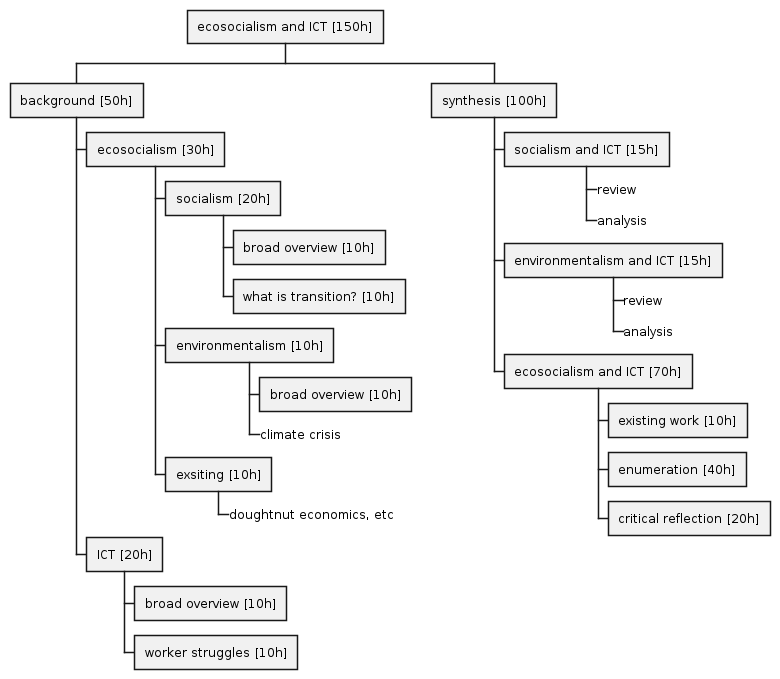
What is the role of information and communications technology (ICT) in supporting a transition to ecosocialism?
Both the climate crisis and global inequality are pressing concerns of our time (, ). Ecosocialism is a merging of socialist and environmental politics that strives for equity of resources and a fair standard of living for all, all while staying within planetary boundaries.
ICT underpins much of the infrastructure and operation of modern society. As a sector of industry, it has a significant environmental impact of its own; it also supports other industries; and it has an ever-increasing influence on how society communicates and is organised.
The way in which society uses ICT will undoubtedly play a role in how we transition to a more sustainable and equal world. For example, during the global protests of 2011 (the Arab Spring, Occupy, Movement of the Squares, etc) much was made of the use of social media to both agitate and organise ("Twitter revolutions", etc). These protests ultimately failed to change the dominant capitalist paradigm under which the majority of the world operates. What role could ICT play to transition to an ecosocialist future? How can ICT workers act to bring this transition about?
To give context and a point of reference, you can situate ecosocialism within a wider space of the sustainable development debate. Within this space are a number of different tendencies with varying levels of concerns regarding the environment and socio-economic wellbeing and equality. These trends fall in to different bands of ‘Status Quo’, ‘Reform’, and ‘Transition’. Those which are most eco-centred and most desiring of socio-economic well-being and equality, are [[ecofeminism]], [[ecosocialism]], [[social ecology]] and indigenous/’south’ movements. They all fall into the ‘Transformation’ band. [[[Sustainable development: mapping different approaches]]]
In terms of their ideas on:
[[Cybernetic Revolutionaries]]
[[Governable Stacks against Digital Colonialism]]
[[Capital is Dead]]
What do the existing eco-socialist tendencies say about technology and specifically [[information and communication technology]] ([[big tech]] etc)
The material impacts prong has more coverage at present. I want to focus more on the political/organisational impacts.
[[Technology and Ecosocialism]]
With regards to systems thinking. What are the points to intervene in a system with regards to a transition to eco-socialism - earth system, political systems, economic systems? Through the lens of technology, presumably.
[[The Stack as an Integrative Model of Global Capitalism]]
[[First and Third World Ecosocialisms]]

URL :
https://www.politybooks.com/bookdetail?book_slug=twenty-first-century-socialism—9781509536559
I am pro-Utopianism and prefiguration. That said, you still need a plan for [[revolutionary transition]].
Condescension towards utopianism is not only poetically impoverished but also a tactical mistake, because it limits the Left’s ability to implement a socialist programme upon taking power.
– [[Half-Earth Socialism]]
This means reviving the utopian socialist tradition that has for far too long been marginalized by the ‘scientific socialism’ of Marxism
– [[Half-Earth Socialism]]
What was a nuanced critique of utopian socialism in Marx’s hands became a bludgeon wielded by his epigones who scorned post-revolutionary proposals as frivolous ‘recipes for the cookshops of the future’.
– [[Half-Earth Socialism]]
By the twentieth century, the utopian socialist tradition was in retreat. [[George Orwell]] – every conservative’s favourite socialist – excoriated vegetarians and sandals to expunge the Left of effeminate ridiculousness
– [[Half-Earth Socialism]]
Critical Marxist theories of technology make use of dialectical analysis in order to avoid the determinism inherent in revisionist and Stalinist theories. In light of the rise of authoritarian capitalism (Fuchs 2018; 2019), socialism needs not only brilliant analyses of what is wrong in society, but also visions of 21st-century socialism that show how society can be transformed and what it can look like in the future in order to inspire contemporary class struggles. Perhaps contemporary socialist thought is sometimes too analytic. We need new inspirations from concrete-utopian socialism, from stories,
– [[The Utopian Internet, Computing, Communication, and Concrete Utopias]]
In the age of authoritarian capitalism, it is important that we dream about, imagine, talk about, envision, communicate, discuss, and struggle for concrete socialist utopias.
– [[The Utopian Internet, Computing, Communication, and Concrete Utopias]]
So what is utopian socialism? Good question. That’s kind of the point of the node club. But so what do I know so far?
Historically there is this kind of contrast between utopian socialism and scientific socialism and as far as I understand, Marx and Engels were proponents of what they called [[scientific socialism]], which is something more grounded in reality of the present day.
I think (although someone has said otherwise here recently to me, need to confirm) that they were against utopian socialism, or they had their critiques of it, at least.
Utopian socialism being more about thinking along the lines of the future. Of how would a future socialist society look. They have this famous phrase against producing [[recipes for the cookshops of the future]]. They didn’t want to do that. They just wanted to focus on the present day. That’s a very rudimentary understanding, and I’m sure it’s more nuanced than that.
Personally, I think we do need these recipes for the cook shops of the future. We need to prefigure the way that which we want the world to be and in order to do that, we kind of need to think about the way that we want the future to be.
(That’s an interesting question, actually, what’s the distinction between [[prefiguration]] and the ideas in utopian socialism?)
The other thing to add here is that I feel there’s quite a nice link between [[speculative fiction]] and science fiction and thinking about future societies. So there’s a nice link there between utopian socialism and speculative fiction, which obviously I’m a fan of.
A : video
Found at : https://www.youtube.com/watch?v=DjUr2HwdHwg
Made by : [[Our Changing Climate]]
[[Socialism]]. [[Ecosocialism]].
