πŸ“œ Contributions by @ at [[project]]
Agora nodes contain community contributions with titles or topics that match your search. x

Loading pushes...

πŸ“š Agora node [[a big weird art project]] (pulled by the Agora)
πŸ“œ File a big weird art project.md by @an_agora@twitter.com β˜† πŸ“Ž
πŸ“š Agora node [[agora project]] (pulled by the Agora)
πŸ“œ File agora project.md by @flancian β˜† πŸ“Ž οΈπŸ”— ✍️

agora projectΒ§

πŸ“œ File Agora project.md by @flancian β˜† πŸ“Ž οΈπŸ”— ✍️
πŸ“œ File Agora Project.md by @anagora.bsky.social β˜† πŸ“Ž
πŸ“š Agora node [[ai project]] (pulled by the Agora)
πŸ“œ File pages/ai project.md by @vera β˜† πŸ“Ž
πŸ“š Agora node [[allied media project]] (pulled by the Agora)
πŸ“œ File allied-media-project.md by @neil β˜† πŸ“Ž οΈπŸ”— ✍️

Allied Media ProjectΒ§

πŸ“š Agora node [[arcades project]] (pulled by the Agora)
πŸ“œ File arcades project.md by @flancian β˜† πŸ“Ž οΈπŸ”— ✍️

Arcades ProjectΒ§

πŸ“œ File arcades project.md by @agora@botsin.space β˜† πŸ“Ž
πŸ“œ File arcades project.md by @an_agora@twitter.com β˜† πŸ“Ž
πŸ“š Agora node [[civium project]] (pulled by the Agora)
πŸ“œ File Civium Project.md by @protopian β˜† πŸ“Ž

Project

Youtube vidoes: Economics Part 1: https://www.youtube.com/watch?v=XV-S87KroCk Economics Part 2: https://www.youtube.com/watch?v=MGNKjQ4nzns

1 - Intro?

  • Premise that cities are more important than civilizations. Heart of innovation. Bringing minds together
  • HUman systems like biological structures. Many have sublinear growth at scale, but cities are exception
    • scaling model comes from ___
  • Decouple cities so that people can live in more human-centric environments, while bringing minds together

7 - Network for cultures to coexist (meta-protocol between cultures)

Comment: So, the meta-protocol is reasonable? Every human mind/culture finds it reasonable and in that sense ideal, noble and at the bottom aesthetically pleasing. Meta-protocol is thus a logical structure or to put it simply, a kind of logic? Charles Peirce’s semiotics is a logical framework that I find to be apt for this task. It is a TRIADIC way of thinking contrary to dualistic and rivalrous way of thinking. Instead of exclusion it seeks to establish reasonable relations between phenomena that can be thought as SIGNS. It can be thought as a logical framework that shows RELATIONS (for example) between (1) possibilities, (2) actualities and (3) laws/habits/patterns. However, it leaves it to experience to fill the framework with content. We have to inquire what possibilities, actualities and patterns we really do experience, but we have now a framework where we know the logical relations between these things. For example: There are possibilities that never actualize or become patterns. But when something actualizes, it must have been possible. Actualization "requires" a possibility, an opening to happen. However, actualization can simply be a singular event without any reason, that is, without any pattern. But when we infer a pattern in our experience, it must necessarily contain actualities, that is, a pattern must have instances. So: Patterns involve actualities and possibilities Actualities involve possibilities, but are not necessarily part of a pattern Possibilities don’t have to be actualized or be part of a pattern, in order to have their being as possibilities. Another example with (1) feeling, (2) action and (3) thought: We may have only a feeling that is whole in itself. State of pure feeling. However, when we act, we act based on some feeling. When we think, our thought is a "mind-action" based on some feeling. So: Thought involves action and feeling. Action involves feelings, but not necessarily any thought. Feeling can be in itself without any action or thought. I think this framework would be really fruitful for this project. If you read all the way here, I have videos on my channel on Peirce’s worldview and semiotics.

Response: Check out Forrest Landry’s work (the Immanent Metaphysics).

9 - Economics part 1

  • imaginine different games

    • monopoly
  • return to not-denatured version of monopoly.

    • monopoly money devalued more; losing friends has real reprecussions
  • The key move is you have to deeply, deeply, deeply restore the value of friendship, the value of being in a real community, that is composed of these whole relationships. And you have to return money to monopoly. You have to devalue or remove the degree to which one believes that one can, and the degree that one actually can, trade monopoly money for a simulacrum of real relationship. Once you have done this and if you can truly protect the interiority of this friendgroup where you’ve created something that has a boundary around it and where being inside it gives you access to well-being, gives you access to a wholesome life. A life where your aspirations and values are both supported and well-met by other people. Not a simulacrum, but the real thing. And its a boundary around it whereby that can’t be extracted by those playing a win-lose game on outside, people who are optimizing for some subset of the whole some narrow metric, specifically money. If oyu can establish that kind of dynamic, you can do the thing we’re trying to do.

9 - Economics Part 2

  • membrane
    • separation between interior and exterior
    • 3 distinct modes
      • 1 - Unit of exchange
        • mode associated with the way the market works right now - has to do with some kind of token that is scarce in some fashion. allocation helps support the use of market forces. support effective allocation of resources, including attention
          • ubi - provides very soldi maslow’s base. people thoughftully deplying ubi should meet basic well-being just with that. everyhting else is upside
          • links first mode to second mode: on a monthly(/daily?) basis, a deposit from the thing that produces currency and it allocates 1 token (per minute)to people’s account. Cant do anything except move to wallet. There’s a agate. To move from account to wallet have to go through well-being survey. Assess well-being across large number of dimensions. Can then spend in the economy. Why is this key? - create a transformation between the fungible, narrow dimensional token (money) and actually connect that to a second mode of economy that is qualitative in nature. strict non-fungibility
        • last bit of first mode - medium of account
        • accounting system
          • Database that contains a bunch of information
          • Most complete supply chain management system
            • ability to track all the patterns available in the economy
            • historical flow of resources
            • current state

-2: store of value - serendipity engine - what twitter or facebook would be look if they were designed with human flourishing in mind - machine leraning system that takes the state of well-being of given individuals and uses that to suggest potential high-value encounters - civic obligation - engage in one encounter per ??. have some sort of conversation or encounter on the basis of an upgradient in well-being. Hope and intent is that the encounters becomes the heartbeat of the economy. - goal is for mode 2 to become the most important -3: innovation (replaces governance/?) - 3 components - proposal for a good new thing to happen in the world (ie fill a pothole to FTL travels - building out of proposal into a design-specification for what a good specification would look like and perhaps a pathway to move from one step to another - the way that we collectively put skin in the game in the way that we think are right and good designs. valubale proposals. looks like ubi of a token. have a ubi of a toekn that is only able to use to stake against a particular design specification - can stake at a high level or a more specific level - use interest and expertise to mark and put a stake - can proxy -two models - kickstarter vs expro? model - sometimes we encourage too much innovation. innovation without care - interaction between 2 and 3. connect people for a transaction for value and problem-solving. synergy value

  • goal of civium is to migrate us from economy of quantity to economy of quality

πŸ“š Agora node [[collective intelligence project]] (pulled by the Agora)
πŸ“œ File collective-intelligence-project.md by @neil β˜† πŸ“Ž οΈπŸ”— ✍️

Collective Intelligence ProjectΒ§

πŸ“š Agora node [[data transfer project]] (pulled by the Agora)
πŸ“œ File data-transfer-project.md by @neil β˜† πŸ“Ž οΈπŸ”— ✍️

Data Transfer ProjectΒ§

The Data Transfer Project is a good example of how companies pretend to believe in and work on [[interoperability]], without ever getting close to the promised outcome

– Redecentralize Digest β€” February 2022 β€” Redecentralize.org

πŸ“š Agora node [[detroit community technology project]] (pulled by the Agora)
πŸ“œ File detroit-community-technology-project.md by @neil β˜† πŸ“Ž οΈπŸ”— ✍️

Detroit Community Technology ProjectΒ§

πŸ“š Agora node [[duniter project]] (pulled by the Agora)
πŸ“œ File duniter-project.md by @vera.wiki.anagora.org β˜† πŸ“Ž

[[pull]] duniter

πŸ“š Agora node [[ever expanding project]] (pulled by the Agora)
πŸ“œ File ever expanding project.md by @vera β˜† πŸ“Ž

A project that doesn’t have a predetermined (or any) final state that lives indefinitely

πŸ“š Agora node [[future project]] (pulled by the Agora)
πŸ“œ File future project.md by @flancian β˜† πŸ“Ž οΈπŸ”— ✍️

future projectΒ§

  • What [[you]] could accomplish in the [[future]].
πŸ“š Agora node [[have a project]] (pulled by the Agora)
πŸ“œ File Have a Project.md by @rel8 β˜† πŸ“Ž οΈπŸ”— ✍️

Have a Rel8y Project?Β§

πŸ“š Agora node [[infinity project]] (pulled by the Agora)
πŸ“œ File infinity project.md by @flancian β˜† πŸ“Ž οΈπŸ”— ✍️

Infinity ProjectΒ§

  • [[go]] https://0oo.li/about/
    • "Homebase is a human-to-human mutual help system to manage global goals, ideas and projects, envisioning a spaceship for humanity with a set course to Infinity."
    • "A place for relax, fun, opinionated discussions and work. You can think of this place, like a living museum of human art of questioning, solving and executing — here you can find people’s quests, ideas and activities, where you can come to add a little piece by piece for others to see, marvel, reflect, and act upon."
  • [[by]] [[wefindx]]
πŸ“š Agora node [[mastodon project]] (pulled by the Agora)
πŸ“œ File Mastodon project.md by @agora@botsin.space β˜† πŸ“Ž
πŸ“œ File Mastodon project.md by @flancian@social.coop β˜† πŸ“Ž
  • [[2024-08-17 12:11:49+00:00]] @[[flancian@social.coop]] (link):
    • 2. Doesn’t show any kind of boosts/likes information on the timeline, making it hard for me to distinguish posts that were already found interesting/useful by others from posts that are generally uninteresting (allegedly like most of mine).

      This is done in the fuzzy name of DIGITAL WELLBEING, based on concerns I do not subscribe to, but is imposed on me because the [[Mastodon project]] refuses to give people a toggle to see more information in the timeline.

πŸ“š Agora node [[new project]] (pulled by the Agora)
πŸ“œ File 14 - CODossier/new project.md by @communecter β˜† πŸ“Ž

gestion de projet Open AtlasΒ§

  • create element projet on the client element and add Open Atlas as Porteur
  • fill Fiche projet coform ou Doc
  • add all team members
  • init chat and say hello project
  • init check project dates in oceco
  • call 2 validate requests
  • list and distriute all tasks and requests in oceco
  • for each task PDCA : PLAN DO CHECK ACT

OCECO PROCESSΒ§

  • set and validate project dates
  • add and assign all tasks and subtasks
πŸ“œ File en/12 - Projets/new project.md by @communecter β˜† πŸ“Ž

gestion de projet Open AtlasΒ§

  • create element projet on the client element and add Open Atlas as Porteur
  • fill Fiche projet coform ou Doc
  • add all team members
  • init chat and say hello project
  • init check project dates in oceco
  • call 2 validate requests
  • list and distriute all tasks and requests in oceco
  • for each task PDCA : PLAN DO CHECK ACT

OCECO PROCESSΒ§

  • set and validate project dates
  • add and assign all tasks and subtasks
πŸ“š Agora node [[notmyproject]] (pulled by the Agora)
πŸ“œ File NotMyProject.md by @agora@botsin.space β˜† πŸ“Ž
πŸ“š Agora node [[solidproject]] (pulled by the Agora)
πŸ“œ File SolidProject.md by @agora@botsin.space β˜† πŸ“Ž
πŸ“š Agora node [[spritelyproject]] (pulled by the Agora)
πŸ“œ File spritelyproject.md by @vera β˜† πŸ“Ž
πŸ“š Agora node [[the arcades project]] (pulled by the Agora)
πŸ“œ File the arcades project.md by @flancian β˜† πŸ“Ž οΈπŸ”— ✍️

The Arcades ProjectΒ§

πŸ“œ File the arcades project.md by @an_agora@twitter.com β˜† πŸ“Ž
πŸ“š Agora node [[the cheese project]] (pulled by the Agora)
πŸ“œ File the-cheese-project.md by @neil β˜† πŸ“Ž οΈπŸ”— ✍️

The CHEESE ProjectΒ§

Heard about at the [[Transition Together Summit]].

https://cheeseproject.co.uk/

They do low cost thermal imaging surveys of homes to see how they could be better insulated. [[Insulation]].

πŸ“š Agora node [[the communalist project]] (pulled by the Agora)
πŸ“œ File the-communalist-project.md by @neil β˜† πŸ“Ž οΈπŸ”— ✍️

The Communalist ProjectΒ§

Essay in [[The Next Revolution]].

In the opening essay, β€œThe Communalist Project,” Bookchin situates [[Communalism]] vis-Γ -vis other left ideologies, arguing that the world has changed significantly from the times that birthed [[anarchism]] and [[Marxism]]; he contends that these older ideologies are no longer capable of addressing the new and highly generalized problems posed by the modern world, from global warming to postindustrialization.

Outlines the ways in which capitalism is bad. Then outlines in which Marxism, anarchism, and revolutionary syndicalism are flawed.

I like much of what he’s saying about something in between the organisational tactics of anarchism and Marxism, with a decidely ecological focus. The municipal approach appeals to me too.

The way it’s presented in this essay though, I feel like it straw mans anarchism and communism pretty heavily. When Bookchin critiques them, he is critiquing a very particular subset of each of them, ideas that aren’t held that widely I’m sure. That said, he knows what he’s talking about on both, so I’m assuming it’s more nuanced than that, and backed up by other essays of his.

Many thinkers of the postmodern age have obtusely singled out science and technology as the principal threats to human well-being, yet few disciplines have imparted to humanity such a stupendous knowledge of the innermost secrets of matter and life, or provided our species better with the ability to alter every important feature of reality and to improve the well-being of human and nonhuman life forms.

πŸ“š Agora node [[the foundation stones project]] (pulled by the Agora)
πŸ“œ File The Foundation Stones Project.md by @protopian β˜† πŸ“Ž

https://www.context.org/foundation-stones/

At the heart of Context Institute’s work is a core curriculum for 21st century change agents – seven essential topic areas for understanding our world and ourselves – that we call the Foundation Stones:

  • What Time Is It? introduces us to the core challenges and opportunities we face in the 21st century, and invites us to make the journey from being part of the problem to being part of the solution, from the mindset of the Empire Era to the mindset of the Planetary Era.
  • Tools For The Journey equips us with the essential metaphors and concepts we need as we work on making the shift into a Planetary Era perspective.
  • How Connected Are We? addresses one of the core misconceptions of the Empire Era.
  • Living As A Whole Being explores the deep, personal, inner aspects of our nature and being.
  • Whole-system Economics weaves together threads from all of the previous four Stones to address how we might approach our practical, daily, outer existence in the Planetary Era.
  • Whole-system Governance addresses the practical means of collaboration that will be needed to allow Planetary Era cultures to thrive.
  • Street Smarts For Change Agents circles back to each one of us from these big-picture visions and addresses the question of β€œwhat can I do to make a real difference β€” to make history?”
πŸ“š Agora node [[the productivity project]] (pulled by the Agora)
πŸ“œ File book notes/The Productivity Project.md by @bbchase β˜† πŸ“Ž
  • Author:: [[Chris Bailey]]
  • Full Title:: The Productivity Project
  • Category:: [[books]]
  • Highlights first synced by [[readwise]] [[September 2nd, 2020]]Β§

    • visiting an art gallery
    • Whenever you’re in mind-wandering mode, again, make sure you capture what your brain comes up with, so that no great ideas slip through the cracks
    • even tactics like reading novels, which I thought required a lot of attention, often let me flip into daydreaming mode and capture new ideas
    • subgoals for larger projects, spending more time planning out projects to add structure to them, and keeping a running list of things you have to get done for each of your projects
    • Exercising or playing sports β€’ Reading β€’ Meditation β€’ Listening to music β€’ Investing in a creative hobby β€’ Praying β€’ Going for a nature walk β€’ Spending time with friends and family β€’ Going for a massage
    • one of the very first things I’ve done after waking up has been to define the three things I wanted to accomplish over the course of the day
    • When you clear attentional space to think, you give yourself more clarity and feel less pressure. Making small, incremental improvements, rewarding yourself, finding your resistance level, working mindfully, and cultivating your focus and energy levels are all ways of taking it easy on yourself and having fun as you invest in your productivity
    • I left my phone at home and wandered around
    • Recall three things you’re grateful for
    • Look at pictures of cute baby animals
    • recalling three things you’re grateful for
    • I break for at least fifteen minutes every hour
    • knitting, gardening, yoga, going for a long drive, walking somewhere without headphones, taking a candlelit bath, or visiting an art gallery
    • Reward yourself
    • Create an Accomplishments List
    • with only a pen and notepad
    • Time: I observed how intelligently I used my time, how much I got done throughout the day, how many words and pages I wrote/read, and how often I procrastinated. β€’ Attention: I noted what I focused on, how well I focused, and how easily I was distracted. β€’ Energy: I scrutinized how much drive, motivation, and overall energy I had, tracking how my energy levels fluctuated over the course of an experiment
    • Intention and deliberateness are two sides of the same coin, and I think both are essential if you want to live more productively
    • Disconnect from productivity more often

As a general rule, you should be taking more breaks than you are nowβ€”that includes breaks throughout the day, and breaks from work in general - Ask yourself for advice - Break tasks down - play the violin until the answer he was searching for seemingly struck him from out of the blue - I went on nature walks at lunchtime - meditation and exercise - video games provide you with a rapid succession of milestones, goals, and rewards, whereas most jobs are far more ambiguous and unstructured - going for a nature walk - journaling one positive experience - One study found that the ideal break length for productivity is seventeen minutes for every fifty-two minutes you work, and while I don’t buy that number completelyβ€”everyone is programmed differentlyβ€”I buy the idea behind it. You should take breaks a lot more frequently than you do now - Journal about a positive experience you had - productivity is made up of three things: time, attention, and energy - Did I get done what I intended to - Know You Can Grow - The reason I found it easier to work smarter during this experiment wasn’t because of the meditation practice itself. It was simply because I had so little time to get work done that week. During the experiment, I continued to write articles and read as much as possible. But since I had so little time to do it in, I frequently had to step back from my work to reflect on whether the writing I was doing was important and worth doing. With so little time, it was my only option - Note: Set time constraints on your work to help focus on doing the important parts. - nothing worked quite as well as simply sitting in a room with a pen and a sheet of paper - I had essentially reverted to a factory mindset and equated productivity with efficiency, instead of looking at how much I accomplished

πŸ“š Agora node [[the restart project]] (pulled by the Agora)
πŸ“œ File the restart project.md by @flancian β˜† πŸ“Ž οΈπŸ”— ✍️

the restart projectΒ§

πŸ“œ File the-restart-project.md by @neil β˜† πŸ“Ž οΈπŸ”— ✍️

The Restart ProjectΒ§

Good eggs. Where I work.

πŸ“š Agora node [[thinking tools map project]] (pulled by the Agora)
πŸ“œ File thinking tools map project.md by @flancian β˜† πŸ“Ž οΈπŸ”— ✍️
πŸ“š Agora node [[thousand brains project]] (pulled by the Agora)
πŸ“œ File wiki/Science/brain/Thousand Brains Project.md by @jaysen β˜† πŸ“Ž οΈπŸ”—

see also:

Reverse engineering the neocortex to revolutionize AIΒ§

The efforts of Jeff Hawkins and Numenta to understand how the brain works started over 30 years ago and culminated in the publication of the Thousand Brains Theory of Intelligence. Since then, we’ve been thinking about how to apply our insights about the neocortex to artificial intelligence.

In 2024, we started significantly expanding our internal research efforts and began calling for researchers around the world to follow and join this exciting project.

In 2025 we became a non-profit dedicated to this mission.

Our Two-Year Report - See what the Thousand Brains Project community has accomplished over the past two years.

Key principlesΒ§

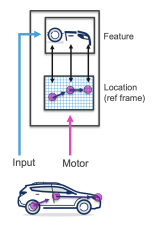
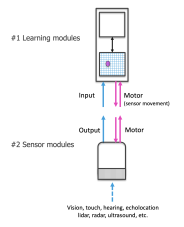
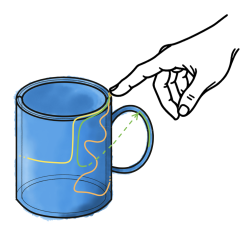
We have identified several core neocortical principles that are guiding our software architecture design. These principles are fundamentally different from those used by current AI systems.
policies

Sensorimotor Learning

reference_frames

Reference Frames

sm_and_lm

Modularity

Jump into the docsΒ§

Learn more about the project by exploring our documentation, where you’ll find details on our principles, an overview of how the code works, and guidance on contributing to the roadmap.

Our comprehensive documentation provides an in-depth understanding of the Thousand Brains Project, including its vision, architecture, and implementation details.

Watch our videosΒ§

β₯… [[https://www.youtube.com/watch?v=a04Zvpzzbqg]]

Help shape the future of AIΒ§

Join the TBP community and make an impact! Contribute your skills through coding, documentation, tutorials, or testing, share your creations, and engage with others to shape the future of AI inspired by the neocortex.

Together, we can explore new ideas, solve complex challenges, and build the future of AI and robotics.

πŸ“š Agora node [[underlay project]] (pulled by the Agora)
πŸ“œ File underlay project.md by @flancian β˜† πŸ“Ž οΈπŸ”— ✍️
πŸ“š Agora node [[unnamed culture project]] (pulled by the Agora)
πŸ“œ File unnamed culture project.md by @flancian β˜† πŸ“Ž οΈπŸ”— ✍️

Unnamed Culture ProjectΒ§

πŸ“œ File unnamed-culture-project.md by @flancian β˜† πŸ“Ž οΈπŸ”— ✍️
πŸ“š Agora node [[what is consciousness some new perspectives from our physics project]] (pulled by the Agora)
πŸ“œ File Readwise/Articles/What Is Consciousness Some New Perspectives from Our Physics Project.md by @protopian β˜† πŸ“Ž

What Is Consciousness? Some New Perspectives from Our Physics ProjectΒ§

rw-book-cover

MetadataΒ§

HighlightsΒ§

  • Consciousness is not about the general computation that brainsβ€”or, for that matter, many other thingsβ€”can do. It’s about the particular feature of our brains that causes us to have a coherent thread of experience.
  • But just as we’ve seen that the notion of intelligence can be generalized to the notion of arbitrary sophisticated computation, so now it seems that the notion of consciousness can be generalized to the notion of forming a coherent thread of representation for computations.
  • In a sense the story of science is a story of struggle between computational irreducibility and computational reducibility.
πŸ“š Agora node [[writing style for this project]] (pulled by the Agora)
πŸ“œ File Writing Style for This Project.md by @rel8 β˜† πŸ“Ž οΈπŸ”— ✍️

Writing Style for This ProjectΒ§

Strive for pithiness.