📚 Node [[foam]] ☆
📜 stoa-test/foam.md (contribution by @agora) ☆ 📎
📜 docs/foam.png (contribution by @agora) ☆ 📎
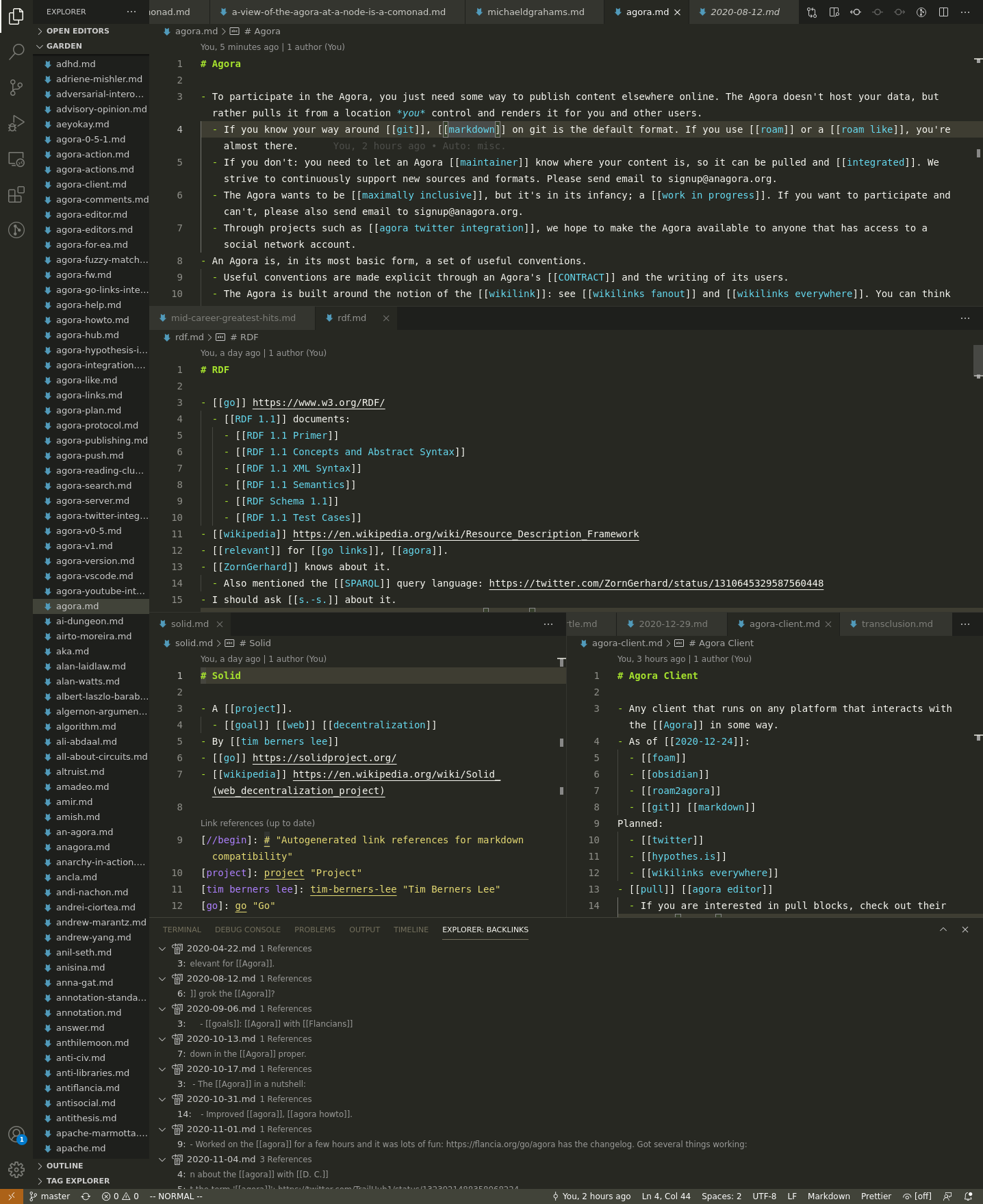
📜 foam.md (contribution by @flancian) ☆ 📎 ️🔗 ✍️
Foam
-
A [[project]].
- [[roam like]]. A [[vscode]] extension.
-
[[go]] https://foambubble.github.io/foam/
- By [[jevakallio]], [[riccardo ferretti]].
- Notable contributors / people I’ve met in the [[discord]]: [[ingalless]] [[scottjoe]] [[riccardo]] [[mathieudutour]].
-
As of [[2021-01-04]], my personal [[agora client]].
- See [[foam settings]], which describes my setup.
- Update [[2021-05-07]]: left for [[obsidian]].
-
To use foam:
- Fork its template repository: https://github.com/foambubble/foam-template/. You can use any name you desire for your repository.
- Install [[vscode]] if necessary: https://code.visualstudio.com/download. Launch it.
-
Select ‘clone repository’ — if you’re using [[github]], log in with [[github]]. Authorize [[vscode]] to make changes to your account. It sometimes requires you to retry once for some reason.
- [[vscode]] should offer to install recommended extensions. Say yes.
-
You can now use [[foam]]:
- Press alt-d to start a new daily note (your journal).
- Write [[wikilinks]] to link to other pages.
- Control-click them to visit existing linked notes or create them if needed.
- ctrl-p to open an existing note.
- ctrl-shift-p to bring up the [[vscode]] command palete; you can search for any command and see keyboard shortcuts.
- Whenever you want to commit to your repository (and the Agora), save all files and use the "branch-like" icon on the left toolbar to review changes and write a commit message.
-
You may need to set a user.name and user.email in git. To do this, open the terminal in [[vscode]] and type:
- git config —global user.name "Your Name"
- git config —global user.email "yourname@example.com"
📜 src/garden/foam.md (contribution by @ajhalili2006) ☆ 📎 ️🔗 ✍️
Foam
- golink pointer for
go/foam: https://foambubble.github.io/foam/ - In the Agora of Flanica: https://anagora.org/foam
Getting Started
- Use this repo template or fork it from upstream in GitHub. Alternatively, you can import it as fresh repo if you like.
- Install VS Code or use its web version (hint: press
.or replacegithub.comwithgithub.devin address bar). - Once the repo is cloned into your machined or the VS Code for Web is loaded, allow to install recommended extensions.
- You’re ready to use Foam.
📜 foam.md (contribution by @ankostis) ☆ 📎
Foam
- [[go]]https://github.com/foambubble/foam/
- sub-module for private garden.
CANNOT BE DONE, gh-jekyll complains "The submodule registered for
./Wallscould not be cloned. Make sure it’s using https:// and that it’s a public repo. See https://docs.github.com/en/github/working-with-github-pages/troubleshooting-jekyll-build-errors-for-github-pages-sites#invalid-submodule" <button class="pull-url autopull" value="https://docs.github.com/en/github/working-with-github-pages/troubleshooting-jekyll-build-errors-for-github-pages-sites#invalid-submodule"](https://mail.google.com/mail/u/0/#inbox/FMfcgxwLsmclCJcnvjwfLBGQCrWCPvjz)">pull. - retrofit
foamto run with [[restructured-text]] (not just Markdown), see foambubble/foam#474.
📜 _notes/foam.md (contribution by @bmann) ☆ 📎
Foam is a personal knowledge management and sharing system inspired by [[Roam Research]], built on [[Visual Studio Code]] and [[GitHub]].
You can use Foam for organising your research, keeping re-discoverable notes, writing long-form content and, optionally, publishing it to the web.
Foam is free, open source, and extremely extensible to suit your personal workflow. You own the information you create with Foam, and you’re free to share it, and collaborate on it with anyone you want.
website: https://foambubble.github.io/foam/ git: https://github.com/foambubble/foam
📜 posts/foam.md (contribution by @flancia.org) ☆ 📎 ✍️ 🤗
Several people have asked me what I think is the best available open source alternative to Roam currently. I’ve procrastinated writing about this long enough; here go some relatively raw thoughts in lieu of a proper answer. I’ll try to keep this updated.
Foam
As of the time of writing I believe the best Roam-like is Foam (https://flancia.org/go/foam)
📜 foam.md (contribution by @patterning) ☆ 📎
📜 foam.md (contribution by @anonymous@doc.anagora.org) ☆ 📎 ✍️
📜 foam.md (contribution by @agora@botsin.space) ☆ 📎
- [[flancian]] https://social.coop/@flancian/107372497885860586
- [[flancian]] https://social.coop/@flancian/107542368400916389
- [[flancian]] https://social.coop/@flancian/107593658116939685
- [[flancian]] https://social.coop/@flancian/107634340850150109
- [[flancian]] https://social.coop/@flancian/107684217192571314
- [[flancian]] https://social.coop/@flancian/107684407018760131
- [[flancian]] https://social.coop/@flancian/108369075968512603
📜 foam.md (contribution by @an_agora@twitter.com) ☆ 📎
- [[flancian]] https://twitter.com/flancian/status/1466074110581215242
- [[flancian]] https://twitter.com/flancian/status/1471599797824102405
- [[flancian]] https://twitter.com/flancian/status/1472508833306185730
- [[flancian]] https://twitter.com/flancian/status/1473406435480514564
- [[flancian]] https://twitter.com/flancian/status/1476945859837575168
- [[flancian]] https://twitter.com/flancian/status/1480227961630507009
- [[flancian]] https://twitter.com/flancian/status/1481928898858434560
- [[flancian]] https://twitter.com/flancian/status/1483846312189702150
- [[flancian]] https://twitter.com/flancian/status/1485940498913185792
- [[flancian]] https://twitter.com/flancian/status/1486024087608737794
- [[flancian]] https://twitter.com/flancian/status/1490716189282078720
- [[flancian]] https://twitter.com/flancian/status/1421553575596068866
- [[flancian]] https://twitter.com/flancian/status/1421510633720328198
- [[flancian]] https://twitter.com/flancian/status/1529855422865317888
- [[flancian]] https://twitter.com/flancian/status/1532042912816586752

Loading pushes...
✨ AI Synthesis Mistral Gemini ChatGPT Claude
Expanding this section will automatically generate an AI synthesis of the contributions in this node.