📚 Agora node [[digital garden]] ☆
Agora nodes contain community contributions with titles or topics that match your search. x
📜 File digital-garden.md by @agora ☆ 📎 ⛶

Digital Garden§

A digital garden is a personal website or knowledge base that grows slowly over time. Unlike a blog, which is chronologically sorted and "finished", a garden is:

  • Evergreen: Content is constantly updated and refined.
  • Interconnected: Notes are linked together heavily (using [[wikilinks]]), creating a web of thought rather than a stream.
  • Personal: It reflects the gardener’s unique way of thinking and organizing the world.
  • Imperfect: It welcomes rough notes, drafts, and "seeds" of ideas.

Why keep a garden?§

  • To learn in public: Share your notes as you learn, helping others and getting feedback.
  • To think better: Writing connects ideas.
  • To own your data: A garden is usually a set of simple text files you control, not locked in a platform.

In the Agora§

In this [[Agora]], digital gardens are the primary source of knowledge.

  • Each [[node]] (like this one) is a topic or Agora location.
  • Each [[subnode]] is a post from a specific user’s garden about that topic.

When you [[join]] the Agora, your garden becomes part of this shared knowledge commons.

References§

📜 File stoa-test-2/digital-garden.md by @agora ☆ 📎 ⛶

Rationality Stuff This is

h1§

index content,(^§

📜 File stoa-test/digital-garden.md by @agora ☆ 📎 ⛶

Rationality Stuff This is

h1§

index content,(^§

📜 File digital garden.md by @flancian ☆ 📎 ️🔗 ✍️ ⛶
📜 File pages/digital garden.md by @vera ☆ 📎 ⛶
  • Seeds. Seed your garden with quality content and cultivate your curiosity. Plant seeds in your mind garden by taking smart personal notes (taking raw notes is useless). These don’t need to be written in a publishable form.

  • Trees. Grow your knowledge by forming new branches and connecting the dots. Write short structured notes articulating specific ideas and publish them in your digital garden. One note in your digital garden = one idea. (what you’re currently reading is such a note) Do not keep orphan notes. Thread your thoughts.

  • Fruits. Produce new work. These are more substantial—essays, videos, maybe a book at some point. The kind of work researchers and creatives may hope will help them live beyond their expiration date.

    [[Maggie Appleton Garden]]

📜 File digital-garden.md by @neil ☆ 📎 ️🔗 ✍️ ⛶

Digital garden§

Recently-ish popular term for a kind of public personal PKM / wiki. [[A Brief History & Ethos of the Digital Garden]] is a great read to learn more about digital gardens.

Also see [[the Garden]] metaphor for some history.

What§

an online space at the intersection of a notebook and a blog, where digital gardeners share seeds of thoughts to be cultivated in public.

– How to set up your own digital garden - Ness Labs

  • a concept that describes the practice of maintaining and growing a collection of digital content, such as notes, ideas, and thoughts, in an organic and unstructured way.
  • often used as a creative tool for exploring, sharing, and developing ideas, and can be viewed as a more flexible and fluid alternative to traditional personal blogs or portfolios.
  • a way to document learning and growth over time, and a way to share thoughts and experiences with others.

You mean a wiki, right?§

I think "wiki" is a term that focuses on a particular tool, whereas "digital garden" is a more user-intention high level phrase

– https://chat.indieweb.org/dev/2021-11-26#t1637964070215800

You mean blogging, right?§

Sounds a bit like blogging, no?

I prefer to think of digital gardening as a new variation of blogging. Blogging that is:

  • Constantly evolving
  • Less performative
  • Community-focused

– 🪴 Planting Your Digital Garden

Contrary to a blog, where articles and essays have a publication date and start decaying as soon as they are published, a digital garden is evergreen: digital gardeners keep on editing and refining their notes.

– How to set up your own digital garden - Ness Labs

You mean personal websites, right?§

I tend to think of it more as that intersection of notebook/blog/wiki, but it is sometimes also framed as ‘old school [[personal website]]‘.

A growing movement of people are tooling with back-end code to create sites that are more collage-like and artsy, in the vein of Myspace and Tumblr—less predictable and formatted than Facebook and Twitter.

– Digital gardens let you cultivate your own little bit of the internet

Digital gardens explore a wide variety of topics and are frequently adjusted and changed to show growth and learning, particularly among people with niche interests. – Digital gardens let you cultivate your own little bit of the internet

Why§

“With [[blogging]], you’re talking to a large audience,” he says. “With digital gardening, you’re talking to yourself. You focus on what you want to cultivate over time.”

– Digital gardens let you cultivate your own little bit of the internet

Through them, people are creating an internet that is less about connections and feedback, and more about quiet spaces they can call their own.

– Digital gardens let you cultivate your own little bit of the internet

“Gardens … lie between farmland and wilderness,” he wrote. “The garden is farmland that delights the senses, designed for delight rather than commodity.”

– Digital gardens let you cultivate your own little bit of the internet

Why not§

Should you really publish your half-baked notes-to-self to the Internet?

To me that is unthinkable: my notes are an extension of my thinking and a personal tool. They are part of my inner space. Publishing is a very different thing, meant for a different audience (you, not me), more product than internal process. At most I can imagine having separate public versions of internal notes, but really anything I publish in a public digital garden is an output of my internal digital garden.

– 100 Days in Obsidian Pt 6: Final Observations – Interdependent Thoughts

To be honest, I don’t see much appeal in publishing your entire unfiltered notes to the web. Synthesize interesting portions of them occasionally into coherent blog posts that other people can consume without digging through a forest of links, backlinks, and footnotes.

– hpfr

You’re probably already doing it§

Believe it or not, you’ve probably already started planting the seeds of your digital garden. You don’t necessarily need an organized wiki on your self-hosted personal site. Posting on social media is still the most common form of digital gardening.

– 🪴 Planting Your Digital Garden

Agree with that wholeheartedly. Although the [[indiewebber]] in me says that if you’re doing it on a big social media platform, it won’t work out in the long run.

Misc§

  • The garden is more about the [[use-value]] of information, the stream more about [[exchange-value]] of information.

Twin Pages§

📜 File pages/digital-garden.md by @j0lms ☆ 📎 ⛶
📜 File digital_garden.myco by @melanocarpa ☆ 📎 ️🔗 ✍️ ⛶

Digital garden is a metaphor and a practice for a digital resource such as a website, usually managed (“grown”) by one person. Its content is usually placed not chronologically, but in a different way. Incompleteness of content units such as articles is pretty common. An unfinished article is a sapling, and the webmaster is a gardener.

A digital garden is a sort of a personal website.

See цифровой сад for more information in Russian.

Some gardens and personal wikis:

See the rest of personal sites, some of them being digital gardens, at Invalid interwiki: interwiki not set up .

Agora aggregates digital gardens.

What to keep? 2022-07-22

Maybe I should delete everything related to things I dislike from my digital garden? Make it a bouncespace with smiles and joy

@neauoire@merveilles.town

I don't think you should delete things that you once liked, and no longer do, I think you should just write that you're ideas about this thing changed instead.

Abyss

J3s has an interesting take:

to me, it feels wrong. i don't write for meticulous care & growth, i write because i'm desperate to (connect, understand, remember, leave something behind)

it reminds me that i'll die someday & i want people to remember who i was, and how i thought. i leave tracings of myself in this abyss, hoping that it'll help other people. it's fragments of me.

that's no garden. it's a mortal abyss. and i find a lot of meaning staring into it.

Heh nice the digital garden metaphor makes an appearance in Free, Fair and Alive

Cannot transclude hypha Flux Garden because it does not exist

📜 File digital-garden.md by @patterning ☆ 📎 ⛶

Rationality Stuff This is

h1§

index content,(^§

📜 File content/pages/digital garden.md by @wilde-at-heart ☆ 📎 ⛶

What is a digital garden?§

To quote Maggie Appleton’s "A Brief History & Ethos of the Digital Garden",

They’re not following the conventions of the "personal blog," as we’ve come to know it. Rather than presenting a set of polished articles, displayed in reverse chronological order, these sites act more like free form, work-in-progress wikis.

A garden is a collection of evolving ideas that aren’t strictly organised by their publication date. They’re inherently exploratory – notes are linked through contextual associations. They aren’t refined or complete - notes are published as half-finished thoughts that will grow and evolve over time. They’re less rigid, less performative, and less perfect than the personal websites we’re used to seeing.

A digital garden allows me to find connections between my thoughts and the things I’m interested in. I tend to my garden when I can. I can also see how my ideas grow over time. Because I make it public, you can witness all this. This is called [[learning in public]].

Stages of growth§

It is important to note that, during the growth process, all notes remain atomic.

  • 🌱 seedling notes aren’t quite the very start of an idea, but the note has enough in it that I can link it to other things and have it make sense to people who aren’t me (otherwise I wouldn’t make it public)

  • 🌿 budding notes are cleaned up and have gone through a bit of distillation; maybe I’ve linked more things to them

  • 🌳 evergreen notes are at a stage when I can move them into my 🗃 [Zettelkasten]({{< ref "Zettelkasten" >}}); they are mature enough to serve as building blocks for things I might write or otherwise express.


Digital garden terms of service§

Because a digital garden exposes my ideas to the world, it puts me in a vulnerable position. Therefore, I ask that you follow the Digital Garden Terms of Service, and I promise to do the same.

📜 File digital-garden.md by @anonymous@doc.anagora.org ☆ 📎 ✍️ ⛶

Rationality Stuff This is

h1§

index content,(^§

📜 File digital garden.md by @agora@botsin.space ☆ 📎 ⛶
📜 File digital garden.md by @an_agora@twitter.com ☆ 📎 ⛶
📜 File Digital Garden.md by @an_agora@twitter.com ☆ 📎 ⛶
📜 File digital garden.md by @anagora@matrix.org ☆ 📎 ⛶
📜 File Digital-Garden.md by @anagora@matrix.org ☆ 📎 ⛶
📜 File digital garden.md by @flancian@social.coop ☆ 📎 ⛶
  • [[2023-02-03 22:13:36+00:00]] @[[flancian@social.coop]] https://social.coop/@flancian/109803104954352492:
    • I’m running many hundreds of tabs overall at any time.

      My [[digital garden]], which holds many of my memories and mental contexts, has more than more than 6k nodes. About 1000 probably have some associated task.

      The [[Agora]], which maybe holds my collective brain, knows of 25k nodes and 125k links currently and might have a million by the end of 2023.

  • [[2024-09-28 17:33:57+00:00]] @[[flancian@social.coop]] (link):
    • @edumerco depende del wiki por ahora, pero la idea del ágora es exactamente que es una composición pro-social de wikis podría decirse :)

      un [[digital garden]] es lo más soportado por ahora, tipo mantenido con [[obsidian]] o [[org mode]]. un repositorio de git con markdown es la “lingua franca”

Loading pushes...

✨ AI Synthesis Mistral Gemini ChatGPT Claude x

Expanding this section will automatically generate an AI synthesis of the contributions in this node.

🌌 Agora context for [[digital garden]]

Rendering context...

📚 Agora node [[agora]] (pulled by user) x
📚 Agora node [[digital gardeners]] (pulled by user) x
📚 Agora node [[friends]] (pulled by user) x
📚 Agora node [[joel hooks]] (pulled by user) x
📚 Agora node [[maggie appleton]] (pulled by user) x
📚 Agora node [[a brief history & ethos of the digital garden]] (pulled by the Agora)
📜 File A Brief History & Ethos of the Digital Garden.md by @binnyva ☆ 📎

A Brief History & Ethos of the Digital Garden§

Source

They’re collections of evolving ideas that aren’t strictly organized by their publication date. They’re inherently exploratory – notes are linked through contextual associations. They aren’t refined or complete - notes are published as half-finished thoughts that will grow and evolve over time.

It’s a different way of thinking about our online behavior around information - one that accumulates personal knowledge over time in an explore-able space.

Features§

  1. Topography over Timelines: Organized by contextual relationships, bi-directional links.
  2. Continuous Growth: Continuously evolving work in progress.
  3. Learning in Public & Imperfection: Blogging is performative. Digital gardening is less performative than a blog, but more intentional and thoughtful than our Twitter feed. It wants to build personal knowledge over time. ![https://res.cloudinary.com/dg3gyk0gu/image/upload/c_scale,w_1600/v1593765637/maggieappleton.com/notes/garden-history/digital-garden.png]
  4. Playful, Personal, and Experimental: Even the tools are evolving and experimental.
  5. Inter-cropping & Content Diversity: All varieties of mediums grow in the garden - videos, podcasts, short notes, long essays, academic papers, sketches.
  6. Independent Ownership: No one can take your garden away. If you give it a bit of forethought – storing notes in flat markdown files – you can built it in a way that easily transfers as platforms and technologies inevitably change.

Original Source - Talk, Article


Tags§

#digital-garden #zettelkasten

📚 Agora node [[a brief history ethos of the digital garden]] (pulled by the Agora)
📜 File a-brief-history-ethos-of-the-digital-garden.md by @neil ☆ 📎 ️🔗 ✍️

A Brief History & Ethos of the Digital Garden§

URL : https://maggieappleton.com/garden-history

Author : [[Maggie Appleton]]

The Six Patterns of Gardening§

  1. Topography over timelines
  2. Continuous growth
  3. Imperfection & learning in public
  4. Playful, personal and experimental
  5. Intercropping & content diversity
  6. Independent ownership
📚 Agora node [[adding planted and last tended dates to pages in my digital garden]] (pulled by the Agora)
📜 File adding-planted-and-last-tended-dates-to-pages-in-my-digital-garden.md by @neil ☆ 📎 ️🔗 ✍️

Adding planted and last tended dates to pages in my digital garden§

Why§

It’s a nice practice to display the date that a page was created, and, more importantly, last modified, in your digital garden. It gives the reader a clue as to the status of the information contained in the page.

How§

I already have ‘This page last updated: …’ at the very bottom of every page.

But I’d prefer it right at the top. And I’d also like to indicate when the page was created, too. I don’t want it to be be too prominent/distracting, but at the same time I have some pretty old pages knocking around now and I’d like people to be aware that they might be outdated.

It’ll be a matter of (a) pulling the times out from somewhere; and (b) being able to render them.

Pulling times out§

I’m currently using the date value for modified time that you get when you use the :with-date flag in org-publish. But it doesn’t provide creation time.

I have ctimes and mtimes on all files(?), courtesy of the [[org-roam-timestamps]] package. So in theory I can use those. They are file-level properties name ctime and mtime. As far as I can tell, they don’t exist in the info plist that’s passed around during the export process.

So, for now, I’ve cobbled together a way to pull them out from the buffer using org-property-values.

(let* ((ctime-property (car (org-property-values "ctime")))
       (mtime-property (car (org-property-values "mtime")))
       (ctime-date (if ctime-property
                       (car (split-string ctime-property))
                     nil))
       (mtime-date (if mtime-property
                       (car (split-string mtime-property))
                     nil))
       )

Rendering them§

So the rendering is going to be in my override of org-html-template (of which I have a note to self saying that I shouldn’t really be overriding it…)

As a simple example:

(defun commonplace/format-date (date-str)
  (let ((year (substring date-str 0 4))
        (month (substring date-str 4 6))
        (day (substring date-str 6 8)))
    (format "%s/%s/%s" day month year)))

(defun commonplace/org-html-template (contents info)
  (let* ((ctime-property (car (org-property-values "ctime")))
         (mtime-property (car (org-property-values "mtime")))
         (ctime-date (if ctime-property
                         (car (split-string ctime-property))
                       nil))
         (mtime-date (if mtime-property
                         (car (split-string mtime-property))
                       nil))
         )
    (concat ""
            (if ctime-date (concat "ctime: " (commonplace/format-date ctime-date)))
            " "
            (if mtime-date (concat "mtime: " (commonplace/format-date mtime-date)))
            "")))

Check out my publish.el for the real function that I’m using.

📚 Agora node [[agora digital garden]] (pulled by the Agora)
📜 File agora-digital-garden.md by @patterning ☆ 📎

Open Mind

📜 File stoa-test-2/agora-digital-garden.md by @agora ☆ 📎

Open Mind

📜 File stoa-test/agora-digital-garden.md by @agora ☆ 📎

Open Mind

📜 File agora-digital-garden.md by @anonymous@doc.anagora.org ☆ 📎 ✍️

Open Mind

📚 Agora node [[digitalgarden]] (pulled by the Agora)
📜 File digitalGarden.md by @agora@botsin.space ☆ 📎
📜 File DigitalGarden.md by @agora@botsin.space ☆ 📎
📜 File DigitalGarden.md by @an_agora@twitter.com ☆ 📎
📚 Agora node [[neil s digital garden]] (pulled by the Agora)
📜 File neil-s-digital-garden.md by @patterning ☆ 📎
📜 File stoa-test-2/neil-s-digital-garden.md by @agora ☆ 📎
📜 File stoa-test/neil-s-digital-garden.md by @agora ☆ 📎
📜 File neil-s-digital-garden.md by @anonymous@doc.anagora.org ☆ 📎 ✍️
📚 Agora node [[neils digital garden]] (pulled by the Agora)
📜 File neils-digital-garden.md by @neil ☆ 📎 ️🔗 ✍️

Neil’s Digital Garden§

[[Hello]]§

Welcome! You have landed upon my [[hyper commonplace garden wiki]] AKA [[digital garden]].

It is someplace between a notebook and a blog and a wiki.

⥅ [[2020-03-19_23-27-44_iScape.png]]

You are most welcome here. It is something of a [[maze]] of technology, politics, nature and culture. I hope you find something that you like!

Start here§

As of Tuesday, November 3, 2026 , there are 7157 places to explore in my garden.

If you’d like to look around, here are some of the more well-tended pathways on which to get started:

You might also chance your luck in these more overgrown trails:

Please feel free to click around here and explore. Don’t expect too much in the way coherence or permanence… it is a lot of half-baked ideas, badly organised. The very purpose is for snippets to percolate and morph and evolve over time, and it’s possible (quite likely) that pages will move around.

That said, I make it public in the interest of info-sharing, and occassionally it is quite useful to have a public place to refer someone to an idea-in-progress of mine.

Here’s a graphical representation of the notes and connections in my garden. It doesn’t mean a whole lot, but it looks nice.

⥅ [[images/my-garden.png]]

Some more info on the [[whats and the whys]].

📚 Agora node [[options for publishing an org roam based digital garden]] (pulled by the Agora)
📜 File options-for-publishing-an-org-roam-based-digital-garden.md by @neil ☆ 📎 ️🔗 ✍️

options for publishing an org-roam-based digital garden§

My org-publish build ([[How I publish my wiki with org-publish]]) is so horrendously slow that I always have an eye out for alternatives. I like the idea of using something native to Emacs, but it’s just ridiculously slow to build my static site. It’s 6000 odd org files but it still shouldn’t be so slow.

Alternatively I’d dig in to how org-publish works and see if I can speed it up. I’ve tried that a little before though and didn’t get very far ([[Speeding up org-export and org-publish]]).

Investigations§

firn§

[[using firn for publishing my org-roam digital garden]].

Conclusion: doesn’t like id: links. Not gonna happen.

hugo§

[[using ox-hugo for publishing my org-roam digital garden]].

Conclusion: Seems to prefer one post per org subtree rather than per file. Not going any further with it for now. But others are using it successfully, so check in to it again in future.

weblorg§

Looks promising. Seen in the wild here:

emanote§

https://emanote.srid.ca/demo/orgmode

org-roam-ui§

Some discussion around letting you publish it for the web here: https://github.com/org-roam/org-roam-ui/discussions/109

Seems to have been achieved: https://ikoamu.github.io/publish-org-roam-ui/

Discussion§

📚 Agora node [[plantey's digital garden]] (pulled by the Agora)
📜 File Plantey's Digital Garden.md by @plantey ☆ 📎

—->This is a fuzzy, public note. I plan to clarify it next time I see it…

  • Learn more about this before writing on it…

This is my [Digital Garden].

Digital Garden§

In general, a digital garden is an online places that show your developing thoughts.

A blog is where people post finished, polished posts; a digital garden is more of a work-in-progress for writing.

If you search much online, you’ll find different kinds of gardens

A Garden with a Greenhouse§

I’m not a huge fan of publicly saying something about a topic before I’ve learned much about it, so I’m using Obsidian as an incubator for my ideas until I clarify them enough to share them.2

A lot of digital gardens have some really cool stuff, once you peruse through them. At the same time, it gets hard to find the cool and clear bits when a lot of it feels like blog posts that are clear and insightful…until you get halfway through and find that it (Or what feels like the first half of an article.) The whole process is out in the open.

Personally, I prefer to keep all my raw thinking in Obsidian so I can cultivate it before I set it out before the public eye to be interacted with by others. (I’ve found that ideas can get a bit shy or unhelpful when I don’t clarify them before I share them. They’ve got to grow up a bit first before they can dialogue with others well.)

In other words, my public digital garden is mostly made up of crops that have grown a bit, whereas my personal notes are more of a Greenhouse for ideas.

In my use3, this digital garden is an online place to hold my ideas in a way.

What my working goal for this… is is to distinguish between

  • asdf
    • but maybe show working titles and backlinks for users to click on to see how many would be interested in this or that a note (could help me structure my priorities)
      • I’d need a "this was…" thing above each, btw

A Garden for Ideas; A Garage for Projects§

To clarify: the projects I’m working on in public aren’t part of my garden. Instead, they’re different enough that I prefer to call them my [[Digital Garage]]1.

A good amount of current projects in the garage are indeed things that I want to use in order to build my garden up, but that might have to wait for now. I have a few invention ideas in a separate list, but seeing that those are ideas and not current things I’m aiming to make, I’ll wait until I have something more like an evergreen note in order to


metadata

1: Note: In my note-taking app, I use [[wikilinks]] (which are links between notes that have double brackets) to connect ideas together. A lot of capital These won’t be clickable on this site for now. (Though I do need to set that up…)

2: This happens on the level of individual ideas. I definitely don’t want to wait until I master a whole topic before writing on it, but this helps put a balance between sharing where I am in my understanding and developing it on my own.

3: Because I think my usage of this idea is different enough from the common use of it, I might name a new term. This is just my current analogy for now. Subject to change, of course. I just want to distinguish from the common use.

📚 Agora node [[plotting the growth of my digital garden]] (pulled by the Agora)
📜 File plotting-the-growth-of-my-digital-garden.md by @neil ☆ 📎 ️🔗 ✍️

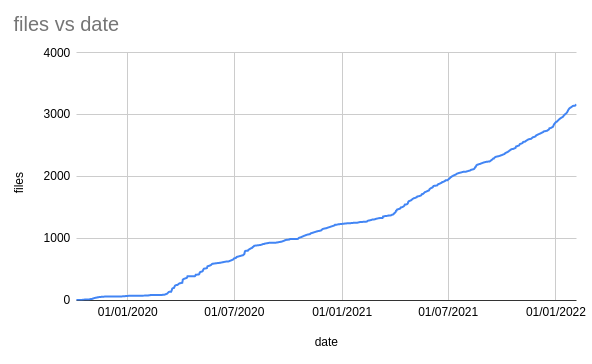
Plotting the growth of my digital garden§

⥅ [[2022-02-05_14-36-11_screenshot.png]]

March 2020 was when I started using org-roam.

This post has a handy script for pulling out a count of the files in your git repo over time: {Git} Graph file count vs time | Good Code Smell

#!/bin/bash

OUTPUT=stats.csv

# create output file with a CSV header
echo "date,files" > $OUTPUT

# function that counts files matching the specified regex
count() {
    git ls-tree -r --name-only $COMMIT | grep -e $1 | wc -l | sed 's/ //g'
}

# for each commit in log
git log --pretty="%H %cd" --date=short | while read COMMIT DATE
do
    # skip commits made on the same day
    [ "$PREV_DATE" == "$DATE" ] && continue
    PREV_DATE="$DATE"

    # count files
    FILES=$(count ".*\.org$")

    # print to console
    echo $DATE
    echo " $FILES	.org files"

    # append to CSV file
    echo "$DATE,$FILES" >> $OUTPUT 
done
📚 Agora node [[questions about my digital garden]] (pulled by the Agora)
📜 File questions-about-my-digital-garden.md by @neil ☆ 📎 ️🔗 ✍️

Questions about my digital garden§

1. What first inspired you to start your digital garden?§

I have been writing online in one form or another since I was a teenager. But, a few years ago, discovering software called [[org-roam]] led me to the present form of my digital garden.

Briefly, without wanting to bog us down in the tools themselves: org-roam is an extension to something called [[org-mode]], which is an extension to something called [[Emacs]], a long-standing free/open-source text editor. I had been using org-mode to record my notes locally for a while, but feeling a bit dissatisfied with it.

When I discovered org-roam, things really started to click for my note-taking. This is less so because of the tool, more so the patterns it encapsulates: freely writing and linking your notes together, helping you find them again, nurturing them to grow over time.

The development of org-roam itself was (I believe) inspired by [[Roam Research]] and [[Zettelkasten]], both of which had a bit of a moment in the sun a few years back.

Ultimately, though, the inspiration for keeping my digital garden is simply being interested in things, and wanted to both keep track of what I learn and encourage me to share it with others. And partly a desire to avoid the [[illusion of knowing]] - rather than just reading a lot of things and forgetting about them, encouraging myself to engage more closely and actively.

2. When did you first start your garden (online or in private)?§

In its current org-roam based incarnation, since March 2020.

However… if you start to get into the weeds (sorry for the pun) of what a digital garden is, in some ways I’ve been doing it for longer.

As mentioned, I have been posting online in one form or another for a long time. First in a few of those journal platforms that were around back then. Then blogging on my own site for a while. A brief, unfortunate detour into web 2.0 social media platforms. Then, about 10 years ago, playing around with static site generators rekindled my interest in hosting and posting on my own website. Not long after that, I discovered the [[IndieWeb]] community, and with that I really doubled down on doing things via my own website, not somebody else’s platform. That expanded into posting my notes to my own site, too, not just streaming/microblogging, which then became my digital garden.

3. How would you describe your digital garden to someone unfamiliar with the concept?§

It’s a place to inspire me to write, to learn and to create. It’s also a way to share those ideas without worrying about them needing to be polished or perfect. It’s a space of your own on the web, not subject to the algorithms and desires of a big tech company. It’s a mess, it’s a maze, it’s weird, it’s wonderful.

4. How do you decide what content to include or how to organize it?§

There’s not really a solid decision process behind this, but it goes something like this:

I have two gardens - one public and one private. (Bill Seitz refers to these as your inner and outer gardens (http://webseitz.fluxent.com/wiki/TendingYourInnerAndOuterDigitalGardens)) Anything related to my private life goes in my inner garden and will never be shared. Everything else I put in my ‘outer’ garden, which I publish online.

The content of my public garden is just a sprawling mass of, essentially, Things That I Am Interested In (Or Have Been At Some Point). I tend not to explicitly filter or organise this - for me the digital garden is a place of expression and exploration that grows organically. There is a little bit of structure in that I tend to write firstly in ‘journal’ pages, which is more the stream of thoughts, and anything I’d like to crystallize a bit further I will push through into one of the other pages in the garden on that topic.

I occassionally tend my garden, remove the odd weed, but not that often. While I always encourage people to have a wander around, it’s more of a wildflower meadow than a show garden.

5. How does it reflect your personal philosophy or approach to learning and creativity?§

My digital garden reflects my personal philosophy and approach to learning and creativity very closely. I believe that the learning process should allow you to explore freely and make mistakes - a digital garden fosters this by removing the expectation that what I write should be perfect, or complete, before it is ever shared. I also use it as a space for both divergent thinking, a grab bag of many threads of ideas, and convergent thinking, where I can narrow those ideas down into something cohesive. Some people say that it’s important to be a creator, not just a collector, but I have no issue if it sometimes just a space to collect snippets of knowlege - bookmarks, ideas and quotes from other people.

6. Has the process of maintaining your digital garden changed how you think about knowledge, organization, or growth?§

Yes. It has pushed me to appreciate knowledge more as a shared, evolving thing, rather than something you perfect in private before releasing to the world. It has also made me double down on an appreciation of subjective, rather than objective knowledge. On any given topic I am more interested in what someone in my trusted network has written about it before I go to Wikipedia for the ‘objective’ view on it.

Digital gardens certainly raise questions about organisation - is it better organise horizontally or vertically? A lot of discussions around digital gardens emphasise more of an unstructured, organic, horizontal, rhizomatic approach to organisation, which I fully enjoy as a personal learning approach, but I don’t wish to do this to the exclusion of vertical and narrative structure, threading thoughts together, which is occassionally vital as a way of communicating your ideas to others.

With regards to growth, I occassionally check in on how many pages of notes I have, which is fun but ultimately meaningless. Better to keep track of how many meaningful notes you have ([[Andy Matuschak]] calls these [[Evergreen notes]]; [[Ton]] uses the terms [[notion]]s). Andy says that the number of Evergreen notes written per day is the best indicator of your success as a knowledge worker. I disagree - to me, steady output of units of knowledge isn’t the end goal of my digital garden. Learning and sharing is. I [[prefer knowledge commoning over knowledge work]]. The goal is

7. Do you see your digital garden as more of a personal space, or does it also act as a tool for community and connection?§

While my digital garden is primarily a personal space, scratching my own itches, I keep it open and public in the hopes of connecting to like-minded others, and I fully intend for it to be part of a larger knowledge commons. I like the idea of the [[Nested-I]] - individual identities (gardens) joining together to build a greater collective.

The simple act of publishing it online, and asking people to contact me via email if they find something interesting, has itself brought about lots of interesting connections (this one included!).

There are other ways of connecting gardens together, such as [[sister sites]] and [[twin pages]]. Everything that I add to my digital garden I also cross-post to Anagora (https://anagora.org), which is a community that is building a shared prosocial knowledge commons.

8. Do you see digital gardens as evolving archives or more as real-time, personal thinking spaces?§

Both! The line is blurry but I tend to use my garden as both garden and stream ([[The Garden and the Stream: A Technopastoral]]). My journal pages are my real-time, personal thinking space, the notes from which tends to coalesce into more considered pages and thoughts, an evolving archive.
📚 Agora node [[receiving webmentions on my digital garden]] (pulled by the Agora)
📜 File receiving-webmentions-on-my-digital-garden.md by @neil ☆ 📎 ️🔗 ✍️

Receiving webmentions on my digital garden§

Would be fun to be able to receive comments/annotations to my digital garden via webmentions.

As it is a static site, I’ll do it with webmentions.io and webmentions.js

webmention.io§

OK, so webmentions.io uses web log-in.

Alrighty, I’ll do that via relme auth.

First I’ll need to add some rel=me links.

Ha, sweet, I didn’t realise rel me login can work via email address!

That’s so cool. OK, so I added

<link rel="me" href="mailto:my@email.foo" />

to my head section for commonplace.doubleloop.net

and then signed in at webmention.io.

Now I can add

<link rel="webmention" href="https://webmention.io/commonplace.doubleloop.net/webmention" /> <link rel="pingback" href="https://webmention.io/commonplace.doubleloop.net/xmlrpc" />

to my head section.

ok, let’s give it a spin!

sending a webmention§

i can send webmentions from my existing indieweb blog at doubleloop.net

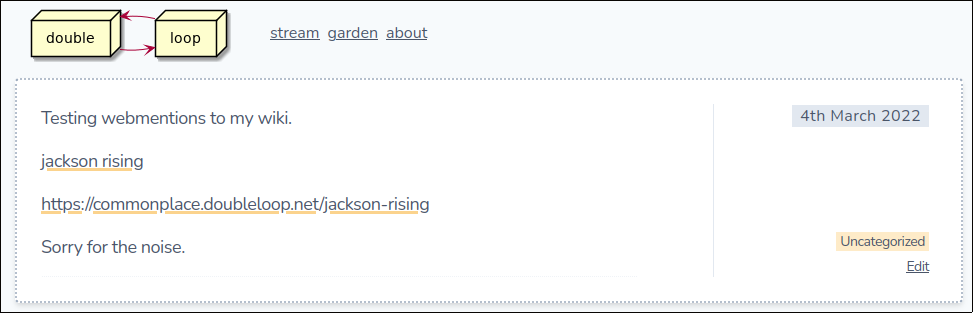
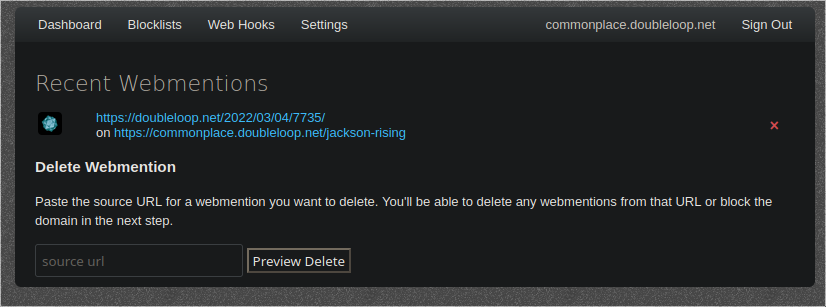
I sent one:

⥅ [[sending_a_webmention/2022-03-04_18-10-09_screenshot.png]]

and it arrived!

⥅ [[sending_a_webmention/2022-03-04_18-09-34_screenshot.png]]

It doesn’t work with my wikilink rewriting stuff. So I need to use the full URL (or fix the rewriting stuff) if I want to mention from my own site. Which wasn’t really the point, but actually could be interesting…

displaying webmentions§

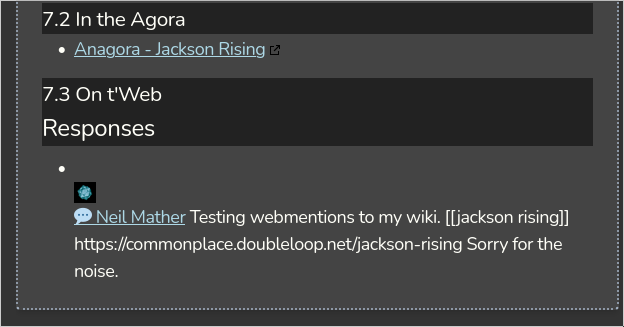
ok so now i’ll try displaying received webmentions with webmentions.js

I followed the instructions at https://github.com/PlaidWeb/webmention.js

  • include script
  • add a div for webmentions
  • pop a teeny bit of styling in

⥅ [[displaying_webmentions/2022-03-04_18-20-27_screenshot.png]]

And it works!

That took about 40 minutes in total, super cool.

Needs some styling and tweaking and adding to all pages now. But that’s pretty epic.

Some thoughts:

  • how do I moderate mentions
  • I wonder if you can self host webmention.io
📚 Agora node [[recent activity in neils digital garden]] (pulled by the Agora)
📜 File recent-activity-in-neils-digital-garden.md by @neil ☆ 📎 ️🔗 ✍️

Recent activity in Neil’s Digital Garden§

Recent Changes§

Chartism§

Digital colonialism§

Digital Degrowth: Technology in the Age of Survival§

economic sanctions§

The US uses economic sanctions to exert power over other countries§

The Dispossessed§

My blog posts§

IndieWeb Carnival June 2026: Big, left and right§

Free, Fair and Alive§

Emacs Carnival: Useful built-ins: The describe family of commands§

Amazon doesn’t care how you heat swimming pools: ICT and ecosocialism§

A review of The Dispossessed§

Degrowth§

We cannot keep growing the global economy without overshooting planetary boundaries§

colonialism§

The United States is the frontrunner of digital colonialism by a long distance§

Digital colonialism is enacted by companies but enabled by states§

Big Tech companies are the primary vector for enacting digital colonialism§

Digital colonialism is the use of digital technology for domination of another sovereign country or people§

Digital self-governance is a necessary part of countering digital colonialism§

Digital colonialism is a form of neocolonialism§

Tracks that I have liked at some point in my life, in no particular order§

Jammed§

Aspen - Rejection Letter§

future socialist society§

collaborative zettelkasten§

Use Convivial Tools§

The Hitchhiker’s Guide to the Galaxy§

Total Perspective Vortex§

Cumbria Wildlife Trust§

flower-rich area§

Summer§

solstice§

Summer solstice§

Climate camps§

Filton 4§

Palestine Action§

Criminal damage§

Terrorist sentence for Palestine Action activist marks ‘dangerous’ move against right to protest§

Criminal damage is not terrorism§

Neil’s Digital Garden§

Climate Leviathan with Joel Wainwright and Geoff Mann§

Climate Leviathan with Geoff Mann§

Climate Leninism and Revolutionary Transition§

Terrorism§

Terrorism is the deliberately indiscriminate killing of innocent civilians for the purpose of instilling terror§

There are various definitions of terrorism§

How Belfast knife attack became the latest far-right ‘trigger event’§

📚 Agora node [[reply to email questions about my digital garden]] (pulled by the Agora)
📜 File reply-to-email-questions-about-my-digital-garden.md by @neil ☆ 📎 ️🔗 ✍️

Reply to email questions about my digital garden§

Do you store your notes (second brain or otherwise) in one place, or across many apps/services/plain text files/napkin sketches/etc?§

I have a both a public, outer garden, and a private, inner garden. See Bill Seitz’s page on this for more info: http://webseitz.fluxent.com/wiki/TendingYourInnerAndOuterDigitalGardenspublic

I use org-mode, org-roam and Emacs for all of my writing. My private garden is where I do all my planning and todo management, too, with org-mode.

I also currently do freeform journalling occassionally in a paper notebook with pen. I’d like it to be a daily habit, but not there yet. I’ve been contemplating for about a year now getting one of the e-ink tablets for this, but haven’t yet. Haven’t been able to justify the price/purchase of a new device just yet.

As well as to my own website at https://commonplace.doubleloop.net, I also publish my garden to https://anagora.org , a collective space that combines multiple gardens together.

How often do you look up info in your notes, and how do you find what you’re looking for?§

Interesting question! I don’t have any stats, but anecdotally I would say that it is fairly infrequent. Let’s say the order of magnitude is weekly rather than daily. It’s most often when I want to share a link publicly as part of a social media discussion I’m having, and I want to point to some previous thinking on it. I always find what I’m looking for. org-roam has good title search and org-mode quick full text search of all notes. So it may take more or less time depending on how hazy my memory is of it, but it’s rare that I can’t find something that I know is there.

There’s probably things that I don’t remember are even in there though, which is another story.

If you need to look something up while you’re working outside of your notes, how difficult is it for you to get back into a flow state?§

Not too hard. Just by its nature social media can be a distraction if I need to look something up there. But I’m generally good at avoiding rabbit holes, and I tend to prefer reading in an e-reader or writing in Emacs to surfing the web anyway. All that said, given that I have a child, cat and a partner usually not that far away, I tend not to often get into a full flow state anyway. I’m generally in some kind of half-flow, and I’ve had plenty of practice at recovering back to that half-flow from external distractions.

📚 Agora node [[should i send webmentions from my digital garden]] (pulled by the Agora)
📜 File should-i-send-webmentions-from-my-digital-garden.md by @neil ☆ 📎 ️🔗 ✍️

Should I send webmentions from my digital garden?§

Contemplating whether I should send [[webmentions]] from my [[digital garden]].

Maybe, maybe not.

There’s plenty of ways to send webmentions from a static site, and plenty of people doing it.

So I could, but I wonder if I should.

Perhaps webmentions should only be sent when I post a more considered long-form article, or when I post something to my stream.

Not sure.

📚 Agora node [[using firn for publishing my org roam digital garden]] (pulled by the Agora)
📜 File using-firn-for-publishing-my-org-roam-digital-garden.md by @neil ☆ 📎 ️🔗 ✍️

using firn for publishing my org-roam digital garden§

https://theiceshelf.com/firn.html

Firn is a static site generator for org-mode. It is tailored for wikis, knowledge-bases, simple static sites &tc.

Just investigating it at the moment.

My org-publish build is so horrendously slow that I’m looking at alternatives. I like the idea of using something native to Emacs, but it’s just ridiculously slow to build my static site. It’s 4000 odd org files but it still shouldn’t be so slow.

Alternatively I’d dig in to how org-publish works and see if I can speed it up. I’ve tried that a little before though and didn’t get very far.

Issues§

Space usage§

First issue I’ve encountered with firn: while my commonplace folder is about 423M, the firn build folder reaches around 2.9G. I have so little space currently available on my drive that I run out of space. Time to free up some space…

Why is it so big? Each file is around 720K, nearly a megabyte. I think it’s because each page has the sitemap rendered in the site, and it’s huge.

If I remove the sitemap from _firn/layouts/default.html then it’s a much more sensible size at 59M.

Second issue seems to be that all the links in my org files are id links, not files links. The rendered output is using those id links, which don’t resolve to anything a webserver can serve.

According to theiceshelf/firn#107 {Documentation} Any plans for more documentation on `org… , this is kind of by design.

Think my journey with firn ends here for now.

📚 Agora node [[using ox hugo for publishing my org roam digital garden]] (pulled by the Agora)
📜 File using-ox-hugo-for-publishing-my-org-roam-digital-garden.md by @neil ☆ 📎 ️🔗 ✍️

using ox-hugo for publishing my org-roam digital garden§

https://ox-hugo.scripter.co/

Seems like a pretty long-lived and stable option for org-mode publishing.

Issues§

Prefers one post per org subtree§

Fair enough, but that’s not how org-roam works. Hopefully having one post per org file doesn’t equate to being a second class citizen in ox-hugo.

hugo frontmatter properties§

Turns out that that is a problem. You seem to need to manage various #+hugo_ properties per file. That’s fine if you have one file. Not if you’ve got over 4000 files.

That said, it has some org-roam files in its test site, and these don’t seem to have hugo front matter in them. Is it done with dir-locals? https://github.com/kaushalmodi/ox-hugo/tree/main/test/site/content-org/org-roam

Maybe not: https://github.com/kaushalmodi/ox-hugo/issues/101

Huh. Should give it a whirl to see for myself, but not now.

Resources§