πŸ“š Agora node [[data]] β˜†
Agora nodes contain community contributions with titles or topics that match your search. x
πŸ“œ File data.md by @neil β˜† πŸ“Ž οΈπŸ”— ✍️ β›Ά

dataΒ§

Data is the foundational resource of the modern economy

– [[Digital Capitalism online course]]

UNCTAD projections from 2019 suggesting that data-intensive businesses will account for 70 percent of the new value generated in the global economy over the next decade

– [[Digital Capitalism online course]]

Data is made through [[datafication]].

While many lenses and frames exist to conceptualize data, framing data as a form of capital allows us to understand the ways in which value can be derived from data, thus helping us unpack the motives behind its use by corporations and why data extraction within has become central to the economy4. Data as a form of capital is distinct from, but has roots in economic capital. Much like social and cultural capital, data capital is convertible, under certain conditions to economic capital.

– [[Digital Capitalism online course]]

πŸ“œ File data.md by @agora@botsin.space β˜† πŸ“Ž β›Ά
πŸ“œ File Data.md by @agora@botsin.space β˜† πŸ“Ž β›Ά
πŸ“œ File data.md by @an_agora@twitter.com β˜† πŸ“Ž β›Ά
πŸ“œ File data.md by @flancian@social.coop β˜† πŸ“Ž β›Ά
πŸ“œ File data.md by @kausch@twitter.com β˜† πŸ“Ž β›Ά

RT @ontocommons: An #Ontology makes #data more understandable and usable by providing controlled vocabulary. Read our interview with Barry…


Loading pushes...

✨ AI Synthesis Mistral Gemini ChatGPT Claude x

Expanding this section will automatically generate an AI synthesis of the contributions in this node.

🌌 Agora context for [[data]]

Rendering context...

πŸ“š Agora node [[2003 10 04 rss data]] (pulled by the Agora)
πŸ“œ File _posts/archive/2003-10-04-rss-data.md by @bmann β˜† πŸ“Ž

layout: post title: RSS-Data created: 1065284640 categories:

  • Personal Publishing

So the current meme in blogland is “RSS-Data”. Basically, cramming a bunch of other stuff into RSS feeds so that it can be usefully used/consumed/displayed on the receiving end: everything from weather information to event/calendar information.

Sounds like a good idea. Except, as I watched all these ideas roll past, that it didn’t sound like such a great idea. And then I found that LaughingMeme pretty much agrees:

Jeremey Allaire has proposed RSS-Data, an attempt to wedge XML-RPC serialization into RSS, an idea which is so phenomenally bad, and wrong headed, I’m momentarily speechless. (At least of anything I would say in public)

The joy, however, of being behind the curve is someone else has already said it for you.

Go read the full article for pointers to lots of other people that aren’t that thrilled by RSS-Data. It can be basically summarized by saying “We’ve already got this, it’s called RDF, and it works”.

πŸ“š Agora node [[2004 11 23 google is a deaf user that loves reading metadata]] (pulled by the Agora)
πŸ“œ File _posts/archive/2004-11-23-google-is-a-deaf-user-that-loves-reading-metadata.md by @bmann β˜† πŸ“Ž

layout: post title: Google is a deaf user that loves reading metadata created: 1101251065 categories:

  • Personal Publishing
  • Web Development
  • Search Engine Voodoo

Going through my aggregator, I saw Marc crying out for any sort of structured information, any sort of meta-data:

What’s your excuse why you’d flow structured data through RSS 2.0 and lose it’s structure? I gotta understand why that is a good thing? Marc’s Voice: But WAIT! I am NOT an rdf Zealot

And then I read that Google is deaf:

What if a deaf user sees a topic that interests him or her, and wants to know what these subject-matter experts have to say about it? Should he or she go without simply because the moderator thinks it would disrupt the natural feel found in the panel’s voices? bestkungfu: Google is a deaf user

Too true. The best way to design sites is to think of search engines as one of your primary visitors. A visitor that can’t see graphics, can’t hear podcasts, and doesn’t know what to do with a bunch of Javascript.

And as Marc says, let’s not get mired down in format wars, or stop implementing and innovating because of format wars. Agree on open standards and APIs, stick more data in there, and wait for "cool stuff" to happen.

πŸ“š Agora node [[2009 04 27 open web vancouver open restaurants open data]] (pulled by the Agora)
πŸ“œ File _posts/archive/2009-04-27-open-web-vancouver-open-restaurants-open-data.md by @bmann β˜† πŸ“Ž

layout: post title: Open Web Vancouver, Open Restaurants, Open Data created: 1240820399 categories:

  • Open Web Vancouver
  • Open Web Vancouver 2009
  • owv09
  • Open Restaurants
  • Semantic Web
  • BaconPatioBeer
  • RDF
  • RDFa
  • Food for Robots
  • Vancouver
  • Web 2.0

Open Web Technology Conference in Vancouver, June 11th and 12th 2009

I got notice this weekend that my talk submission to Open Web Vancouver 2009 got accepted.

Open Web Vancouver runs June 11th and 12th and the brand new Vancouver Convention Center, and registration is now open.

Here’s the blurb from the registration page:

This year’s conference promises to be at least as exciting as last year’s. So far we have an exciting speaker roster confirmed, including keynote sessions with Rickard Falvinge, leader of Sweden’s Pirate Party, and Angela ‘webchick’ Byron, Drupal 7 co-maintainer and Lullabot. Other confirmed speakers include:

(BTW Open Web Van peeps - I’m tagging this #owv09, please post this somewhere as the "official" tag)

I posted my talk submission to the Open Restaurants wiki. What’s Open Restaurants? Well, it’s the namespace for that Semantic Web Community Barn Raising that I blogged about a while back. We had our breakfast meeting, 8 people came, and we’ve got a great cross section of Drupal devs, Freebase / semweb schema nerds, open data policy enthusiasts, and NLP experts that want to use Twitter posts to create Skynet :P

I said namespace, because we’ll go about creating some schemas and hopefully bootstrap local communities, web apps, and other producers / consumers to adopt this schema and use it to build interesting things. I have some ideas about doing supply chain modeling for a Farmfed project that Anthony at Farmstead Wines has gotten me roped into.

I joked about the codename for the mashup we’re going to create being called BaconPatioBeer. Except, the more I thought about it … the more I liked it and couldn’t find another URL that seemed perfect. Hence, http://baconpatiobeer.com (which currently redirects to the Open Restaurants wiki). There’ll be a blog up, soon~ish. Oh, look, there’s this Twitter account, too @openrestaurants

I’m excited about getting the chance to work together with a group of people exploring Linked Data concepts directly. The "open data" part is also fascinating, and it looks like we’ll actually get a chance to speak to Vancouver’s city council in support of the concept - nice work, Karen.

So it looks like the "food for robots" phrase that I suggested at Drupalcon is becoming literal, since we’re starting with food-related data. In fact, the Lullabots posted an audio interview of me talking Drupal + Semantic Web. I, uh, haven’t gotten up the nerve to listen to it yet — it was during the day of my all nighter, and I kind of remember looking up into space and monologuing. For more on Semantic Web/RDF in Drupal, try the next interview with Stéphane Corlosquet.

πŸ“š Agora node [[20210103204054 big_data]] (pulled by the Agora)
πŸ“œ File 20210103204054-big_data.org by @ryan β˜† πŸ“Ž

"Big data" is a neologism referring to the mass collection, storage, and organization of data. Such data is usually gathered by independent firms while interacting with apps, but in recent years, law enforcement has started using big data using their own data.

Data collected may include interaction with apps, but also includes personal details as well, and so much so that firms can deduce personal information based purely on your interaction with apps.

A precondition for big data is the commodification of data

πŸ“š Agora node [[20210312162123 lisp_programs_are_also_data]] (pulled by the Agora)
πŸ“œ File 20210312162123-lisp_programs_are_also_data.org by @ryan β˜† πŸ“Ž

Lisp programs are made up of s-expressions and as such the programs themselves are data. S-expressions are ASTsin themselves, so Lisp programs can operate on themselves as data, as well as be evaluated as a program.

πŸ“š Agora node [[20210321205327 the_commodification_of_data]] (pulled by the Agora)
πŸ“œ File 20210321205327-the_commodification_of_data.org by @ryan β˜† πŸ“Ž
πŸ“š Agora node [[20210714215054 data]] (pulled by the Agora)
πŸ“œ File 20210714215054-data.org by @ryan β˜† πŸ“Ž
πŸ“š Agora node [[5b we need an erotics of metadata]] (pulled by the Agora)
πŸ“œ File content/pages/5b We need an erotics of metadata.md by @wilde-at-heart β˜† πŸ“Ž

Much of contemporary metadata scholarship focuses on the ethics of descriptive metadata, particularly classification systems. Rightly so. However, like Susan Sontag argues in her essay "Against Interpretation," I think the focus on ethics and its effects on end users has become more important than the metadata and the labor of the library worker. Instead of purely focusing on ethics, we if we focused on aesthetics. What insights will the open up about the nature of metadata work?

In place of a hermeneutics we need an erotics of art. 1


  • parent [5 Metadata work is a sensual experience]({{< ref "5 Metadata work is a sensual experience" >}})

  • I, for one, hate working with Dublin Core. There are some legitimate reasons for this, but my main dislike is how boring it looks and how uncomplicated it is. That’s it. It isn’t stimulating enough for me. It isn’t fun to work with, visually or intellectually. See [5a The aesthetics of information affects our relationships to it]({{< ref "5a The aesthetics of information affects our relationships to it" >}}) for further discussion on visual/spacial aspects of information.
πŸ“š Agora node [[7 data]] (pulled by the Agora)
πŸ“œ File Artificial Intelligence/Feminist Chatbot/The Feminist Design Tool/7 Data.md by @KGBicheno β˜† πŸ“Ž

7 DataΒ§

There are two main areas where data might be problematic.

  1. Training data for machine learning having its own inherent bias based on how it’s chosen
  2. The collection of data ommitting questions or responses relevant to demographics outside the mainstream

Questions to ask yourselfΒ§

  1. How will you collect and treat data through the development of your design?
  2. Are you aware of how bias might manifest itself in your training data?
  3. Are you aware of how bias might manifest itself in the AI techniques that power your design (like machine learning)?
  4. How could stakeholder-generated data and feedback be used to improve the design?
  5. Will the design learn from the stakeholder’s behaviour, and if so, are you assuming that the design will get it right?
  6. What mechanisms or features could make these assumptions visible to the stakeholder and empower them to change the assumptions if they want to?
  7. How will you protect stakeholder data?

Go to [[8 Architecture]]

For the full list see [[The Feminist Design Tool]]

This is part of the [[Feminist Chatbot Main Page]]

πŸ“š Agora node [[andata]] (pulled by the Agora)
πŸ“œ File andata.md by @agora@botsin.space β˜† πŸ“Ž
πŸ“š Agora node [[big data]] (pulled by the Agora)
πŸ“œ File big-data.md by @ankostis β˜† πŸ“Ž

big-dataΒ§

πŸ“œ File big-data.md by @neil β˜† πŸ“Ž οΈπŸ”— ✍️

Big dataΒ§

Understood as the basic resource of communicative capitalism, big data has the characteristic of being self-renewing. It is inexhaustible and co-extensive with the reproduction of social life. It reaches through and beyond work, even beyond the reproduction of workers, into the social substance itself.

– [[Communicative Capitalism and Class Struggle]]

UPS installed sensors as well as GPS in its trucks in an effort to increase efficiency and control costs. Data on more than 200 elements is collected, including truck speed, number of times the truck is put in reverse, driver seat belt use, the length of time a truck is idling.

– [[Communicative Capitalism and Class Struggle]]

Many such enterprises β€œtrack the time employees arrive, what they do at work, when they leave for breaks, the times they call in sick, schedule details, personal information and much more”, writes the author, Bill Barlow. Workforce analytics lets a company use this information β€œto optimize its labor force by scheduling the right mix of full-time, part-time and temporary labor on a variety of schedules”.

– [[Communicative Capitalism and Class Struggle]]

Approached in terms of [[class struggle]], big data looks like further escalation of capital’s war against labor.

– [[Communicative Capitalism and Class Struggle]]

If earlier waves of automation displaced industrial workers, big data portends the displacement of post-industrial or knowledge workers

– [[Communicative Capitalism and Class Struggle]]

The value in and of big data is for capital, not for the people from whom it is expropriated.

– [[Communicative Capitalism and Class Struggle]]

πŸ“š Agora node [[bridgemetadata]] (pulled by the Agora)
πŸ“œ File bridgemetadata.md by @anagora@matrix.org β˜† πŸ“Ž
  • [[2022-05-11 21:40:50]] [[@flancian:matrix.org]] (link):
    • [[moa schema]]:
    • table [[bridge]] contains one row per moa user, with separate fields prefixed twittter_, mastodon_, instagram_ for auth tokens and last cross posted resource
    • [[bridgemetadata]] maps bridges to workers, keeps track of time of last tweet/toot
    • [[bridgestat]] has counts and such — unsure why it’s a separate table from the above
    • [[mapping]] contains the association of a mastodon post id and a twitter id, unsure why it doesn’t have instagram (perhaps it was created after instagram broke?)
    • [[mastodon host]] contains information about the instances
    • [[settings]] has all the checkboxes from the UI
    • [[workerstat]] does what it says in the tin :)

this is all managed with [[alembic]], which I still haven’t learnt :) but mean to.

πŸ“š Agora node [[categorical data]] (pulled by the Agora)
πŸ“œ File Artificial Intelligence/Introduction to AI/Week 3 - Introduction/Definitions/Categorical_Data.md by @KGBicheno β˜† πŸ“Ž

categorical dataΒ§

Go back to the [[AI Glossary]]

Features having a discrete set of possible values. For example, consider a categorical feature named house style, which has a discrete set of three possible values: Tudor, ranch, colonial. By representing house style as categorical data, the model can learn the separate impacts of Tudor, ranch, and colonial on house price.

Sometimes, values in the discrete set are mutually exclusive, and only one value can be applied to a given example. For example, a car maker categorical feature would probably permit only a single value (Toyota) per example. Other times, more than one value may be applicable. A single car could be painted more than one different color, so a car color categorical feature would likely permit a single example to have multiple values (for example, red and white).

Categorical features are sometimes called discrete features.

Contrast with numerical data.

πŸ“š Agora node [[cheap data]] (pulled by the Agora)
πŸ“œ File cheap-data.md by @neil β˜† πŸ“Ž οΈπŸ”— ✍️

Cheap DataΒ§

πŸ“š Agora node [[chordata]] (pulled by the Agora)
πŸ“œ File chordata.md by @s5bug β˜† πŸ“Ž

ChordataΒ§

TaxonomyΒ§

πŸ“š Agora node [[code as data]] (pulled by the Agora)
πŸ“œ File code-as-data.md by @neil β˜† πŸ“Ž οΈπŸ”— ✍️

code as dataΒ§

πŸ“š Agora node [[copytool export save import json data]] (pulled by the Agora)
πŸ“œ File 04 - Documentation technique/copytool export save import json data.md by @communecter β˜† πŸ“Ž

copytool export save import json dataΒ§

https://docs.google.com/drawings/d/1ACcE-wwXnlHVUvuOh0QrARfRbuImyJC6SkmoZmipJxo/edit Synchroniseur de data entre systeme

  • Analyse la data et la consomation rattachΓ©es Γ  un slug
  • l’Export en JSON
  • l’enregistre dans costum/data
  • montre l’Γ©tat de la data sur la machine locale
  • permet d’importer la data sur la machine locale

LECTUREΒ§

http://communecter56-dev/costum/co/export/slug/xxx basΓ© sur la base de donnΓ©e locale permet de lister les Γ©lΓ©ments et la consommation rattachΓ© au slug les collection analyser sont

  • l’Γ©lement : orga, event, project, person
  • costums
  • forms
  • answers

INSTALLΒ§

basΓ© sur le contenu du dossier costum/data/export_".$slug permet de connaitre l’Γ©tat de la data de la DB locale concernant le slug

  • diffΓ©rencie les documents Γ  un ou plusieurs elements
  • rapport des donnΓ©es installΓ©
  • bouton pour lancer insert
  • Forcer une install http://communecter56-dev/costum/co/export/slug/xxx/install/1 voir l’etat de tout les documents http://communecter56-dev/costum/co/export/slug/xxx/install/answers.json http://communecter56-dev/costum/co/export/slug/xxx/install/costum.json voir l’etat d’un document particulier

INSERTΒ§

http://communecter56-dev/costum/co/export/slug/xxx/mode/insert/insert/costum.json params : insert , nom du document collection.json Γ  traiter import dans la DB locale les data rattachΓ© au slug et contenu dans costum/data/export_".$slug traiter les collection un par un

JSONΒ§

http://communecter56-dev/costum/co/export/slug/xxx/mode/json permet de lire en JSON tout les datas et documents rattachΓ© au slug

SAVEΒ§

crΓ©er le dossier costum/data/export_xxx contenant une sauvegarde de tout les documents liΓ© au slug avant de sauvegarder vous pouvez les visualiser avec /slug/xxx/mode/json http://communecter56-dev/costum/co/export/slug/xxx/mode/json/save/1

wishlistΒ§

  • connect to an online DB instance
  • execute force insert
  • make an interface to choose what is copied
  • generate a readme.md for each export folder containing steps to follow or project specifics
  • manage copy to prod using existing elements
    • check and use existing element id
  • updating a context
  • use updated to check for differences and updates
  • on export index , list all costums of the local machine
πŸ“œ File en/04 - Documentation technique/copytool export save import json data.md by @communecter β˜† πŸ“Ž

coputool export save import json dataΒ§

https://docs.google.com/drawings/d/1ACcE-wwXnlHVUvuOh0QrARfRbuImyJC6SkmoZmipJxo/edit Synchroniseur de data entre systeme

  • Analyse la data et la consomation rattachΓ©es Γ  un slug
  • l’Export en JSON
  • l’enregistre dans costum/data
  • montre l’Γ©tat de la data sur la machine locale
  • permet d’importer la data sur la machine locale

LECTUREΒ§

http://communecter56-dev/costum/co/export/slug/xxx basΓ© sur la base de donnΓ©e locale permet de lister les Γ©lΓ©ments et la consommation rattachΓ© au slug les collection analyser sont

  • l’Γ©lement : orga, event, project, person
  • costums
  • forms
  • answers

INSTALLΒ§

basΓ© sur le contenu du dossier costum/data/export_".$slug permet de connaitre l’Γ©tat de la data de la DB locale concernant le slug

  • diffΓ©rencie les documents Γ  un ou plusieurs elements
  • rapport des donnΓ©es installΓ©
  • bouton pour lancer insert
  • Forcer une install http://communecter56-dev/costum/co/export/slug/xxx/install/1 voir l’etat de tout les documents http://communecter56-dev/costum/co/export/slug/xxx/install/answers.json http://communecter56-dev/costum/co/export/slug/xxx/install/costum.json voir l’etat d’un document particulier

INSERTΒ§

http://communecter56-dev/costum/co/export/slug/xxx/mode/insert/insert/costum.json params : insert , nom du document collection.json Γ  traiter import dans la DB locale les data rattachΓ© au slug et contenu dans costum/data/export_".$slug traiter les collection un par un

JSONΒ§

http://communecter56-dev/costum/co/export/slug/xxx/mode/json permet de lire en JSON tout les datas et documents rattachΓ© au slug

SAVEΒ§

crΓ©er le dossier costum/data/export_xxx contenant une sauvegarde de tout les documents liΓ© au slug avant de sauvegarder vous pouvez les visualiser avec /slug/xxx/mode/json http://communecter56-dev/costum/co/export/slug/xxx/mode/json/save/1

wishlistΒ§

  • connect to an online DB instance
  • execute force insert
  • make an interface to choose what is copied
  • generate a readme.md for each export folder containing steps to follow or project specifics
  • manage copy to prod using existing elements
    • check and use existing element id
  • updating a context
  • use updated to check for differences and updates
  • on export index , list all costums of the local machine
πŸ“š Agora node [[costum cms data]] (pulled by the Agora)
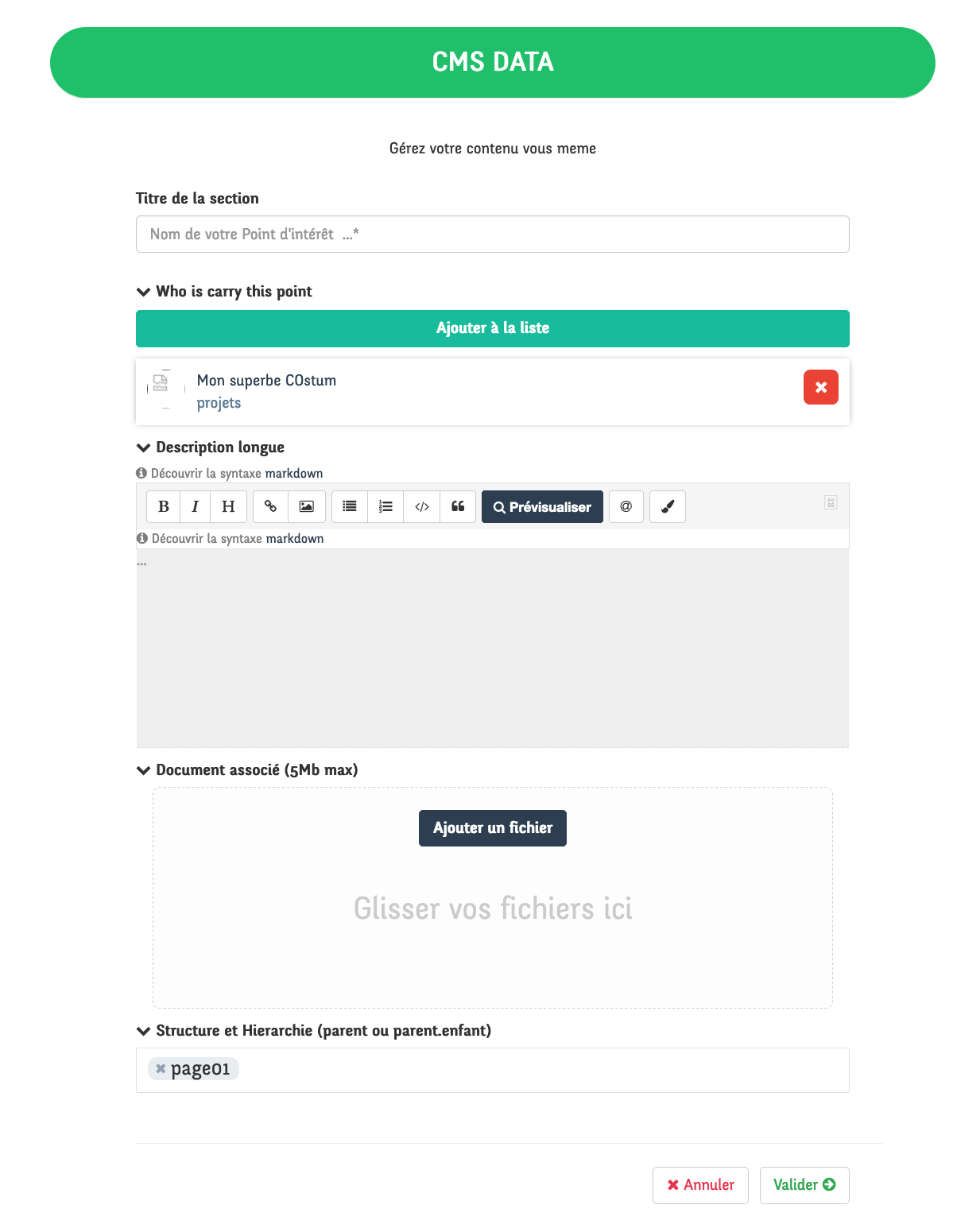
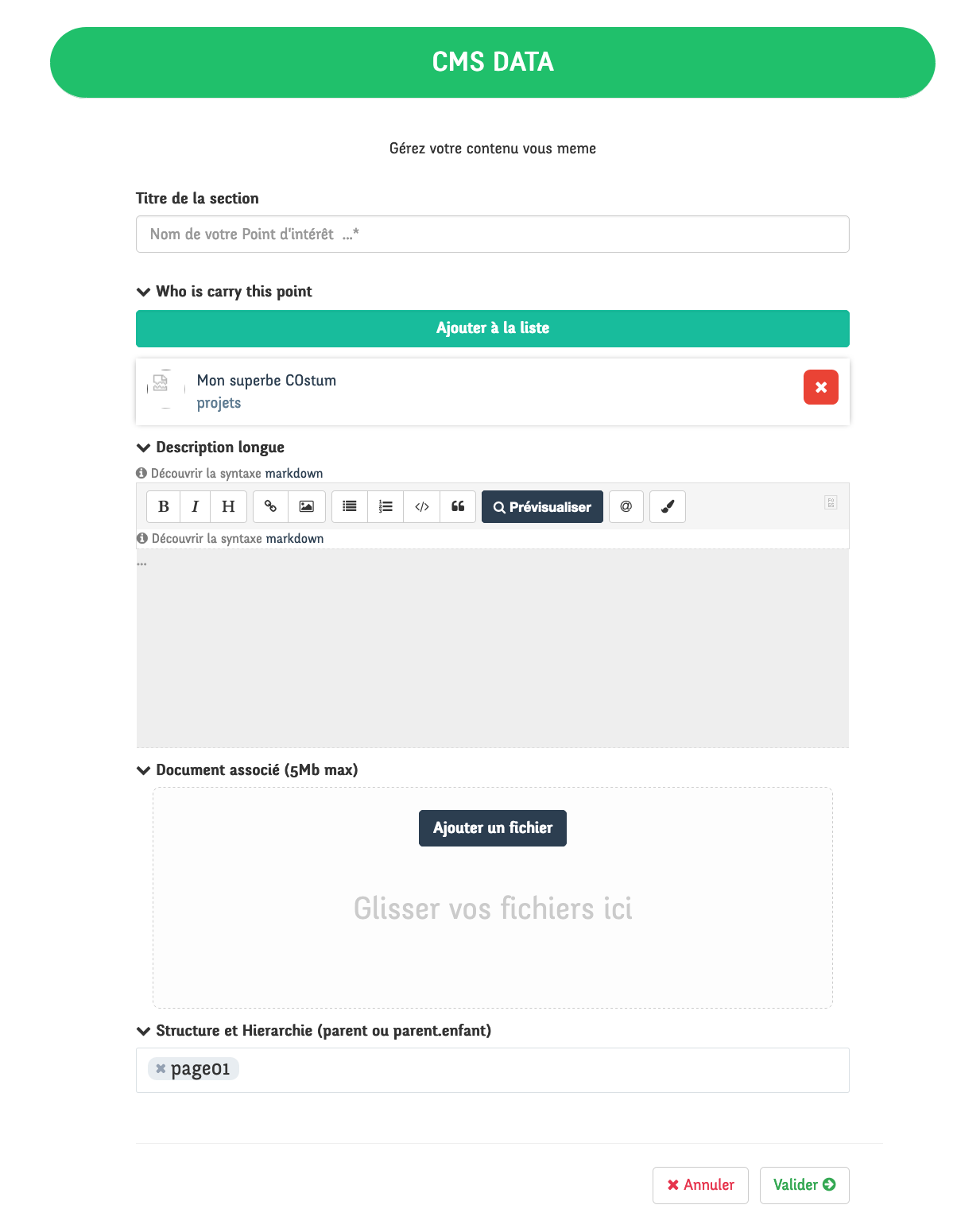
πŸ“œ File en/Images/costum-cms-data.png by @communecter β˜† πŸ“Ž


πŸ“œ File Images/costum-cms-data.png by @communecter β˜† πŸ“Ž


πŸ“š Agora node [[economic policy in response to big tech must go beyond data]] (pulled by the Agora)
πŸ“œ File economic-policy-in-response-to-big-tech-must-go-beyond-data.md by @neil β˜† πŸ“Ž οΈπŸ”— ✍️

economic policy in response to Big Tech must go beyond dataΒ§

Particularly in the context of AI.

economic policy in response to Big Tech must go beyond the fascination with data. If hardware is important too, then opening up data is an ineffective idea at best and a counter-productive idea at worst. It could simply mean that the tech giants get access to even more free data – while everyone else trains their open data on Amazon’s servers. If we want to take back control over Big Tech, we need to pay attention to more than just data.

– Data, Compute, Labour | Ada Lovelace Institute

πŸ“š Agora node [[editing metadata]] (pulled by the Agora)
πŸ“œ File content/Editing metadata.md by @scalingsynthesis β˜† πŸ“Ž οΈπŸ”— ✍️

%% dbfolder:yaml name: new database description: new description columns: column1: input: text key: column1 accessorKey: column1 label: Column 1 position: 0 skipPersist: false isHidden: false sortIndex: -1 config: enable_media_view: true media_width: 100 media_height: 100 isInline: false file: key: file input: markdown label: File accessorKey: file isMetadata: true skipPersist: false isDragDisabled: false csvCandidate: true isHidden: false sortIndex: -1 config: enable_media_view: true link_alias_enabled: true media_width: 100 media_height: 100 isInline: true task_hide_completed: true tags:

  • input: text accessorKey: tags key: tags label: tags position: 100 skipPersist: false isHidden: false sortIndex: -1 config: enable_media_view: true link_alias_enabled: true media_width: 100 media_height: 100 isInline: false task_hide_completed: true config: remove_field_when_delete_column: false cell_size: normal sticky_first_column: false group_folder_column: remove_empty_folders: false automatically_group_files: false hoist_files_with_empty_attributes: true show_metadata_created: false show_metadata_modified: false show_metadata_tasks: false show_metadata_inlinks: false show_metadata_outlinks: false source_data: current_folder source_form_result: root source_destination_path: / frontmatter_quote_wrap: false row_templates_folder: / current_row_template: pagination_size: 80 enable_js_formulas: false formula_folder_path: / inline_default: false inline_new_position: top date_format: yyyy-MM-dd datetime_format: "yyyy-MM-dd HH:mm:ss" filters: enabled: false conditions: %%
πŸ“š Agora node [[fair data]] (pulled by the Agora)
πŸ“œ File fair-data.md by @neil β˜† πŸ“Ž οΈπŸ”— ✍️

FAIR dataΒ§

URL : https://www.go-fair.org/fair-principles/

πŸ“š Agora node [[holdout data]] (pulled by the Agora)
πŸ“œ File Artificial Intelligence/Introduction to AI/Week 3 - Introduction/Definitions/Holdout_Data.md by @KGBicheno β˜† πŸ“Ž

holdout dataΒ§

Go back to the [[AI Glossary]]

Examples intentionally not used ("held out") during training. The validation dataset and test dataset are examples of holdout data. Holdout data helps evaluate your model’s ability to generalize to data other than the data it was trained on. The loss on the holdout set provides a better estimate of the loss on an unseen dataset than does the loss on the training set.

πŸ“š Agora node [[linked open data]] (pulled by the Agora)
πŸ“œ File linked open data.md by @goldfishlaser β˜† πŸ“Ž οΈπŸ”—

linked open dataΒ§

Core ideaΒ§

πŸ“š Agora node [[linkeddata]] (pulled by the Agora)
πŸ“œ File LinkedData.md by @agora@botsin.space β˜† πŸ“Ž
πŸ“œ File linkeddata.md by @agora@botsin.space β˜† πŸ“Ž
πŸ“œ File LinkedData.md by @flancian@social.coop β˜† πŸ“Ž
πŸ“š Agora node [[meta who wants your data]] (pulled by the Agora)
πŸ“œ File Meta who wants your data.md by @agora@botsin.space β˜† πŸ“Ž
πŸ“œ File Meta who wants your data.md by @an_agora@twitter.com β˜† πŸ“Ž
πŸ“š Agora node [[metadata]] (pulled by the Agora)
πŸ“œ File metadata.md by @goldfishlaser β˜† πŸ“Ž οΈπŸ”—

metadataΒ§

Core ideaΒ§

[[dublin core]]

πŸ“œ File Metadata.md by @agora@botsin.space β˜† πŸ“Ž
πŸ“œ File metadata.md by @agora@botsin.space β˜† πŸ“Ž
πŸ“œ File metadata.md by @an_agora@twitter.com β˜† πŸ“Ž
πŸ“š Agora node [[netdata]] (pulled by the Agora)
πŸ“œ File netdata.md by @flancian β˜† πŸ“Ž οΈπŸ”— ✍️

netdataΒ§

πŸ“š Agora node [[notes its time to tax big techs data]] (pulled by the Agora)
πŸ“œ File notes-its-time-to-tax-big-techs-data.md by @neil β˜† πŸ“Ž οΈπŸ”— ✍️

Notes: It’s time to tax big tech’s dataΒ§

– It’s Time to Tax Big Tech’s Data

This article argues that the data that we create should be treated as a commons, and that we should tax the firms harvesting it. Especially at a time when the firms are making even bigger profits from it, and we are most likely going to endure more austerity measures as a result of the pandemic.

I agree with the redistribution of the wealth that big tech is hoovering up, but I’d say we should be working against the enclosure of the commons, not just letting it happen and then taxing it, no? Counter [[surveillance capitalism]] through [[open protocols]] and supporting the building of an [[open web]].

Big Tech is the big winner from the coronavirus crisis, raking in record profits. But their revenue comes from data we create collectively – and we should tax it for the public good.

Inequality has grown hugely in our generation.

The government is currently lending billions to put the economy on life support. Their message has been clear: once this is over it will need to be paid back.

i.e. [[austerity]].

But austerity has not been our only β€˜shared experience’ as a generation, we are also the first to experience the brave new world in which the internet has infiltrated every aspect of our daily life and formed a new digital economy estimated at three trillion dollars.

Whereas the coronavirus is a nightmare for most of us, with internet usage growing by up to 50% during lockdown it is a dream for internet companies and data firms.

also Amazon whose shares have increased by a third with customers reportedly spending almost $11,000 a second on its products. Facebook have outlined in a blogpost how their usage figures have massively increased during the lockdown

β€œthe three largest [[data brokers]] – Experian, Equifax and Transunion – each bring in over a billion dollars annually.

An estimated figure based on this suggests a modest 2% tax would raise over a billion pounds per year. However, more must be done by governments to demand transparency by companies profiting from their use of our data to make it more quantifiable.

Data forms part of our β€˜commons’ – that which we have created or own in common.

As internet companies rake in enormous profits during the lockdown, we should seize the opportunity to make a claim on what we have created and hold it as a public wealth to be invested in services that benefit us collectively.

πŸ“š Agora node [[numerical data]] (pulled by the Agora)
πŸ“œ File Artificial Intelligence/Introduction to AI/Week 3 - Introduction/Definitions/Numerical_Data.md by @KGBicheno β˜† πŸ“Ž

numerical dataΒ§

Go back to the [[AI Glossary]]

Features represented as integers or real-valued numbers. For example, in a real estate model, you would probably represent the size of a house (in square feet or square meters) as numerical data. Representing a feature as numerical data indicates that the feature’s values have a mathematical relationship to each other and possibly to the label. For example, representing the size of a house as numerical data indicates that a 200 square-meter house is twice as large as a 100 square-meter house. Furthermore, the number of square meters in a house probably has some mathematical relationship to the price of the house.

Not all integer data should be represented as numerical data. For example, postal codes in some parts of the world are integers; however, integer postal codes should not be represented as numerical data in models. That’s because a postal code of 20000 is not twice (or half) as potent as a postal code of 10000. Furthermore, although different postal codes do correlate to different real estate values, we can’t assume that real estate values at postal code 20000 are twice as valuable as real estate values at postal code 10000. Postal codes should be represented as categorical data instead.

Numerical features are sometimes called continuous features.

πŸ“š Agora node [[open data]] (pulled by the Agora)
πŸ“œ File open-data.md by @neil β˜† πŸ“Ž οΈπŸ”— ✍️

Open dataΒ§

πŸ“š Agora node [[open repair data]] (pulled by the Agora)
πŸ“œ File open-repair-data.md by @neil β˜† πŸ“Ž οΈπŸ”— ✍️

open repair dataΒ§

πŸ“š Agora node [[opendata]] (pulled by the Agora)
πŸ“œ File OpenData.md by @agora@botsin.space β˜† πŸ“Ž
πŸ“œ File Opendata.md by @agora@botsin.space β˜† πŸ“Ž
πŸ“œ File opendata.md by @agora@botsin.space β˜† πŸ“Ž
πŸ“š Agora node [[own your data]] (pulled by the Agora)
πŸ“œ File own-your-data.md by @neil β˜† πŸ“Ž οΈπŸ”— ✍️

Own your dataΒ§

Twin pagesΒ§

πŸ“š Agora node [[owning your data]] (pulled by the Agora)
πŸ“œ File owning your data.md by @agora@botsin.space β˜† πŸ“Ž
πŸ“š Agora node [[private and public data]] (pulled by the Agora)
πŸ“œ File private-and-public-data.md by @vera.wiki.anagora.org β˜† πŸ“Ž

I’ve been thinking a lot lately about how to separate private and public data. I’m a big fan of [[working in public]] (there is a [https://1lib.us/dl/11775129/7c54b5 book] on this) but the problem I’ve run into is that I don’t always want what I’m doing to be public. For example, my friend has a house party tonight. If I write about it and someone sees it that wasn’t invited they might be insulted. I have now done harm.

πŸ“š Agora node [[puredata]] (pulled by the Agora)
πŸ“œ File PureData.md by @agora@botsin.space β˜† πŸ“Ž
πŸ“š Agora node [[regional monthly manufacturing fed data]] (pulled by the Agora)
πŸ“œ File Economics/Regional Monthly Manufacturing Fed Data.md by @KGBicheno β˜† πŸ“Ž

Regional Monthly Manufacturing Fed DataΒ§

Go back to [[Economics main page]]

#Index generated by surveys of companies in the region of the Fed in which they were taken.

If one index moves -> region about to move If all indexes move -> nation about to move

Comes out ahead of the [[ISM - Manufacturing Index]] so analysts watch closely.

πŸ“š Agora node [[serial correlation in data]] (pulled by the Agora)
πŸ“œ File Economics/Serial correlation in Data.md by @KGBicheno β˜† πŸ“Ž

Serial Correlation in DataΒ§

Go back to the [[Econometrics Main Page]]

Are the future values driven by the past values?

Can we look at past values to predict future values?

need to use the right kind of analysis

Regression Result IntrepretationΒ§

Look at X value

It has a positive and statistically signficant relationship with future values

WHEN

The #T-stat is greater than 1.5 and the #P-value is less than 0.1.

This can be confirmed by looking at the coefficient for the X variable. If it is small (say 0.002), then that means a rise of 1 in the target value leads to only a 0.002 rise in the x value.

This tells us there’s correlation, but doesn’t give us the tool to figure out how to predict future values.

πŸ“š Agora node [[social data]] (pulled by the Agora)
πŸ“œ File social-data.md by @neil β˜† πŸ“Ž οΈπŸ”— ✍️

Social dataΒ§

πŸ“š Agora node [[soldata]] (pulled by the Agora)
πŸ“œ File soldata.md by @agora@botsin.space β˜† πŸ“Ž
πŸ“š Agora node [[sources of economic data]] (pulled by the Agora)
πŸ“œ File Economics/Sources of Economic Data.md by @KGBicheno β˜† πŸ“Ž

Sources of Economic DataΒ§

Go back to the [[Econometrics Main Page]]

See the macroeconomics page on [[Master list of economic reports with links]] for a considerably large list of sources.

Also note the FRED Excel add-in from the Federal Reserve of St Louis.

πŸ“š Agora node [[temporal data]] (pulled by the Agora)
πŸ“œ File Artificial Intelligence/Introduction to AI/Week 3 - Introduction/Definitions/Temporal_Data.md by @KGBicheno β˜† πŸ“Ž

temporal dataΒ§

Go back to the [[AI Glossary]]

Data recorded at different points in time. For example, winter coat sales recorded for each day of the year would be temporal data.

πŸ“š Agora node [[wide data]] (pulled by the Agora)
πŸ“œ File wide-data.md by @neil β˜† πŸ“Ž οΈπŸ”— ✍️

Wide dataΒ§

Wide Data sets are much smaller than Big Data sets, making them easier to manage, but the key defining characteristic is that wide data is made up of data that comes from many disparate and unconnected data sources.

The move to Wide Data is only just beginning, but technology research firm Gartner predicts that 70% of organisations will shift their focus from Big to Small and Wide Data by 2025.

https://charitydigital.org.uk/topics/topics/what-is-wide-data-10127

I mean taking data from a wide variety of sources makes sense, but labelling it as ‘Wide Data’ (capitalised…) sounds like a bit of a marketing thing. I don’t think many charities (especially not small charities) ever worked with [[Big Data]] either, not the scale that ‘Big Data’ really is.

πŸ“š Agora node [[wikidata]] (pulled by the Agora)
πŸ“œ File wikidata.md by @flancian β˜† πŸ“Ž οΈπŸ”— ✍️

WikidataΒ§

πŸ“œ File pages/Wikidata.md by @sparql β˜† πŸ“Ž

type:: [[SPARQL Endpoint]], [[RDF Store]] url:: https://query.wikidata.org triples:: 13 629 675 308 date:: [[Feb 14th, 2022]]

πŸ“œ File Wikidata.md by @agora@botsin.space β˜† πŸ“Ž
πŸ“œ File wikidata.md by @agora@botsin.space β˜† πŸ“Ž
πŸ“œ File Wikidata.md by @an_agora@twitter.com β˜† πŸ“Ž
πŸ“œ File wikidata.md by @an_agora@twitter.com β˜† πŸ“Ž
πŸ“œ File Wikidata.md by @anagora.bsky.social β˜† πŸ“Ž
πŸ“œ File Wikidata.md by @kausch@twitter.com β˜† πŸ“Ž

RT @WikimediaCM: #Wikidata 10 years ! πŸ˜„ cc @Wikimedia https://t.co/kGbfuWsMnK


πŸ“š Agora node [[πŸ”’ data]] (pulled by the Agora)
πŸ“œ File πŸ”’ data.md by @an_agora@twitter.com β˜† πŸ“Ž