1014
https://habr.com/ru/articles/781798/
Хорошее введение в иероглифы. Я это всё знал, что показывает совсем уж входной уровень материала, но интересно всё равно.
[[14]] is not a centered hexagonal number.
The closest centered hexagonal numbers are [[7]] (index # [[2]]) and [[19]] (index # [[3]]).
First 20 centered hexagonal numbers: [[1]], [[7]], [[19]], [[37]], [[61]], [[91]], [[127]], [[169]], [[217]], [[271]], [[331]], [[397]], [[469]], [[547]], [[631]], [[721]], [[817]], [[919]], [[1027]], [[1141]].
[[square]]: 196
[[square root]]: 3.7417
[[cube]]: 2744
[[cube root]]: 2.4101
[[natural log]] (ln): 2.6391
[[base-10 log]] (log10): 1.1461
[[base-2 log]] (log2): 3.8074

Loading pushes...
Expanding this section will automatically generate an AI synthesis of the contributions in this node.
Rendering context...
https://habr.com/ru/articles/781798/
Хорошее введение в иероглифы. Я это всё знал, что показывает совсем уж входной уровень материала, но интересно всё равно.
Whoa, there go 15 days without posting. It’s funny, how many times have I run into random abandoned blogs where the last few posts begin like this post? I wonder if I’ll quit anytime soon. I don’t feel like quitting really, I’ve just been busy with other things. Let’s wait and see :)
I wrote several things that I thought of posting, then didn’t because I felt they needed work. It’s funny — I don’t really have any regular readers, I think, so it doesn’t make an immediate difference whether I post what I write straight away (and perhaps edit it live) or postpone publishing until I’ve "polished" it (which realistically may never happen).
I feel like I mostly write for archive.org; what I write could end up persisting there, and might be read many years from now. This train of thought led me to write one of the pieces I mentioned. I will probably clean it up a bit and post it after finishing this entry (but then again, maybe not).
Going back to the 15 day long hiatus: I’ve been busy with several things related to Machine Learning — and, to put it succinctly, that makes me happy.
I have this fuzzy long-term plan to learn it well, and a more tactical approach that consists in just keeping an eye out for reasonable opportunities to apply what I’ve learnt hands-on. Now I’ve finally found a project at work that could benefit from ML, so I’ve put aside some of my time to experiment with it. Everything is taking long, as it’s usually the case with programming (for me, anyway), but I really enjoy the process so for once I don’t really mind. It’s such a nice change; I don’t really feel this way about my day job, usually. I don’t think I’ve felt this way about something technical since I was in university.
I’ve also read papers that I found stimulating:
I’ve probably spent 35h over the last three weeks doing ML, and if I remember correctly I’ve enjoyed all of it. Overall I reckon I’ve probably put 100 hours into learning ML in all formats (Coursera and podcasts included) since I started.
Going by the now contended 10000 hours rule of thumb — I have 9900 hours to go.
In reply to: https://twitter.com/MentalNodes/status/1261010969230270470
There is git for projects—should we have git for ideas?
I’m hoping that at some point I’ll be able to use the version history of my [[wiki]] to turn the evolution of my [[graph]] into a nice timelapse animation – I think that would be a really fun visualisation, to see it grow and morph over time, new links forming, new clusters.
see reading as a moral imperative! people died to give us the ability to read.
if you have not read widely, you are as good as someone who is not read at all. read diversely.
do not criticise without advantage
assume others know when something is wrong
quality time vs garbage time!
ordinary moments can be gifts if we appraoch them from the perspective
alive time vs dead time — sit around and wait or make every second count
some people lean in and some lean away
Years ago, in a high school English class, I shared something with my discussion group. Later, people used what I had said in their essays and presentations and got credit for it. I brought this up to the teacher, telling her that people were using my ideas. She looked at me and said, “Ryan, that’s their job.” I’m very glad she said that and that I heard it at a young age.
amateurs focus on outcomes more than processes; we should always focus on the work and know we can rely on the systems to deliver us results
there are professional habits and amateur habits; make sure you are practicing the right one
'competition is for losers'; when you compete, someone loses! run a race with yourself
Years ago, in a high school English class, I shared something with my discussion group. Later, people used what I had said in their essays and presentations and got credit for it. I brought this up to the teacher, telling her that people were using my ideas. She looked at me and said, “Ryan, that’s their job.” I’m very glad she said that and that I heard it at a young age. i don't know how to explain that you should care about other people
ask the best questions. questions are what separate us from others, not answers
what do you do with your money?
production and peace are very different and cannot be compared
choose what will teach you the most, not what will pay you a most. make sure you choose opportunities that you will learn the most from and take the most out of
put your precepts up for display! make your commitments public so that they will be honored
no man steps in the same river twice - heraclitus
your last book won't write your next one
run rates always start at zero
former Coca-Cola CEO Brian Dyson: “Imagine life as a game in which you are juggling some five balls in the air. You name them — work, family, health, friends, and spirit… and you’re keeping all of these in the air. You will soon understand that work is a rubber ball. If you drop it, it will bounce back. But the other four balls — family, health, friends, and spirit — are made of glass. If you drop one of these, they will be irrevocably scuffed, marked, nicked, damaged, or even shattered. They will never be the same.”
there is no party line for what you should and should not do
do not feel obligated to do anything with your money
feel free to just not reply to things selectively ignoring is the key to productivity do not feel obligated to entertain everyone
sometimes you can just take a break
i learn more every day man make sure your work helps you learn every action takes some mentral weight
src In distributed organizations, everyone can have a 'corner office' - a space that they own. there is so much more you can do in terms of space management when you define the office; and you can choose to define your office as the space you feel that you will be most productive in!
This blog might be relevant for future work, it's written by the creator of Wordpress.
https://linus.zone/latest control, attention and relationship how to feel in control be conscientious about where attention is. is your complete attention going in the right direction? scattered attention can quickly contribute to a sense of chaos and lead to a lack of control over work!
Do not think just of spending attention, but also of redirecting the attention you waste into things that make your time more variable and enjoyable.
When you are working on something, redirect all of yourself into it! FOcus on focus. [[]] what do we need to know to start making a difference?
ds knowledge: vocab and ontological understandign
prerequisite is vocabulary - you must speak the lnaguage to understand the ideas
ontological knowledge is so easy to pick up when you're doing the work vs relaxing format text to be scanned easily!

after seeing a post from tiffany day this never really occured to me as something i can or should be interested in.
lol candy bad no need to question originality there's never any pressure to know all of the answers conclusions aren't the answer, sometimes it's the thought process itself that matters — drawn back to the endless conversation about dsl for mtg game between dustin and i that never took off, but lead to a lot of valuable conversations about semantics
Escucharé la [[Lecture 03: Structuralism in Anthropology and Literature]]
With Trump being kicked off Twitter, the discussion about Parler being kicked off [[AWS]], there’s lots of discusison about federated and censorship proof social networks.
I got drawn into a long thread [kicked off by Stefan George](https://twitter.com/StefanDGeorge/status/1347861734716035074 ) of [[Gnosis]], who wanted to post a bounty to save/store Twitter stuff to IPFS. I [pointed out that Twitter archives already exist](https://twitter.com/bmann/status/1347937473494618112 ?s=20).
From there I got into a whole back and forth, including people suggesting that Twitter data should be mass exfiltrated to setup an alt social network. Maybe at one point I would have reached for a purely technical solution like this, but here’s my final take:
Technical tricks to try extract Twitter data is probably orders of magnitude harder than …just doing the work in building out critical mass communities.
The difference between the two approaches? One is technical challenges, the other is marketing and community building. [@bmann](https://twitter.com/bmann/status/1348350579072921605 )
I am… somewhat distraught that a lot of decentral type people think about this issue as censorship, rather than the "let’s deplatform fascists issue" that it actually is. Twitter is in no way a public utility. Own your "distribution" — whether it’s direct mailing list subscriptions or your own community social network: run your own Discourse or Mastodon server. Twitter is today’s mass media: use it for distribution, but know that you’re there at the company’s sufferance.
And of course, when I see lots of crypto people happily using Medium and Substack, I’m not going to take the rest of their opinions seriously. Your words need to get backed up by actions, my dudes.
Jeff Henshaw popped back up on Mastodon — and he’s hosting his own Mastodon server. He was asking me why I’m on Mastodon, here’s my answer:
the concept of collective ownership / maintenance.
Nothing wrong with “multi user” systems, but we have to clearly understand that it costs people time and some server resources to run things.
I’m working on a model of awareness that people should pay for apps — that behind that app are real people, not just corporations.
“Exit to community” is a related theme. Plus governance, etc etc @bmann@social.coop
Yes, I’m posting my own content back to my own site. Which means it becomes part of my forever content, and also I can link to and include it in search.
I guess I should document my [[Twitter Archive]], which lives at https://tweets.bmannconsulting.com/. In a week or so, when [[Fission]] has [[Github Actions]] support, I can start publishing this to [[IPFS]] directly, instead of hosting it on Github Pages. Doing this direct from Google Sheets to Fission would be ideal, as a little one off Twitter Archive app.
It was really easy to setup. Michael Hawksey’s @mhawksey post explains it all: [[Keeping your Twitter Archive fresh and freely hosted on Github Pages]].
I just emailed Michael to see if I can send him some thank you money, or donate to some project on his behalf.
Kautsky believed that imperialism would gradually move to a period where imperialist powers would exploit the third world collectively rather than competitively and individually. This is why Lenin called his book on imperialism "the highest stage of capitalism", because he rejected the idea that capitalism would move into a new era of imperialism. History shows that Kautsky was correct, though. (link
Saw this article, makes me think of [[Mike Caulfield]]‘s work on [[misinformation]] and the importance of [[web literacy]].
John became increasingly radicalised by an online barrage of far-right disinformation. “Posts of homeless British soldiers were set against Muslim families being given free homes. Now I know the posts were all fake, but the 15-year-old me didn’t bother to fact-check.”
– How far right uses video games and tech to lure and radicalise teenage recrui…
[[public key]]
Open source database designed to be an [[Airtable]] alternative. [[MIT License]], with SaaS and premium versions available.
Sells Intel [[NUC]] mini-PCs — which are basically like a Mac Mini.
I’m exploring [[SSG]]s again, and trying out [[GitLab Pages]] for the first time. Now that I’m helping to run [[Moa Party]], I’m going to make a static site for it, for status updates and documentation and so on.
[[Hugo]] I’ve used a bit, because [[Micro.blog]] uses it, so to make a custom theme, I installed it locally for testing.
[[Zola]] is a [[Rust]]-based SSG. I haven’t really had any personal experience with Rust, but I’m very interested in it, especially because Rust is very commonly used to compile to [[WebAssembly]].
There is a page documenting Zola with GitLab pages. The mention of git submodules is not comforting.1
OK, Zola experiment over. I used the Juice theme and got Zola running and it is nice and fast. But — I want to maintain this as a docs site using [[wikilinks]], likely also being compatible with [[Obsidian]] as an editor. I know [[Jekyll]] best so I’ll just use that.
Started created a blank Jekyll site, and briefly wanted to make a "status" type like my journal logs here, but really just can keep it simple for now. Saving my fragments of setup for this here in case I want to come back to it.
  - scope:
      path: "_status/*"
      type: status
    values:
      layout: status

collections:
    status:
      output: true
      permalink: /status/:year/:month/:day/
Well, that ended up being an epic build out of a full [[Jekyll]] site. I went back and used the [[Digital Garden Jekyll Template]]. It is a lot slimmer than the [[Simply Jekyll]] theme I use here, which has me itching to tinker some more.
I’m pretty happy with how the site turned out: https://moaparty.com
Everyone, including myself, thinks that git submodules is a good idea, until actually working with them in practice for any period of time. ↩
it's often hard to realize or rationalize, but it's impossile to build the perfect tool outright. the perfect tool is only built over many iterations and trials; it's important to continue to iterate, rather
trends are cast over shorter time periods than we account for. when working with data, it's often risky to extrapolate with just two or four data points; with human behavior, these trends are often both pointed out and lost.
It’s that part of the day where I force myself to write a daly note. There. Done. Mission accomplished lol
Oh yeah, I went all the way to fuckin [[hood river]] to get my [[single dose vaccine]] and the fuckin [[FDA]] recalled it the same day. I’m so pissed. This corona thing is such a nightmare. Just end already
playing with new software for [[android]]
test
read frederick beiser, a philosopher and scholar of german idealism. he has intimate knowledge of the german idealist period and is one of its leading scholars, so learning his work may be super important to understand the influence of german idealism on contemporary philosophy
who are post kantians? they're revolutionaries in practical philosophy, converting kant's idea that 'the principles of morality should be sought in human rationality and freedom', "completing" kant's revolution in practical philosophy by deepening his morality and developing kantian legal and political ideaologies
[[Tor and Wordfence]]. I use Wordfence on some sites. It seems that [[Wordfence]] blocklists certain exit nodes from [[Tor]] if it associates those nodes with bad activity. Fair enough, I guess, though a shame that Tor users get bounced as a result. If it happens to someone, they can start a new Tor circuit to find an exit node that isn’t blocklisted.
Bookmarked: [[Appropriate Measures]]. Critique of [[appropriate technology]].
[[Holochain]].
Reading: [[The Left Hand of Darkness]]
Listened: [[Restart Radio: Our 2021 Summer Reading List]]
Read: [[The UK’s new ‘right to repair’ is not a right to repair]]
Interesting to learn that [[Niklas Luhmann]] (of [[zettelkasten]] fame) had some work in the area of [[second-order cybernetics]] and [[autopoesis]].
[[Digital gardens and systems thinking]]
Watched [[Pan’s Labyrinth]] (again).
Listened: [[Ray Ison and Ed Straw, "The Hidden Power of Systems Thinking: Governance in a Climate Emergency"]]
Noded: [[bolo’bolo]]
[[The Red Army Faction: Marxist Guerrilla Warfare in West Germany]]
Listening: [[After Geoengineering: Carbon Removal and Social Transformation]]
Updated spacemacs to latest on develop branch. Updated packages. Nothing seems broken (yet…)
(org-roam) Upgrading the Org-roam database from version 17 to version 18
Process emacsql-sqlite<2> not runningIt feels faster but wonder if I’m just imagining it.
This quote about [[Anarchism and right to repair]] caught my eye.
Anarchists often get caught up in the world of ideas, but right to repair gives us a chance to engage practically and I’d encourage all of us to get involved.
Interesting to note that [[Heinz von Foerster]] and [[Francisco Varela]] pop up in the acknowledgements for [[Tools for Conviviality]].
Updated to [[YunoHost]] 4.3.
Missing credentials error.Listened: [[Immediatism: 690 Debord, Ressentiment, & Revolutionary Anarchism, by Aragorn!]]
Listened: [[Immediatism: 691 Preface to The Society of the Spectacle, by Ken Knabb]]
[[openEngiadina]]
Read: [[The Knowledge Ecology]]
well, i’m back once again. this is one of the only outlets i have to write my feelings out on, at the moment.
my discord account got disabled for 0 reason. this means that most "vent" channels i could have access to are no longer accessible because well, i can’t access discord. so this place might actually get use again for the next few days.
to recap, on the 10th, some people started seeing my messages as "spam" - i initially thought "that’s funny", laughed, and moved on. 2 days later, i received an email proclaiming my account had been disabled for "spam and/or platform abuse". "oh, i have other accounts i can use though," i thought. little did i know how easy it was to also get accounts locked, with phone verification required. since i had my phone number on my main account which was now banned, discord also blacklisted my phone number from use on any other accounts.
i have contacted discord support and am just waiting for a response from them, my hopes are not super high. and in general i’m pissed. i am potentially losing 5 years of my life, most if not all of my friends, to a simple "flag" on my account and it sucks. i am trying to keep my head up but it’s hard when a platform treats you as an enemy from the start.
as a sidenote, i created a telegram account under @iamtilda - if you need to make contact with me, this is probably the best way at the moment besides twitter or osu!.
i also want to tackle why i’ve been so inactive in using this agora. i think i mostly got demotivated because i wrote the same things every day, having done the same things every day for a while now. so i think i might try and do new things every day now. if i think about it, discord was really holding me back, a procrastination tool disguised as a communications platform.
so, yes, you will probably see more entries in the coming days. hopefully i can keep myself to it.
source :: cite:not_one_man_not_one_penny
tags :: GermanyGerman Social Democratic PartyKarl Kautskyhistory of socialism
The SPD (Sozialdemkratische Partei Deutschlands) was the first working-class party in the history of the world
The SPD was the first large party to try and work out the writings of Marxand Engels
SPD was the model for world socialist movement
Steenson asserts that German social democracywas just one interpretation of Marx, like the Soviet Unionwas
German social democracy also cannot simply be called Marxism
Socialists were often barred from other forms of association, which partially explains why the SPD was so all-encompassing
German social democracy has its origins in the Revolutions of 1848
There was a feeing that the cause for workers had been betrayed
The revolutionaries had failed to come up with a unified German state
Workers felt that an alliance with the bourgeois liberals could not get them what they wanted
After 1848 workplaces began educating workers via educational associations, and overall workers became more educated
Steenson says there were three remarkable things about these associations:
There was a major expansion of them after the revolution
They were politicized, especially those associated with radicals
See: Stephan Born
In August of 1848 the General German Workers' Brotherhood (Allgemeine deutsche Aerbeiterverbrüderung) was formed. It had its own newspaper, called Verbrüderung
Thought to have ~18,000 members in 1850
These organizations were very political, unlike the prior existing order which was traditionally apolitical
After the revolution they were met with a wave of reaction, and worker's associations that extended beyond their own localities became illegal in some areas
Until the 1860s there were times where workers would make alliances with liberals generally
The liberals were in conflict with the Prussian aristocracy, and were divided among themselves, and some factions recognized the need to work with labor
Prussia did not have a large industrial proletariat at this time
The workers, generally class conscious realized that the bourgeoisie were their enemy broadly
The 1860s saw the formation of the first working class political party in German history: the Allgemeiner deutscher Arbeiterverein (ADAV) ([[file:../20210131230029-general_german_workers_association.org][General German Workers' Association]])
One of the founders of the ADAV was Ferdinand Lassalle
He left two legacies to German social democracy:
Insistence on general adult male sufferage
A deviation from the liberal principle of franchise based on property
State financial support for workers' coopratives
In practice it took the form of protection of workers generally
The workers movement sought out Lassalle, he did not create the organization himself
Lassallebelieved that male sufferage would promote civil war, and was hostile to parliamentarianism
Lassallehoped that he could help establish a Germany that was not unlike the France of Napoleon III a parliamentary government with a monarch who would protect worker interests
The early workers movement espoused liberal ideals
Lassallepaved the way Marxismto enter German political thought, even if he appeared to be an opponent of sorts to Marx
Union of German Workers' Leagues
Differed from ADAV:
Retained close ties to bourgeois radicals
Concerns were less political than ADAV
More democratic than ADAV
Fell apart by 1870
August Bebelwas elected president of the Verbund at the fourth congress in 1867 (?)
Bebel and Wilhelm Liebknechtworked to connect the Verbund to the [[file:../20210204223950-first_international.org][First International]]
In 1869 the Verbund voted to dissolve and merge into the Sozialdemokratische Arbeiterpartei
Verbund promoted trade unionswhen ADAV tried to avoid them
Bebeland Liebknechtwere (as the author asserts) the two most important individuals in German social democracy history prior to WWI
August Bebelwas elected to the German Reichstagevery term between 1871 and 1912
Wilhelm Liebknechtwas a firebrand, "a man of extremes", was acquainted with Marxand Engels
ADAV became more autocratic over time, increasing dissatisfaction among members
ADAV cooperated with Prussiaopenly
With the disillusion of the Verbund and a split likely to happen in the ADAV, Bebel, Liebknecht, and others managed to unite the two factions under the SDAP
The founders of the SDAP worked to prevent the rise of a personality cult, a singular autocratic leader as had happened in the ADAV
it did so by having the entire executive elected by local party organizations
During the formation the SDAP resolved itself to not be like the ADAV
Bebel had the following points regarding party formation:
Local organizations and the general organization had to be equally important
The organization had to have monthly dues
Dues should be waived for subscribers of the party paper
The SDAP avoided using the term "republic" anywhere in its name or program for fear of being politically repressed
Critique of the Gotha Programmewas published posthumously by Karl Kautskyin 1891 (at the behest of Engels to fight Lassalleanism within the party, which was at least as popular as Marxism was in the party from the start
In 1870 Napoleon IIIdeclared war on Prussia
The ADAV considered Napoleon the chief enemy of socialism on the continent
The SDAP was ambivalent as a party, but Bebel and Liebknecht opposed the war vocally
The workers movement overall was opposed to the war
A red scare of sorts led to Bebel and Liebknecht sentenced to prison for two years
The founding of Germany led to an economic boom, and subsequently did wonders for the German workers movement
In the early days of the German Empire the German Reichstagwas an impotent political body
Germany implemented universal male sufferage, but it hardly mattered because of how weak the Reichstag was
German unification made it easier for the various workers' parties to unify
Once Germany unified Bismarckconsidered the socialists enemies of the state
After unification the SDAP was significantly better organized than the ADAV
In 1874 in Gotha, the ADAV and the SDAP unified into the SADP (Sozialdemokratische Arbeiterpartei Deutschlands), adopting a primarily Lassallean program:
iron law of wages
"one reactionary mass#34;
state funded workers' co-ops
Marxand Engelscriticized the new program in Critique of the Gotha Programme and elsewhere, though saw the unification as ultimately a victory
The SADP operated with a strong central executive committee that controlled local organizations
the organizations rules made it difficult for one person to have too much influence
In 1876 the Prussian government dissolved the SADP
this did not stop the party from growing however
Two assassination attempts on Kaiser Wilhelm Iwere the justification for Bismarck to dissolve the Reichstag and outlaw the socialist parties
In 1878 the Reichstag passed anti-socialist legislation that outlawed socialist parties until 1890
While outlawed, the SADP became the most popular political party in the Reich
The anti-socialist law was moderate compared to 20th century standards, but harsh by the standards of the time
The law repressed socialists in the following ways:
Meetings suspected of being communist / socialist in nature could be broken up and property could be confiscated
Participants were fined
Leaders were jailed for several years
What was considered socialist was often left up to local authorities, and local authorities came down on any organization that even seemed socialist
In spite of all this the SADP was still incredibly popular, and socialists were not barred from being elected to the Reichstag
In these years there were factions that centered around Reichstag politics and being more radical
The radicals won out for the following reasons:
Bebel was a radical
The moderates were not as skilled as the radicals
Many of those who could have led the moderates emigrated or died
Marxism gained a lot of ground in the party and was advanced as the ideology of German social democracy in this time
In the 1880s Karl Kautskyand Eduard Bernsteinemerged as the party's leading theoreticians. Bebel too became a Marxist in this time
Marxism gave the radical factions a clear ideological vision, as opposed to the moderates who lacked a specific vision
The anti-socialist law itself made heroes out of the socialists. The law was seen as extremely repressive and this made the socialists look sympathetic
Many large cities in Germany had local clandestine socialist organizations
This outlaw period inspired a sense of heroism among the German socialists
Some characteristics of the German Reichstag
In 1871 elections were held every 3 years, and after 1893 every 5 years
Election required an absolute majority, otherwise a runoff election was held between the two highest vote getters
The Reichstag had several major political factions:
Socialists
Conservatives
National Liberals
Center
Various left-liberal alignments
Various smaller parties
The SPD's constituency was the industrial working class
The SPD was the only truly national party in Germany. All others were regional
All local organizations were capable of running candidates
The SPD was not interested in creating "winning machines" so much as they were propagandists
The SPD was largely ambivalent about winning elections. It wasn't their primary focus but they tried anyway
The SADP's ability to survive the outlaw period was remarkable in itself
Bismarck found other political opponents besides the socialists as time went on, allowing the socialists to gain more ground electorally
1890 was a turning point: now that the socialists could operate openly they won almost 20% of the vote
The most serious election for the SPD was the election of 1907, called the Hottentot election which resulted in the biggest loss for the SPD since the 1890s
The biggest electoral gain for the SPD was the election of 1912, where the SPD won more than four million votes
Rosa Luxemburgwas critical of this victory, as she felt that the focus on electoral politics distracted from real socialist work and required the SPD to compromise its message
After 1912 the SPD entered into an agreement with the Progressive party to trade support in a runoff election, something they had never done before, and actively opposed
Success in electoral politics seems to have bred contentment with the status quo
The disaster that was 1907 is in part why the party was willing to make a compromise in 1912
"The party sacrificed principle without gaining much advantage"
The compromise would deal a death-blow to the radicalism of the party
The outlaw period had fostered a sense of camaraderie among the SPD members elected to the Reichstag, and thus they always voted together
One of the strengths of this period was the fact that the German SPD was so strongly united
Since the beginning however there had been internal disagreements between moderates and radicals in the party
Prior to the outlaw period German social democrats largely saw the Reichstag as a way of platforming issues and speechmaking, rather than a means of accomplishing anything
Liebknecht believed that the Reichstag was a "fig leaf for despotism"
Eventually however the socialists felt that they could make better use of their seats in the Reichstag by proposing legislation
Bismarckdealt with social democracy in two ways:
Active repression
"Bribing" the lower classes with social safety nets, hoping to win favor with the workers and take that favor away from the socialists
The socialists were caught off guard by the second tactic of Bismarck's, and between 1881 and 1884 weren't sure how to handle it
Would they support legislation that made the lives of workers better, thereby admitting that the state was not the enemy of the workers?
In the end they decided to vote against Bismarck's social insurance on the grounds that they were being repressed anyway
Voting against them made them more popular, as it showed the workers that the S(A)PD was on the side of the workers
This would not happen today
As time went on moderate socialists did not see the state as the enemy, and that the state could be used for reform
Eventually the SPD began proposing their own legislation
The German socialists in the Reichstag were always reformist, as they never introduced legislation that in any way altered the property relations of Germany
Few socialists saw these things as ends in themselves
For the entire period that this book covers, all social democrats felt that by proposing reforms they could at least make achieving their own goals easier
The socialists in the Reichstag were always looking to reform the rules around the Reichstag in particular. Parliamentary immunity was often sought after because the socialists in the Reichstag were frequently imprisoned
Socialists were not equal before the law in Imperial Germany
The goals of the social democrats in parliament included:
Broader rights for women
Legitimacy of children born out of wedlock
Limit police and court powers of search and seizure
Open trials and jury proceedings
Depoliticization of civilian courts
Reducing the role of religion in schools and in courts
Tried to get the law to apply to everyone in Germany equally, as Alsace-Lorraine for example was governed by special status
Tried to lower franchise age
Tried to reform Reichstag seat distribution
Elimination of indirect taxes
Chancellor to be responsible to the will of the people
Progressive income tax
None of these things were ends in themselves but would help the social democrats in their more radical goals
None of their proposed reforms were ever enacted into law
Also tried to introduce labor law, such as an 8 hour work day
None of the proposals made by the SPD posed a serious challenge to German capitalism
The more Marxist members of the SPD were uncertain of how a socialist society could emerge from a capitalist one simply by proposing legislation
As time went on the SPD began to see the state as a weapon that could be used by the socialists instead of their opponents
Paul Singerwas the person who organized the SPD delegation to the Reichstag during the Wilhelm years
Singer was a business owner who gradually became a socialist
He used his business to help fund the SPD's political activities
In an early Reichstag speech, Liebknecht said that the best foreign policy was no foreign policy at all
For a long time the SPD supplied no commentary on foreign policy, although they did betray some biases:
Most socialists were nominally pacifists, though in practice this was not the case
They hated and feared Imperial Russia
Most socialists opposed a standing army and preferred a defense militia
Opposition to colonialism and imperialism
In the late 1880s Bismarck introduced a bill that involved funding of steamboats. The social democrats were split on whether or not they'd support the legislation, and ultimately chose to attach an unreasonable amount of amendments to the bill
During this period the social democrats developed a contradictory critique of colonialism:
To them colonialism was a holdover of feudalism rather than something that was capitalistic
They also saw colonialism as "exporting the social question" i.e. a capitalist effort to cope with overproduction and overpopulation in the metropole
Unlike English colonialism, German colonialism was largely a drain on the German economy
Colonialism was also rejected by socialists on humanistic grounds
German social democracy offered no worthwhile critique of colonialism overall, save for a few theoreticians like Karl Kautsky
The SPD had a hard time deciding if imperialism was progressive as well
Rosa Luxemburgcritiqued the SPD policy on imperialism
A. Fendrich (?) anticipated Vladimir Lenin#39;s critique of imperialism
The socialists felt that they did not need to develop a "world policy," as there would be plenty of time for that once they seized state power
The socialists were known for their anti-militarism, and were often seen as unpatriotic
Karl Liebknechtsaw militarism as a weapon against the proletariat
The German fear of Russia was similar to the fear of Russia in the United States, and this fact weighed heavily on the minds of the social democrats
Partnership and compromise led to a weakening of the SPD position, and had they not compromised perhaps they would have been more militantly opposed to WWI
Prior to the 1860s workers organizations were rare in Germany due to reactionary repression after 1848
Functioned more like medieval guilds
First modern trade unionin Germany was formed in 1862 called the Fortbildungsverein fur Buchdrucker und Schriftsetzer
Focused on ecnomic well-being of members
Because the ADAVespoused the iron law of wages they were not vigorous supporters of trade unions
only pressure from below caused them to become involved with trade unions
In contrast to the ADAV August Bebelrecognized the importance of trade unions and worked for their establishment
Strikes were contentious within the SDAP at first, because strikes were not always a net gain for workers, and in fact sometimes made things worse
During the reactionary repression period trade unions all but vanished, as they were difficult to operate in exile
Trade unions were never subordinate to the SP(A)D, it's just that the party benefitted from the success of the unions
After the antisocialist law was repealed, the German trade unions unified, making it easier to deal with the SPD as an equal
Union membership exploded after the repeal of the antisocialist laws
As time went on, as the unions grew, so did their bureaucracy
Carl Legienwas the head of the general union commission from 1890 to 1920, and was roughly the equivalent of Samuel Gompers but not as powerful
Legien was an active socialist an SPD member as well
Although the party did not believe in the iron law of wages they continued to believe that improved working conditions were only half measures
The party did not heavily invest in trade union activity because they felt that capitalism was going to be overthrown any day now, and that it would be superfluous
In 1893 trade union membership made up 12.3% of the party vote, and by 1907 it was 57%
The author believes that despite this high membership, the party should have been prioritized, and yet it was not
The mass striketactic was one that had been around long before the SPD
Rudolf Hilferdinghad proposed it as a way to get out of the parliamentary gridlock the SPD found themselves in
By 1903 the SPD was actively opposed to the idea of a mass strike, so much so that when the idea was floated at the Second International the SPD simply ignored the matter
The 1905 Russian Revolutionhad shown the value in this tactic, however
The party became conservative regarding strikes because the rising cost of living etc. was making striking more risky
The same socio-economic situation which made union leaders conservative had the opposite effect on the rank and file. The rising cost of living, the intense and widely shared experience of strike and lockout, and the unprecedented aggressiveness of employers generated in the workers a new militancy and a receptiveness to radical political ideas. —- Carl Schorske, German Social Democracy, 1905-1917, as quoted in this book
Between 1905 and 1906 the use of the mass strike was fiercely debated
Trade unions opened the debate with opposition to the tactic
At a party congress in 1906 August Bebelgave one of the longest speeches in party history saying that it was a worthwhile tactic. The resolution passed
He believed that trade unions should be subordinate to the party
In 1906 the general union commission and the central committee of the SPD signed a secret deal saying that the party would fund strikes but would actively work to prevent strikes
The mass strike was thus only to be used as a defensive tactic
The author implies that the increasing bureaucracy in the trade unions caused a rise in such conservative attitudes
The growth of the bureaucracycaused a turning down of radical politics among workers (as is common
Legien believed that unions were the agents of the transition to socialismand permanent features of socialist society as well
German socialists were pariahs in their own country for a number of reasons, including being perceived as unpatriotic and anti-religious
Because socialists were excluded from institutions and things such as social clubs, socialists often made their own counterpart organizations
Party rarely kept records about itself for fear of being cracked down upon by police
Most important role in the SPD prior to 1905 were the Vertrauenspersonen, elected channels of communication between the locals
The most atomic form of the party was the local
Strong local personalities led to the reform of 1905
The two things that caused the 1905 reforms were the inadequate reforms of 1900, the fact that the association laws in Prussia were eased, and that the left wing of the party was concerned about the moderate part of the party growing
These radicals felt the only solution was strong centralization
Vertrauenspersonen system was done away with
Between local level orgs were a district and state level organization, which in turn reported to the national
Bureaucracy was added at every level, causing conservative swings in the party
Like so many other bureaucracies in so many other places, that of the SPD was better designed to maintain the status quo than it was to respond swiftly to the frequently changing moods of the people it supposedly served.
The centralization countered the reformist bend of the party but not the conservative one
Emotionally and intellectually, many of the radicals were included to place a great deal of faith in the radical potential of the SPD's mass following, so much so that they failed to discover until it was too late that the bureaucracy very effective buffered party policy and the leadership from the pressure of the more radical lower echelons of the movement.
So powerful was the attraction of organization for the radicals that on at least two occasions when they analyzed the dilemma of the party as a crisis of leadership, their only solution was to expand the executive. In August 1905, during the peak of the debate over the mass strike, Karl Kautsky observed to his friend Victor Adler , the leader of Austrian socialism, that the executive was "a collegium of old men who have become so absorbed in bureaucracy and parliamentarianism that they curse every increase of their work load." Kautsky's solution was to add new members to the executive, including two or three trade unionists. Given the profoundly reformist inclinations of most leading trade unionists, these additions could only have made the executive more cautious.
The growing bureaucratization brought with it standardization and office work, e.g. purchasing of typewriters
Party congresses were the top of the organizational structure of the SPD, which dealt with either exceptional issues or challenges to party leadership
Police attended party congresses and could interrupt speakers and even shut down sessions
Workers were over-represented in the SDP, since most of its membership was industrial urban workers
The primary function of the SDP press was education and propaganda
Wilhelm Liebneckt: "Knowledge is power."
Clara Zetkinwas most notable in this period, as her background was in journalism, she was a major figure in SPD publishing
SPD publishing included newspapers, theoretical journals, special interest workers newspapers, and so on
SPD newspapers only accounted for at most 2% of Germany's total newspapers
Everyday language often had radical underpinnings in imperial Germany. Arbeiter often in effect meant "socialist" for example
By the 1900s the socialists had all kinds of ancillary worker's associations, such as cycling clubs, singing clubs, etc.
A "free thinkers" club to combat theism
These associations were often not part of a union or party and were not financially supported in that manner
Workers libraries were set up but they were not very popular until after 1914
Socialism was largely a male activity in Germany, and this had four results:
Women often formed their own associations
Women who managed to join male-dominated socialist groups tended to be more radical than their male counterparts
Women were frequently oppressed within the party, and weren't allowed to participate politically until 1908
After 1908 women participation exploded. The end of separate organizations reduced both their radicalism and influence
Three major factors effected the development of the SPD:
Nature of economic activity of an area's population
Political practices of a given region
Overwhelming dominance of Prussia
A recurring debate throughout the party was whether or not to vote for budgets. The socialists always voted no
The SPD operated all throughout Germany, not just inside of Prussia, and it was these regional differences that caused certain parties to behave differently
When Prussia acquired the rest of Germany, Prussia simply became the powerhouse of the larger German state
State workers had to vote using open ballots and could not legally strike or join socialist parties. This caused the SPD to focus on public workers in particular
A large debate that went through the entire history of the SPD in this time was whether or not the SPD should participate in the Landtag, the local Prussian representative assembly
Getting elected to the Landtag was difficult
Socialists wanted to get elected to try and change the insane Prussian voting laws
Bavaria was very agricultural, less draconian than Prussia, and open to reform
A prominent socialist in the SPD branch in Bavaria managed to make the peasant question a national issue
Bavarian socialists were hostile to the centralization efforts of the party
The official ideology of the SPD was Marxismbut that doesn't mean even most of the party or most of the rank-and-file were necessarily guided by Marxism
For the most part the party was eclectic and opportunistic in its approach to practical activities, with limits imposed only by a very vague, rarely articulated set of assumptions.These assumptions—-including hostility to the state, concern for the welfare of industrial workers, rejection of capitalism, and a commitment to political democracy (i.e. universal sufferage with a responsible Representative government)—-were not sufficiently precise or consistent to justify the label theory.
Theory was not always the most important part of the SPD, and it was not consistent, but it was majorly funded by the party
Ferdinand Lassalledrove the theory of the social democratic movement initially, promoting:
state-supported workers coops
Lassalle believed that the state could eventually be used to move away from capitalism and into socialism
Lassalle was more of a figurehead than a theoretician
Babel and Liebknecht believed that the party's theory would develop with party actions, and as such only developed theory when they believed it would help them politically
Eugen Dühring in the early days of the worker's movement, proposed a comprehensive system for understanding the universe, and human society for all history, rejecting all major thinkers before him
Duhring was majorly influential, having been an enemy of the enemy of the social democrats and a reputable intellectual
Eduard Bernsteinwas a disciple of Duhring's
Marxand Engelscountered Duhring with the text now known as /Anti-Dühring
Anti-Dühringconverted Karl Kautskyand Eduard Bernsteinto Marxism
Engels gave Kautsky a copy of Critique of the Gotha Programme something which had circulated privately but had never been published as of the late 1880s. Kautsky used this to develop the strong theoretical base of the party
Upon the publication of Gotha, the Reichstag Faktion harshly attacked Kautsky
Wilhelm Liebknechthad never deeply studied Marx's ideas, but often used the fact that he personally knew Marx and Engels as a cudgel. He had always instead been focused on politics
Karl Kautskywas perhaps the largest popularizer of Marxism after Engels
Kautsky's earlier works did not add anything to Marxism, but were summarizations and simplifications of Marx's works
Kautskyand Bebelhad a mutually cooperative working relationship, even if they occassionally disagreed
Eduard Bernstein#39;s revisionismwas combatted harshly by Kautsky, who ended up winning out against Bernstein twice in two major party votes on whether or not the party should become reformist
Kautsky's influence in the party decreased rapidly with the death of Bebel, and he finally left the SPD in 1913 after opposing entering the first world war
Kautsky believed the SPD was "revolutionary" and not "revolution-making", that the goal of socialist activity should be to heighen contradictions in capitalist society rather than armed insurrection
Kautsky believed in the "strategy of attrition", of wearing down the enemy (capitalist society) progressively
Initially, Bernstein was not very theoretical. He devoted much of his early time in the SPD to organizing work.
Bernstein became an editor of an important party newspaper, and received personal correspondence with Engels. His editorial line sided with Bebel and Liebkneckt.
Bernstein worked out of Switzerland during the outlaw period, and then once the Reich had pressured Switzerland to expel the German socialists, he moved to London until 1901.
While in London Bernstein came under the influence of English thinkers, and once Engels died, he felt free to publish his own opinions without fear of offending an old friend. His first work is called Evolutionary Socialism.
The author makes the distinction between /reformism and /revisionism/, where the former believes in political action to reform either the party or the state. The latter, according to Bernstein, is the active revising of Marxist orthodoxy under the auspices that it's insufficient.
Bernstein ended up rejecting the core of Marxism, in favor of a gradualist approach to achieving socialism.
Many of Bernstein's initial claims were common sense, and not well-researched. Bernstein was an autodidact, not a trained intellectual. Although is claims proved to be challenging for contemporary Marxists, his claims were also shallow and lacked rigor. He was very harshly criticized, even internationally.
Bernstein's revisionism took root and could not be rooted out by the party, as the party refused to take a strong stance for or against it.
Luxemburg was one of the very few prominent women in German social democracy, and was an exceptionally talented thinker. Despite this, she was personally very harsh and this tended to isolate her from others. It's perhaps for this reason, the author speculates, that she has no lasting institutional staying power in German social democracy.
Luxemburg received a doctorate in law in Poland, and became involved in the international socialist movement by means of her ability to speak multiple languages. She was exiled from Poland eventually, and found her way to Germany, having been a close correspondant to Karl Kautsky.
Luxemburg always took the position of radicals, and since the SPD was trying to balance good standing with many political alliances, this meant the party itself would always play a centrist position, obviously antithetical to the radicalism of Luxemburg.
Luxemburg wrote Reform or Revolution in response to Bernstein, arguing that his attitude was petty-bourgeois rather than radical. His reforms had nothing to do with abolishing wage labor.
Luxemburg alienated herself from trade unionists due to something she wrote in Social Reform or Revolution where she says that unions [[file:../20210228142031-the_role_of_trade_unions_in_the_transition_to_socialism.org][can only hope to achieve better working conditions]] in the short term and only locally, and themselves cannot overcome capitalism.
In the debate on the mass strike Luxemburg's contribution to the debate can be found in Mass Strike, Party, and Trade Unions.
Much of Luxemburg's work within the SPD during the middle of the first decade of the 1900s was to push the party in a more radical and active direction.
Luxemburg's most famous work is The Accumulation of Capital, which deals with capitalist reproduction, which Marx also deals with in Capital Vol. 2and Vol. 3. She weighs in on imperialism(she felt that imperialism was not special in terms of the characteristics of capitalism overall) and felt that the role of socialists in an imperialist country were more pressing than those in non-imperialist ones.
Prior to the outbreak of the First World War internationalismseemed like a unique characteristic of the working class movement, with German social democrats at the forefront of this internationalism.
The SPD was the biggest financier of the Second International.
The SPD almost always had to worry about the reaction from the German state, unlike socialist parties in other European nations.
The question of imperialismwas of utmost importance to the Second International, and the SPD ultimately played a moderating role in this discussion.
According to the author, the SPD contributed to the Second International in the following ways:
Its presence guaranteed that it was taken seriously by the bourgeois world.
The German presence stabilized the otherwise volatile organization.
The strict German attitude of not cooperating with non-socialist forces delayed the growth of reformist positions elsewhere, while not necessarily advocating a more radical direction.
The lack of political unity in the German worker's movement contributed to the rise of Nazism
Historians have generally focused on internal weaknesses or failings of the SPD to explain its inability to achieve its espoused ends and to hold the working class together. Some have argued that an opportunistic, reformist leadership sold out the rank and file, betraying socialist principles by not pressing for radical reform in the years before 1914 to 1918. Others have argued that ireresponsible elements of the party's left wing needlessly imperiled working-class unity and the prospects for meaningful reform by talking revolution and urging putschist activities that could only result in disaster. Leninist critics have found fault with the party's rather lose organizational structure and its middle-of-the-road theory. More moderate analysts have emphasized the extent to which the radical ideology of the prewar years failed to come to grips with the real gains made by workers during that period.
These arguments all carry some weight. There can be little doubt that, however justified its fears of repression may have been, the reluctance of the SPD leadership to use more aggressive means to pressure for social and political reform severely restricted the ability of the movement to influence developments in Imperial Germany. Similarly, the cumbersome bureaucratic structure that grew up after 1905-1906 clearly isolated the leadership from the sometimes volatile moods of the rank and file. At the same time, if the crisis of interwar Germany was in part the result of the lack of unity in the working class, the problem would only have been exacerbated had the party leadership pursued a more aggressive course earlier; the forces favoring moderation ⸻ and they were formidable ⸺ would have been unlikely to tolerate such a posture.
Given the ambiguous nature of poltics in the Second Reich and the important regional distinctions within the party, as well as the explicit and implicit differences between the party and the trade unions, unity probably could only have been maintained as it was; that is, by studiously avoiding confrontation with the enemy, trying to preseve internal solidarity, and just waiting for the revolution. While there may have been room for tactical variations on specific issues, the general approach of the party could not have been much different.
Ultimately the fact that the party was constantly trying to balance trade union interest and avoid being repressed caused them to take a more moderate approach, and ultimately betray their revolutionary ambitions.
The SPD itself was torn on the question of reform vs. revolution and as such had an incoherent attitude towards addressing this question.
It's noteworthy that both the Second Reichand the SPDwere known for their sprawling bureaucracy, leading Max Weberto conclude that it was a new type of organization.
The success of the SPD led to an undermining of its radical activity
The SPD probably had one of the most effective propaganda wings of any organization in Germany at the time.
The fact that the SPD had a spurious relationship to formal ideology also caused them to have inconsistent political action sometimes.
Lenin#39;s conception of the vanguard partywas a response to the SPD's strategy of a "party in waiting."
Coronavirus claim:
Some nice advice from [[Maya]] on physical [[notebooks]]: https://occult.institute/@maya/107597154763772355
Listening: [[Socialist States & the Environment w/ Salvatore Engel-Di Mauro]]
A friend is trying some [[Hügelkultur]] beds
Looks like a ton of [[Planet Mu]] back catalog is on [[Resonate]]. That’s rad!
My shoulder pain is getting really bad. Might be time to ditch my old keyboard and get one of these fancy ergo split keyboards. ErgoDox EZ is crazy expensive but looks repairable/durable and if it lasts nearly 20 years like my current one, I can justify it…
Read: [[Apple Promised Us a Repair Program, Where the Hell Is It?]]
Reading: [[On the Sustainability of Free Software]]
Read: [[Incredibly, current climate pledges could keep heating below 2C – but our work isn’t over]]
Enjoyed the session on [[Rewilding]] at the [[Transition Together Summit]]
Finished reading [[Red Plenty]]. Half-fact half-fiction account of Khruschev-era Soviet attempts at economic central planning and its collapse. Epic book. Francis Spufford is a virtuoso writer. No clue how objective it is. But it’s a very good read.
Listened: [[The Green Transition – The Problem with Green Capitalism Part 1]]
[[Stacks]] seem like the formulation of ICT into capitalist vehicles - hence relevance to my study.
The last two chapters of [[Radical Technologies]] are gold.
Learning a bit about [[guild socialism]] through reading [[Platform Socialism]]. It sounds good. Good healthy dollops of municipalism and subsidiarity.
Repaired: [[Repairing a Cat Mate C500 automatic pet feeder]]
[[Global boiling]]
Listened: [[Trip 35: The Internet]]
[[org-timeblock]] and calfw-blocks look worth a look. I’m currently using [[org-timeline]], one of these might be better (although it works well enough for me).
Today is [[14 October 2023]] and I am glad you are here with me.
It has been ages since I’ve in Flancia, sometimes it feels, even as time is varying.
Here is what I call a poem: [[trees]].
This weekend I intend to advance what I call [[open letters]]: documents addressed to groups, openly published even as they are being written.
As of 21:45 CET I did some ‘day job’ stuff (having chosen it) and started a proposal (open letter, as per the above) that I had on my todo list.
Now switching to [[paramita]], planning to continue on related topics but in the [[commons]].
Today we bought the tickets to and from [[Sri Lanka]], happy about it!
Fun, busy [[Repair Cafe]] tonight.
Listened: [[WCV S2: We’ve run with it like a dog with a burst ball]]
Read: [[Reframing and simplifying the idea of how to keep a Zettelkasten]]
Contemplating whether I should send webmentions from my digital garden.
Listened: [[How to talk about avoiding waste, with Keep Britain Tidy]]
Listened: [[Black Box: the hunt for ClothOff – the deepfake porn app]]
[[Updating to Emacs 28 on Linux Mint]].
I updated packages on Mint like a good boy, and now I’m getting complaints from composer when building a project.
Listened to [[New Economics Podcast: Should we be going for growth?]]
[[Listened]] to [[Ghosts in the Machines: Artificial Intelligence, Consciousness, & Capitalism]]
[[Habitat loss]].
[[Film theory]] looks at films and the effect they have on society.
alpha.social.coop using [[coop cloud]] but it’s not up yet.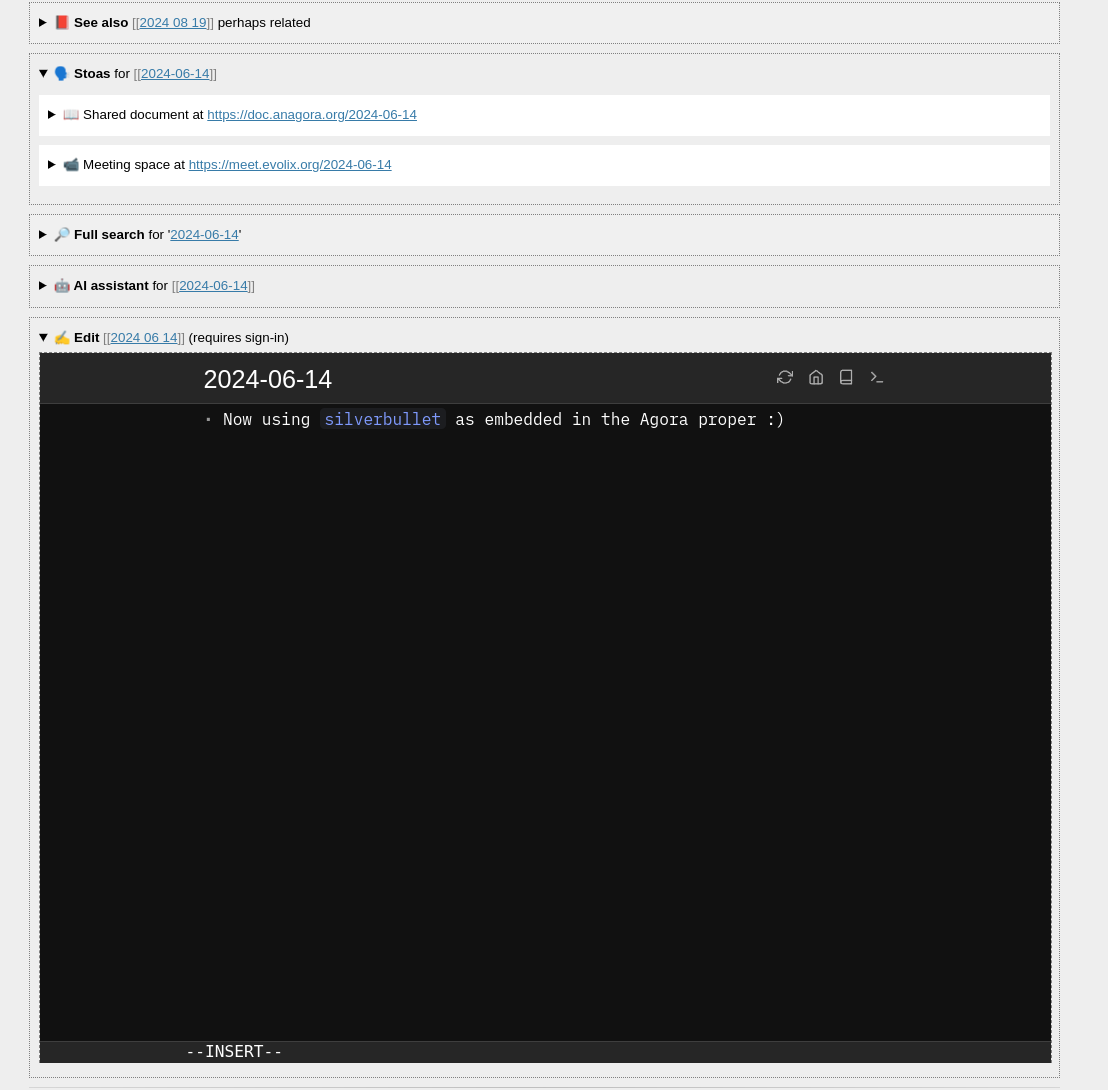 I know it’s a bit self-centered to add the edit box to anagora.org when only I can use it for now, but I wanted to experiment with the editing experience before investing a lot in developing it for others :) I hope it doesn’t get in the way of the experience of others.
/Library/Journal/New%20Page/Daily%20Note (template) in your instance.On Tuesday I went to a workshop on learning the basics of electrical repairs.
[[Doughnut Economics]] has a good overview of what a [[system]] is and why [[systems thinking]] of useful.
Could be a useful exercise to apply the [[Three Horizons]] model to [[reclaiming the stacks]].
[[Watched]]:
We don’t have much time before your attention drifts away so I will try to be short, so even if I seem to take some [[detours]], please rest assured that I believe them to be fruitful enough to warrant the diversion.
We will do the [[revolution]] every year, I say, starting the year you’re reading this if this is the first time you read about this, or sometime in your past once our plans have given fruit and we find ourselves in an incrementally better future.
Hear me out: we should start a #Good Revolution every November by default, with actions proposed rational, loving, kind, and in the open taking effect on December 31st; and if you have a better plan, tell me, and we’ll do [[your revolution]] together.
I’ve given up on keeping my journal entries structured and I think I feel freer for it so I will continue to experiment with it.
I keep thinking of that old story I wanted to write, [[search for the mirrormaker]]
test
That’d be this 2014 post on the topology of manifolds and how they relate to neural networks. The visualizations are great, and it basically blew my mind. I didn’t know of the manifold hypothesis until now.
The manifold hypothesis is that natural data forms lower-dimensional manifolds in its embedding space. There are both theoretical and experimental reasons to believe this to be true. If you believe this, then the task of a classification algorithm is fundamentally to separate a bunch of tangled manifolds.
I don’t understand the whole post, or the whole argument (yet? not to a great level of detail anyway), but: if you want to build a neural network that distinguishes cat and dog pictures, in the worst case that would seem to require a huge network with many more nodes/layers (say, a function of the size of the image) than the number that seems to work reasonably well in practice (six or some other low constant number observed in reality). So the number of dimensions over which the "images" are potentially spread is huge, but it’d seem that in the real world one can rearrange the dog and cat images in a "shape" that then allows for relatively easy disentanglement, and these shapes can probably be realized in much lower dimensions (as per the example, six?). This could explain the observed predictive power of relatively small neural networks.
P.D.: almost unrelated, but the author’s pic is pretty awesome. I mean it.
[[Global heating]].
This is bad because [[The ocean plays a critical role in maintaining a stable climate]].

Learn more about Conductor.


A [[Thinkpad]] with good [[repairability]].


